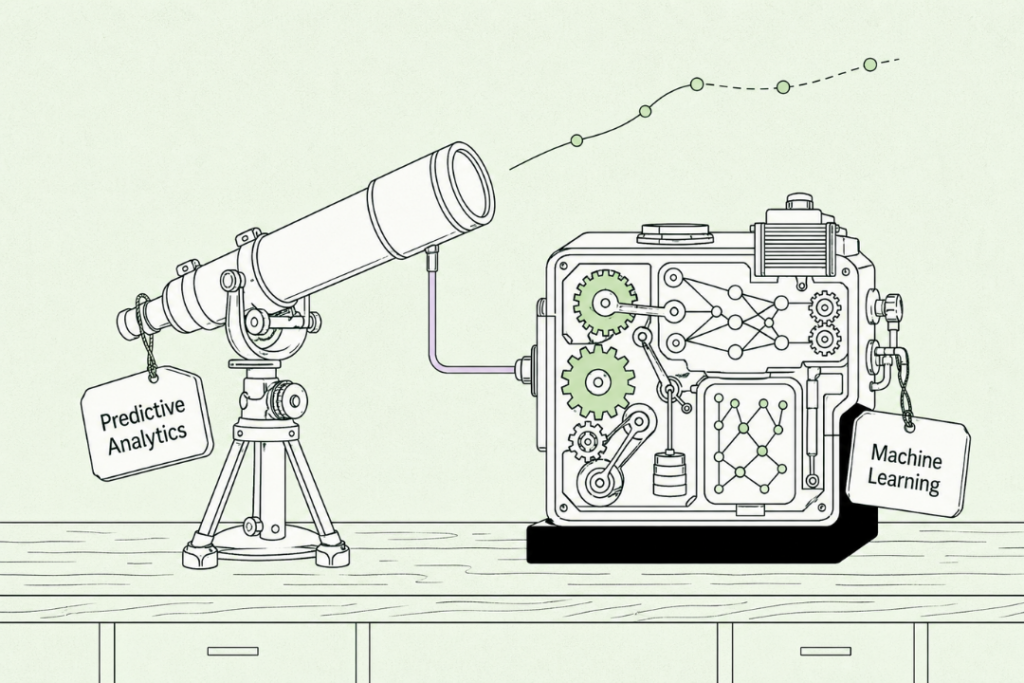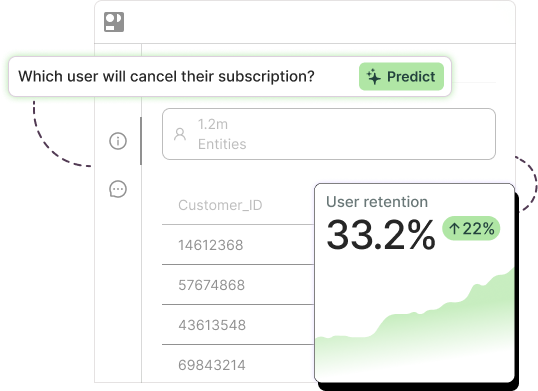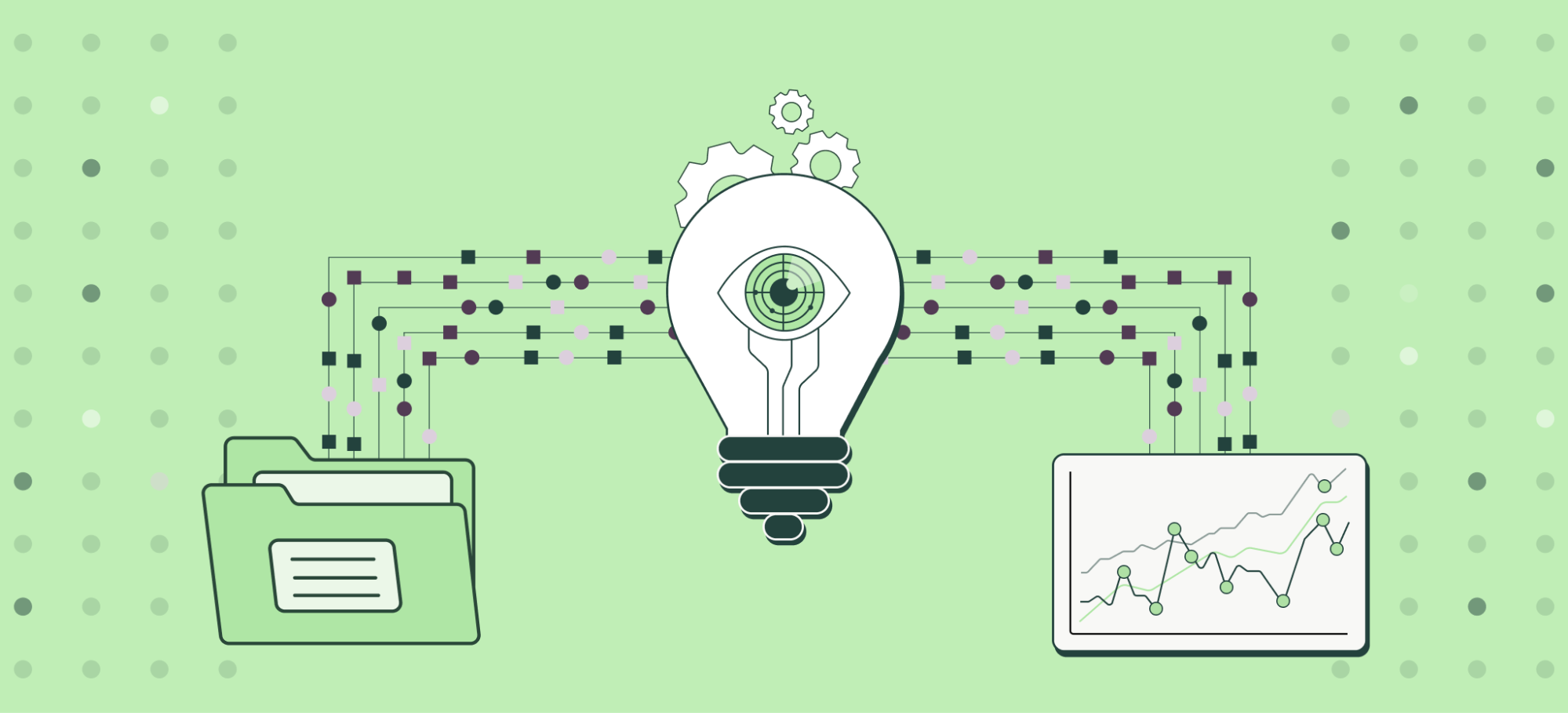
Tired of predictions that feel like guesswork? Picture this: You ask a straightforward business question, such as “Who’s likely to churn next month?,” and boom, a spot-on forecast lands right in your CRM. No PhD required, no waiting months for a predictive model, no data headaches. That’s the power of AI predictive analytics, making it dead simple for any team to swap rearview mirrors for a crystal-clear view of what’s ahead.
Key highlights:
- AI predictive analytics is a combination of traditional predictive analytics methods with machine learning to forecast future outcomes from business data.
- Benefits of AI-powered predictive analytics include higher forecast accuracy, faster decisions, and more scalable operations across teams.
- Companies across industries such as retail, healthcare, finance, marketing, and manufacturing are using predictive analytics with AI to forecast demand, churn, fraud, maintenance risk, and campaign performance.
- Pecan offers enterprise-ready AI for predictive analytics and automates the creation of your entire forecast model, allowing you to get predictions in days instead of months.
What is AI predictive analytics?
AI predictive analytics is the application of artificial intelligence techniques to take a look at your past data, spot patterns, and understand trends. Think of the combo AI and predictive analytics as using your existing business info to make smart predictions about what might happen next.
Advanced algorithms and machine learning models take your operational data and turn it into clear, actionable insights, helping you anticipate changes in the market, customer behavior, and your operations. The most advanced predictive analytics tools even integrate with the apps you already use, delivering the insights right where you need them.
What is the difference between AI and predictive analytics?
The difference between predictive analytics and AI is that, at its core, predictive analytics focuses on forecasting outcomes, while AI focuses on automating or augmenting tasks. You can combine both technologies to forecast what will happen next, then take action while timing still favors your business.
For example, a predictive churn model can flag customers with a 70% risk of churn in the next 30 days. A predictive AI agent can then notify you of this output, prompting you to trigger a Customer Success task in the CRM, launch a retention playbook, and track lift against a control group.
Using AI and predictive analytics together allows you to turn raw operational data into probabilities, scores, and forecasts that drive real decisions, not only reporting.
| Category | Predictive analytics | Artificial intelligence |
|---|---|---|
| Primary goal | Forecast outcomes | Automate or augment tasks |
| Typical outputs | Scores, probabilities, forecasts | Predictions, text, images, actions |
| Common methods to provide outputs | Regression, time series, classification | ML, deep learning, LLMs, agents |
| KPIs to measure success | Accuracy, lift, calibration, ROI | Task performance, reliability, safety |
Take a peek at what a predictive AI agent can do for your business.
Benefits of adopting AI predictive analytics
AI-powered predictive analytics works as a savvy assistant that helps you steer clear of those “uh-oh” moments while making business operations more efficient. With these tools at your disposal, accuracy shoots up, workflows speed by, and avoidable risks take a backseat.
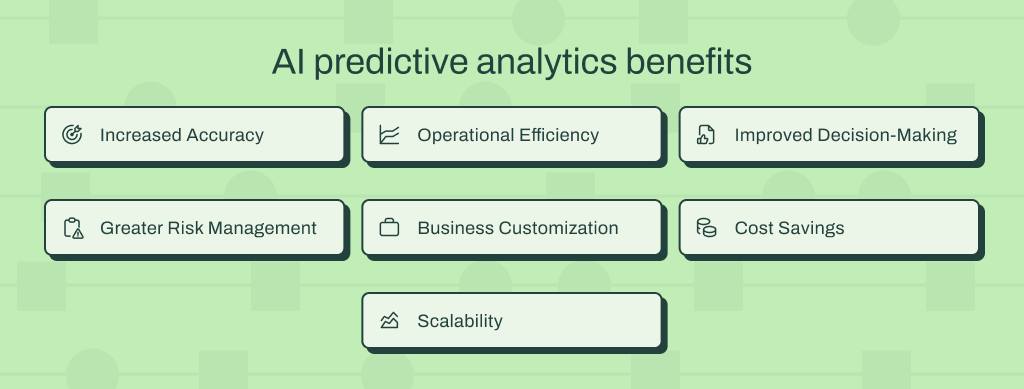
Increased accuracy
Machine learning models excel at catching those complex, non-linear relationships that simple rules miss. While you still need your team to check for proper validation, clean time windows, and controls for data leakage, these modern modeling options generally give you more breathing room.
Plus, AI agents lend a hand here, too. They can automatically flag potential model issues like overfitting or unbalanced labels, so you can fix them fast.
Operational efficiency
It’s no news that a predictive system reduces manual triage. A churn forecast helps a CS team focus on accounts that need outreach today, while a fraud score helps an analyst review the riskiest transactions first – just to mention some predictive analytics use cases your business can benefit from.
Explore churn reduction strategies that can also improve your operational efficiency.
Improved decision-making
When you embrace predictive analytics, you move past just asking “What happened?” to figuring out what’s the best next step. A forecast only matters if it helps you take an action, such as reallocating budget, adjusting reorder points, or escalating a customer case.
Greater risk management
Risk usually comes with warning signs. AI in predictive analytics helps you spot risks such as delinquency, fraud, shipment delays, and customer churn sooner, so you get more time to tackle issues and take action about them.
Business customization
By doing AI predictive analysis, you can personalize outreach, offers, and support when your predictive analytics tool forecasts customer intent. All thanks to models that can score:
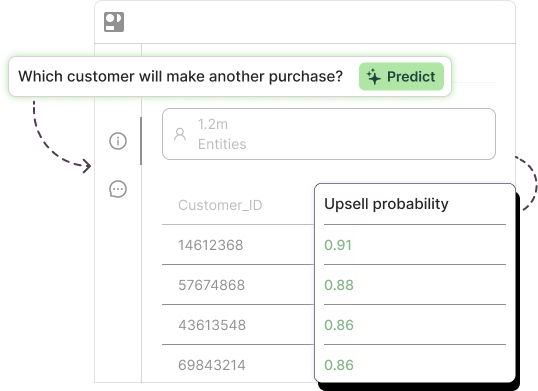
- Likelihood to buy
- Probability to churn
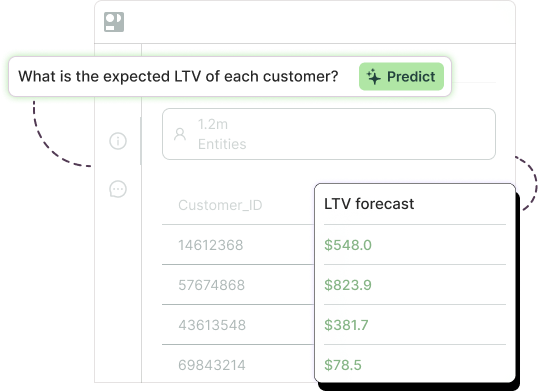
- Predicted LTV (lifetime value)
With these outputs in hand, marketing and CS teams can route messaging and spend based on predicted outcomes, for example.
Cost savings
When your predictive analytics model equipped with AI flags a likely stockout, you can expedite earlier and avoid last-minute premium shipping. If the model identifies low-value segments, you can lower bid pressure and stop paying for clicks that rarely convert.
Churn risk alert? You can skip broad discounts and target incentives to the customers who need a nudge. Call that saving money by spending smarter, not harder.

Scalability
Predictive analytics using AI allows you and your business teams to create multiple models across different business challenges. For example, you might run models for:
- Churn
- LTV
- Demand forecasting
- Fraud assessment
- SLA risk
- And more
No matter which department is using the metrics provided, you can deliver each score into the same tools your teams already run. This scalability allows different teams to use predictive analytics every day without building a new workflow for each model.
8 AI predictive analytics use cases
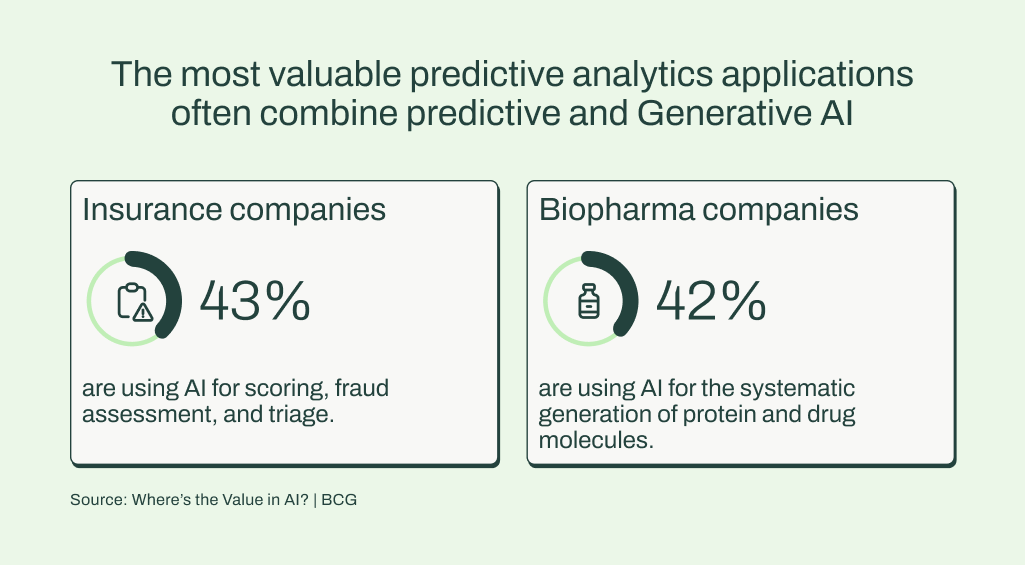
According to a BCG report, the most valuable AI applications often combine predictive and Generative AI. Within the insurance sector, 43% of companies use AI for scoring, fraud assessment, and triage. Almost half (42%) of biopharma companies are using AI (at least in pilots or proofs of concept) for the systematic generation of protein and drug molecules.
Explore these eight AI predictive analytics use cases and see how the technology improves operational efficiency in various industries:
1. Demand forecasting for eCommerce
AI demand forecasting automatically analyzes historical sales, inventory levels, promotions, and external signals such as economic indicators and weather. An inaccurate eCommerce forecast can lead to either bloated inventory or lost sales due to stockouts, which is why AI comes in handy, helping you predict situations like:
- SKU-level unit demand (next 7/14/30 days)
- Stockout risk by fulfillment node
- Overstock risk and markdown likelihood
With this information, you can set reorder points and safety stock based on forecasted demand, not market averages. You might even pull forward replenishment when the model flags a stockout window or reduce orders when it reports slow movers.
See five demand forecasting software options to consider.
2. Customer churn prediction
AI for predictive analytics can forecast churn and identify at-risk customers months in advance. Models scan for subtle warning signs across data sources, such as drops in login frequency, support tickets, or declining usage, to score clients on their likelihood to leave.
These scores allow Customer Success teams to deploy targeted save plays, personalizing training or winback campaigns before cancellations.
Explore how customer churn forecasts help your business.
3. Healthcare diagnostics
AI predictive analytics in healthcare can forecast disease outbreaks or identify high-risk patients who require early intervention. Predictive analytics tools that support the area usually include prioritization, capacity planning, and early warning systems, so you can prepare in advance for:
- Patient readmission risk within 30 days
- No-show likelihood for upcoming appointments
- Length-of-stay forecasts for staffing and bed planning
- Deterioration risk to prioritize follow-ups
4. Financial fraud detection
Financial institutions use predictive modeling to identify anomalies that signal fraudulent activity or credit risk. Outputs allow you to route high-risk cases to manual review, trigger step-up verification for medium risk, and block or hold extreme risk cases when policy allows.
See what fraud and chargeback prevention mean for businesses like yours.
5. Supply chain optimization
Supply chain leaders use forecast production planning to move from reactive firefighting to a proactive strategy. Predictive AI can detect potential delays and tell you where risk will land, so you can act before a missed SLA creates downstream cost.
With supply chain forecasting, you and your business teams can also:
- Proactively message customers before a delay hits their experience scores
- Add coverage or insurance only where the model flags risk
- Prioritize operational attention on the highest-risk shipments
6. Personalized marketing
While most marketers suffer from “launch and pray,” pros leveraging AI and predictive analytics predict outcomes early – such as lead conversion likelihood and customer LTV for acquisition optimization – by employing AI-powered tools. This way, they can reallocate spend before wasting budget – and even forecast campaign ROAS within 24 to 48 hours of launch.
Check our guide on predictive analytics for digital marketing.
7. Predictive maintenance
One of the biggest use cases for predictive analytics is in maintenance, especially when enterprises use AI to anticipate when machinery or equipment is likely to fail.
McKinsey & Company reported that predictive maintenance can reduce machine downtime by 30% to 50% and increase machinery life by 20% to 40%. By analyzing sensor data and historical performance, companies can schedule maintenance at the optimal time, preventing costly unplanned downtime without the waste of over-maintaining equipment that is still in good health.
See how to improve predictive maintenance with generative AI.
8. Gaming campaign optimization
The gaming industry often relies on early forecasts of value signals, such as predicted ROAS, likelihood to convert, and churn risk. With AI in predictive analytics for gaming, you can score players early, then tailor campaigns to likely high-value segments while suppressing spend on low-return acquisition pockets.
Level up your business game by choosing the right optimization for mobile campaigns.
3 key components of AI predictive analytics
Three key components compose AI predictive analytics as we know it today.
1. Data
Data quality drives model quality. You need consistent IDs, consistent definitions, correct time windows, and a label you can trust so your predictive model gets you accurate forecasts.
The features your model uses for training need to reflect availability; otherwise, your data might inflate performance or be based on offline scores that can destroy the accuracy of your deployed model.
Luckily, predictive AI agents can do the hard work of executing health checks on your models. You only need to keep an eye on your dashboard to see if the agent flags any inconsistencies with your data that might influence the outputs.
See how big data for predictive analytics works.
2. Algorithms
Algorithms are the mathematical logic, the “engine” behind your forecasts. It’s up to you to define how a model learns patterns when using a predictive AI tool.
You can choose simple predictive analytics models for interpretability – like which behaviors pushed churn risk up or down – or more complex ones for accuracy on messy, non-linear data, like when churn risk spikes only after a specific combination of usage drop, support friction, and renewal timing.
3. Models
A model turns historical data into a score you can use, such as a churn probability, a fraud risk score, or a demand forecast. To make that score reliable in the real world, you need three things from your model beyond training:
- Monitoring to catch when the data or behavior changes
- Retraining rules to refresh the model before performance drops
- Delivery, so the score shows up where you take action, like a CRM field, a planning workflow, or a review queue.
Without monitoring and retraining, accuracy decays quietly. Without delivery into your day-to-day tools, the prediction stays stuck in a dashboard and never changes outcomes.
How does AI predictive analytics work?
Think of AI predictive analytics as a translation layer between raw data and better decisions. You already have signals in your systems, purchases, product usage, inventory movement, claims, and tickets. Predictive analytics using AI turns those signals into a forward-looking score or forecast, like “high churn risk” or “likely stockout,” so you can act early instead of reacting late.
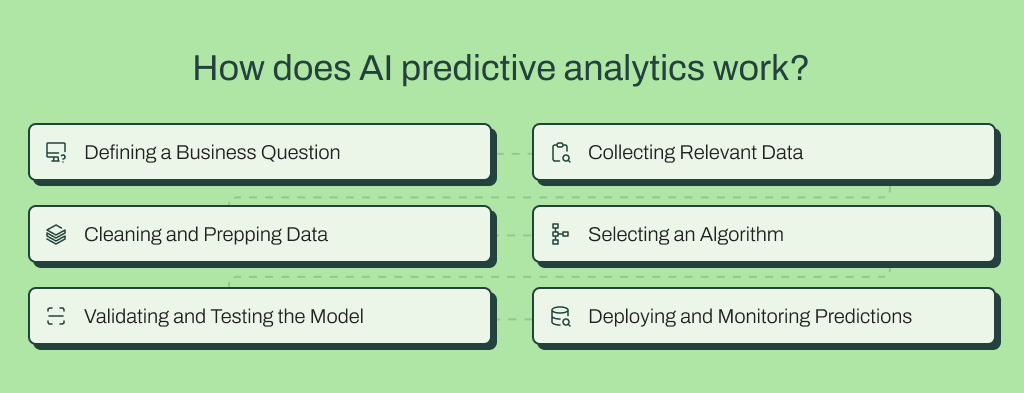
These steps show how you move from signals to a prediction you can trust:
- Defining a business question: Ask what you want the tool to predict, such as “Which customers will churn next month?” Think about the framework: “Given a particular customer at a particular point in time, what is the likelihood that they’ll perform a certain activity in the future?” to create a good question.
- Collecting relevant data: Gather historical and current signals related to the decision, such as transaction history, product and pricing data, behavioral events, and support interactions.
- Cleaning and prepping data: Provide the data you will need to get the forecasts. The best predictive tools in the market handle data cleaning and preparation, so you only need to provide the tables or connect your workflow.
- Selecting an algorithm: Once you’ve inserted your data into the predictive analytics tool, AI will choose the best algorithm to run your model.
- Validating and testing the model: Make sure your uploaded data is all set and that the tool has mapped the table columns correctly, then ask the predictive analytics AI to validate and train your model to provide you with reliable forecasts based on your data.
- Deploying and monitoring predictions: Ask your AI for predictive analytics to send the forecasts straight to your workflows, so you can act on and monitor outcomes directly where work already happens.
The best AI predictive analytics techniques
Predictive analytics techniques tell your model what kind of pattern to learn and what kind of output to produce, whether it’s a probability, a forecast, or an anomaly flag.
| AI predictive analytics techniques | How it works | Best for |
|---|---|---|
| Logistic regression | Statistical modeling uses a logistic function to predict outcomes, like whether a customer will churn or not. | Simple binary classification (e.g., churn/no-churn). |
| Gradient boosting | Gradient boosting learns from mistakes in a step-by-step way. | High-accuracy tasks involving complex, non-linear data. |
| Random forests | Random forests keep things steady by averaging results from several decision trees, making them reliable across different datasets. | Stable classification across datasets with high feature counts. |
| ARIMA-family | Time-series forecasting models analyze how past values influence future ones. | Forecasts showing clear seasonal trends or repeating patterns. |
| Prophet-like models | Prophet-like models help break down trends, seasonal effects, and even holiday variations. | Robustness against missing data and extreme outliers. |
| Deep learning | Multi-layered neural networks identify intricate data features. | Unstructured data (images, text) and advanced sequences. |
| Isolation forests | Isolation forests spot anomalies by figuring out how easily data points can be isolated. | Unsupervised outlier identification in large, unlabeled sets. |
| Autoencoders | Neural networks train to compress and then reconstruct data. | Dimensionality reduction and anomaly detection via error analysis. |
| Rule-plus hybrids | Rule-plus hybrid models blend human logic with machine learning. | Regulated industries requiring predictive power plus compliance. |
| Time-to-event | Survival analysis calculates how long it might take for a specific outcome to happen. | Estimating exact windows for churn or hardware failure. |
| Causal uplift | Causal uplift helps measure the extra impact an intervention might have on a certain behavior. | Marketing aimed at isolating persuadable users for ROI. |
Let Pecan’s AI predictive analytics platform take charge of your forecasts
Pecan is the only AI analytics platform that automates the full predictive workflow, from data prep, feature engineering, and model building to validation. No manual tweaks, no waiting on data science teams. You just ask your question, and our AI agent delivers a tailored model that gets you forecasts straight to your work tools.
Here’s what you can do with Pecan:
- Spot customer churn before it hits
- Forecast demand without the data drama
- Flag fraud and chargeback risks on autopilot
- Pinpoint customer LTV to make every ad dollar count
- Suggest the perfect next offer for upsell and cross-sell
- Score your leads to know who to chase first
We’re your friendly sidekick for forward-looking wins. Book a Pecan demo and see how to make your data work in your favor.

FAQs
Is predictive analytics AI?
Not actually. Predictive analytics focuses on forecasting outcomes, such as churn risk or next month’s demand. AI is the bigger umbrella, as it can automate or assist a wide range of tasks, from predictions to content generation to workflow routing. Many people pair predictive analytics with AI, with predictive analytics producing the score and AI helping push that score into the right action at the right time.
See why AI forecasting is better.
What is the importance of AI predictive analytics?
AI predictive analytics matters because speed and timing are real deal-breakers. When you can predict what will happen next, you can intervene earlier, spend budget where it pays off, and avoid expensive “too late” fixes.
Precedence Research forecasts the predictive analytics market to exceed $21.24 billion by 2026 and reach approximately $113.46 billion by 2035, demonstrating a compound annual growth rate (CAGR) of 20.56% between 2026 and 2035. The rising scale of this projected market expansion shows us explicitly that predictive analytics is moving from a niche technology to a must-have resource for data-driven decisions.
Learn more about AI predictive modeling.
How is predictive AI transforming business decision-making?
Predictive AI changes decision-making by shifting you from hindsight to foresight. Instead of reacting after churn happens or after a stockout hits, you can use leading indicators to prioritize what needs attention now. Add monitoring and retraining, and you get a system that keeps learning as your data and customers change, without turning every improvement into a big rebuild.
Dive deeper into the benefits of predictive analytics.
What are the future trends in predictive artificial intelligence?
Predictive AI will not only give you forecasts; it’ll also make the predictions actionable. You’ll see more decision intelligence setups where a forecast triggers the next best step inside the tools you already use, not another dashboard. According to Gartner, 50% of business decisions will be augmented or automated by AI agents by 2027.

Yakira is a Product Marketing Manager at Pecan AI, focused on how teams adopt predictive AI in real business workflows. She bridges product, data, and go-to-market, framing how predictions are used to create business value.