The B2C Churn and Retention Playbook > Chapter 3
Prevent: customer retention strategies by industry
Customer retention strategies are the actions a brand takes to keep customers it would otherwise lose: a pause option, a reorder reminder, a plan change, a reason to come back tomorrow. At the scale this playbook is written for, the strategy is choosing who gets which action. Everything else is a list of tactics, and you’ve read that list before.
The problem with the usual list (loyalty program, better onboarding, surveys, faster support) is that every item on it works on everyone equally. Which, when you have two million customers, means it works on no one in particular. The customers who were staying anyway get a discount they didn’t need. The customers who’d already decided get a loyalty email they don’t open. The budget spreads thin and the churn rate doesn’t move.
A retention strategy that works at scale is a short menu of actions matched to the customers who are both at risk and likely to respond. The menu is mostly the same across B2C. The matching is where each industry differs, and that’s what the rest of this chapter is about.

Ecommerce: fight silence
Nobody cancels an ecommerce relationship. They go quiet, and the quiet looks exactly like a customer between orders until it doesn’t. So the retention strategy for a store is mostly a calendar, built per customer.
Start with cadence. A coffee buyer reorders every 30 days, a skincare buyer every 60, a pet-food buyer every 21. Your data already holds each customer’s own rhythm, and the signal worth acting on is a gap that stretches past 1.5 times that rhythm. A reminder timed to the customer’s cycle, with their usual product one tap away, outperforms any seasonal promotion you’ll run, and it costs an email.
Then protect the second order. The leak in ecommerce is widest between the first purchase and the second, so the 30 to 45 days after a first order deserve more attention than the rest of the year: a how-to-use message, a sample of the adjacent product, a reason to come back other than a coupon. Customers who make it to order three tend to stay for a long time. Getting them there is the job.
Two exclusions make this profitable. Keep promotions away from shoppers predicted to buy at full price this month, and keep them away from the shoppers who return half of what they order. The first group doesn’t need the discount. The second group isn’t worth it.

Subscription and streaming: fight the cancel click
Subscription churn is explicit, which makes it easier to count and easier to predict. It also splits into two problems that need two different owners.
Involuntary churn comes first: expired cards, failed retries, a bank that declined a charge at 3 a.m. Recurly’s network data for July 2026 puts involuntary churn at 1.25 points of a 3.27% average monthly churn rate across industries, more than a third of the total. That slice belongs to the billing team: a card updater, smarter retry timing, and a friendly note before the card expires rather than after the charge fails. It’s the cheapest churn you’ll ever recover.
Then there’s the cancel click, where the strategy is to make something other than cancelling the easy option. A pause. A skip-a-month. A cheaper plan. A plan that matches how much they use the service, offered before they do the math themselves. Downgrades count as retention. A subscriber on the basic tier is worth more than a former subscriber on no tier.
Content does the rest. A streaming subscriber whose viewing has thinned out needs a recommendation tied to what they used to watch, sent while they’re still watching something. A meal-kit subscriber who skipped two boxes needs the menu for next week to be visibly better than the last two, which is a merchandising decision informed by a churn score.
One caution. Some subscribers have forgotten they’re paying. A cheery “we’ve noticed you haven’t logged in” email reminds them, and they cancel. That group needs silence, and the only way to find it is to measure what each message does to the people who receive it, which is where uplift modeling earns its keep.
Gaming: fight day four
In mobile games the decision gap is measured in days, so the retention strategy has to be too. GameAnalytics’ 2026 benchmarks, drawn from more than 16,000 games, put the median title at around 22% day-one retention and just under 4% by day seven. The player you’ll keep is decided in the first week.
Three actions carry the week. Give the player a reason to come back tomorrow (a streak, a daily reward, an unfinished thing), because tomorrow is the whole battle. Watch for friction, since a player who fails the same level three times in a session is sending the clearest churn signal in the data, and a small difficulty adjustment or a free power-up at that moment is retention at its purest. And use other players: an invite from a friend who’s still playing works better than anything the studio can send.
Gaming’s economics are lopsided, and the strategy should be too. One paying player can be worth hundreds of non-payers, so the churn model’s top priority is the payers, and the budget follows. Protect the payer first. Everyone else can wait a day.
A second caution, specific to gaming: never hand in-game currency to a player who was about to buy it. That’s the fastest way to turn a payer into a non-payer, and a churn score alone can’t tell you who they are. A response prediction can.

Fintech: fight the loss of primary status
Bank accounts don’t close. They go quiet, the way ecommerce customers do, except the quiet has a name: the account stops being primary. The paycheck lands somewhere else. The card slides to the back of the wallet. The balance drifts toward zero and stays there. None of that triggers a cancellation, which is why a fintech retention strategy has to be built on predicted behavior rather than on account status.
The actions follow the moments. When the model predicts a direct deposit is about to move, the direct deposit incentive goes to that customer, not to everyone with a paycheck. When card usage is predicted to fade, the category cashback goes where the customer already spends, so the card stays on top. Fee waivers get aimed by predicted risk instead of handed out to whoever complains loudest, which is both cheaper and fairer.
Fintech’s most underrated retention action is service after a bad moment. A declined transaction at a checkout, a fraud hold on a legitimate purchase, a transfer that took four days: your data shows every one of them, and a short proactive message within the hour (“we flagged this, here’s why, it’s resolved”) turns a trust-breaking event into a trust-building one. Most banks send nothing. The customer remembers that.
Insurance: fight the shopping window
Insurance churn is tied to the renewal date, but the decision happens in the weeks before it, while the customer shops. J.D. Power’s 2026 outlook puts the stakes plainly: 29% of insurance customers switched insurers last year, and just 51% of high-value customers say they will definitely renew. The retention strategy is to get into the shopping window before the competitor’s quote does.
That means a proactive renewal review, 60 days out, aimed at policyholders predicted to shop: a human conversation about coverage and price for the high-value ones, a clear email for the rest. It means telling customers about a rate change before the bill does, with the reason, because a surprise on the invoice is the single most reliable trigger for a quote request. And it means offering the bundle to the customers predicted to shop, where it changes the decision, rather than to the base at large, where it mostly re-prices people who were staying.
A claim is a retention event too, and one the data sees coming. A claim that closes slowly or ends in a dispute predicts non-renewal months ahead. A follow-up call after a rough claim is cheaper than the quote war at renewal.
Aiming the strategy: at-risk and persuadable
Every industry section above ends up in the same place: the action only pays when it reaches a customer who is both at risk and likely to respond. That’s two predictions, and most programs run only the first.
| Likely to respond | Unlikely to respond | |
|---|---|---|
| At risk | The action from the menu, timed to the signal | A service fix if the data shows one; otherwise, let them go gracefully |
| Not at risk | Nothing, and especially no discount | Nothing |
The lower-left box is where most retention budgets leak: at-risk customers who were going to leave regardless of what you sent. The upper-right box is where the rest leaks: customers who were staying anyway and took the coupon on the way to the checkout they were already heading for. A churn prediction model fills in the rows. A response or uplift model fills in the columns. Together they shrink the campaign to the one box that pays, which is usually a fraction of the at-risk list and nearly all of the lift.
The lifecycle team’s side of this, turning scores into journey branches, timing and suppression, has its own chapter in our lifecycle playbook on churn risk scoring for lifecycle teams. And when a customer leaves anyway, the next chapter on win-back campaigns picks up where this one stops.

Customer retention strategies that don’t scale
Blanket discounts. A 20% save offer sent to a whole at-risk segment pays the sure things and the lost causes alike, and the “saved” number it reports includes everyone who was staying anyway. It’s the most expensive line in most retention budgets and the least examined.
Surveys as a strategy. Asking why customers are unhappy is research, and it’s good research. It is also slow, it reaches the customers least likely to answer, and it doesn’t keep anyone. Ask one question, after the fact, and let the behavior data tell you the rest.
Loyalty points for everyone. A program that rewards every purchase equally is a price cut with extra steps. Points earn their keep when they’re used to change a specific behavior in a specific group: a second order, a return after a lapse, a plan upgrade.
Waiting for the exit survey. By the time a customer explains why they left, the decision gap has closed. The reasons are already visible, weeks earlier, in the order gaps, session drops and support contacts your churn model reads.
Treating involuntary churn as a marketing problem. It’s a billing fix. Hand it to the team that owns payments and stop sending win-back emails to people whose card expired.
Where we come in
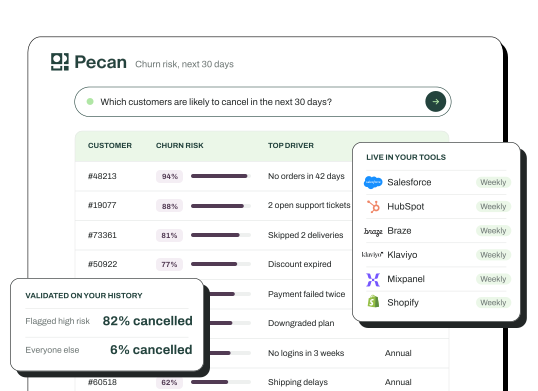
Matching is the hard part, and it’s the part we do. You bring your historical customer data and the question (“who is at risk in the next 60 days, and who would respond to which action?”), the Predictive AI Agent reads that data as it is, trains and validates the churn and response models, and we own the outcome, with scores and drivers live in the ESP, CRM or warehouse your retention team already works in. If you want to see how churn scores turn into actions in practice, our post on turning churn predictions into retention initiatives walks through it with a real DTC example.
See who will churn in the next 60 days:
Book a demoFAQ
What is the most effective customer retention strategy?
At scale, the most effective strategy is targeting: a short menu of actions (pause or downgrade, reorder timing, payment recovery, usage nudges, proactive service, a rationed save offer) aimed only at customers who are both predicted to churn and predicted to respond. The tactics are well known. Aiming them is what makes them pay.
How do you measure whether a retention strategy works?
Hold out a random slice of eligible at-risk customers who receive no action, and compare their retention rate to the treated group after one full cycle. The difference is the lift. Counting customers who received an offer and stayed overstates the result, because many of them were staying anyway.
Do retention strategies differ by industry?
Actions look similar across industries. Triggers and timing differ. Ecommerce fights purchase gaps, subscription fights the cancel click and failed payments, gaming fights the first week, fintech fights the loss of primary-account status, and insurance fights the shopping window before renewal.