Every winback program in the world starts with a number that somebody picked in a meeting.
Ninety days. Sometimes sixty. Sometimes a hundred and eighty, because the VP thought ninety felt aggressive. That number then decides who gets the email, who gets the discount, and who gets quietly written off as gone. It gets applied identically to the customer who reorders every three weeks and the customer who reorders twice a year.
Which means the segment is wrong before anyone writes a subject line.
We think this is the single most expensive mistake in customer winback, and it’s almost never the thing teams try to fix. They rewrite the creative. They test the offer ladder. They argue about send times. Meanwhile the list itself is a mix of people who were never gone, people who left months ago and have already replaced you, and a smaller group in the middle who could genuinely go either way. Those three groups need completely different treatment, and a calendar rule can’t tell them apart.
So let’s talk about how to win back customers in a way that respects that. Tactics first, because plenty of them work. Then the targeting problem, because that’s where the money is.
Why winback beats acquisition, and where that math gets abused
The case for winback is real. You already have the person’s purchase history, their preferences, their contact details, and their tolerance for your emails. You know what they bought, what they returned, what they browsed and abandoned. Acquiring a stranger with that much context costs a fortune. Reaching a lapsed customer costs a send.
That’s the argument, and it’s a good one. It also gets stretched.
The stretch happens when teams take “winback is cheaper than acquisition” and quietly convert it into “any winback spend is justified.” It isn’t. A 25% discount sent to a customer who was going to reorder next Tuesday is a 25% margin donation, dressed up as a reactivation. Do that at scale and your winback program can post a beautiful response rate while making the P&L worse.
Track cost per incremental returned customer. Not response rate. Not revenue attributed. The number of people who came back because you did something, minus the ones who would have come back anyway. Holdout groups are the only honest way to see it, and yes, that means deliberately not mailing some lapsed customers. It’s worth the discomfort.

Lapsed and churned are two different problems
A lapsed customer has drifted. A churned customer has decided.
The difference is whether the relationship still exists in the customer’s head. A calendar can’t see that. Someone who buys seasonally and hasn’t ordered since March isn’t lapsed in July, they’re just seasonal. Someone who bought weekly for two years and has been silent for five weeks is in real trouble, and your 90-day rule won’t flag them for another seven weeks. By then their new supplier has their card on file.
This is why cadence beats calendar. Every customer has a natural purchase interval, and the useful question is how far past their own rhythm they’ve drifted, not how many days have passed in absolute terms. A customer at 3x their normal gap is in a different situation than a customer at 1.2x, even if both hit day 90 on the same Tuesday.
Our churn analysis work gets into how to define these windows properly, and it’s more consequential than it sounds. Define lapse badly and every downstream decision inherits the error.

The winback tactics that still work
None of what follows is exotic. It’s the stuff that consistently earns its place.
Segmented offers, ordered by depth. Start shallow. Free shipping, a category-specific nudge, a reminder of what’s in the cart. Escalate to a real discount only for people who ignore the cheap stuff. Most programs run this ladder backwards, leading with the biggest offer because it converts best in an A/B test. Of course it does. It also trains your base to wait for the discount, and the test won’t show you that cost for another two quarters.
A re-engagement campaign with an actual reason to exist. “We miss you” is not a reason. A restock of the exact thing they bought, a new size in a product they returned, a price drop on a category they browsed three times, those are reasons. The customer win back email that performs is usually the one that could only have been sent to that person.
Channel switching. If someone has ignored eleven emails, the twelfth is not the answer. SMS, a direct mail piece, a retargeted ad, or for higher-value accounts, a human picking up a phone. Silence on one channel is information, and the standard response to it should be a change of venue rather than a change of subject line.
Timing tied to their pattern, not your calendar. Reaching a customer 10 days after their expected reorder date lands differently than reaching them on the first of the quarter because that’s when the campaign was scheduled.
Asking. A one-question survey to lapsed customers produces uncomfortable, useful answers. Sometimes the winback tactic is fixing the thing they told you about.
Where rules-based winback quietly burns money
The standard playbook goes like this, and we’ve watched a lot of teams run it: anyone inactive for 90 days gets a 20% off code. Send it monthly. Report response rate. Declare victory.
Three things go wrong.
The rule can’t see intent, so it treats the customer who has already signed a contract with your competitor the same as the one who just got busy. You pay to reach both. One of them was never reachable.
The rule can’t see value, so a customer worth $80 in lifetime spend and one worth $8,000 get the same 20% and the same email. That’s simultaneously overspending on the first and insulting the second.
And the rule can’t see the incrementality problem at all. It counts every code redemption as a win, including from the people who were already walking back through the door.
Static rules have their place, and we’ve written about rules-based vs machine learning approaches at length. They’re transparent, cheap, and easy to audit. For deciding who is likely to come back, though, they’re doing pattern recognition with one variable and a calendar.
How predictive winback works

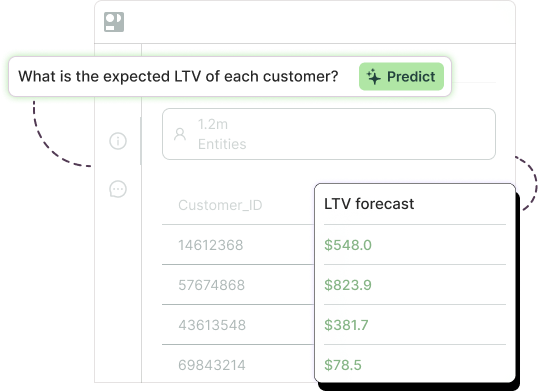
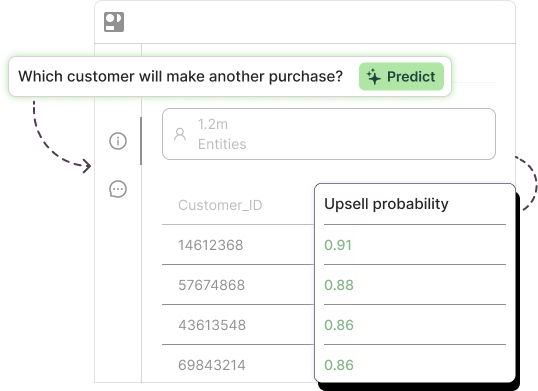
The shift is small to describe and large in effect. Instead of sorting lapsed customers by days since last purchase, you score each one by likelihood to return, and you act on the score.
A model reads what a rule can’t: purchase cadence and how far this customer has drifted from their own, category mix and whether they were broadening or narrowing, discount sensitivity across their whole history, returns, support tickets, email and site behavior in the silent period, tenure, seasonality, the works. Hundreds of signals per customer, weighed against what actually happened to thousands of similar customers who went quiet before them.
What comes out is a ranked list with a probability attached to each name. And that changes the shape of the program.
The top of the list, high likelihood to return, mostly doesn’t need a discount. They need a reason and a reminder. Send the restock note, keep the margin.
The middle is where your budget belongs. These are the persuadable ones: real risk of never coming back, real chance of returning if something lands. This is the group a 90-day rule buries in the middle of a list of ten thousand names.
The bottom of the list is where you stop spending. Not out of cruelty. Because the money does more good in the middle.
Hydrant did a version of this when they wanted to win back more previous purchasers rather than keep broadcasting to everyone who’d ever bought. Same list, different order, different result.
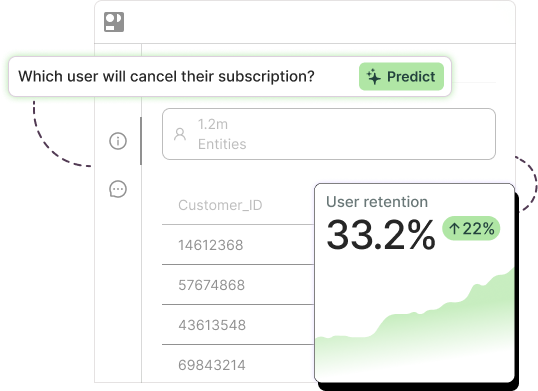
The same logic drives AI for customer retention work, just aimed at people who are still with you. Winback is retention with worse odds and better data.

Match the incentive to the person, not the segment
Once you have a score, the offer stops being one decision and becomes many small ones.
A customer whose entire history shows they’ve never bought at full price doesn’t need convincing on price, they need a reason to choose you over the next discounter. A customer who has never used a code and always paid full freight might be lost over something you can fix without spending a cent. Someone who churned after a bad delivery experience wants an acknowledgment, not 15% off the thing that arrived broken.
Models give you the propensity. Your history gives you the mechanism. Put them together and the winback email stops sounding like a mass mailing, because it isn’t one.
What we’d do first
If you’re building customer winback strategies from scratch, or rebuilding a program that plateaued, we’d start here.
Define lapse per customer, not per company. Compute each person’s typical gap and measure drift against it. This alone will reshuffle your list.
Set up a holdout before you send anything else. You cannot improve a program you can’t measure honestly, and every month without a holdout is a month of numbers you’ll have to caveat later.
Score, then spend. Rank the lapsed base by return likelihood, aim your budget at the middle, and hold the discount back from the people who don’t need it.
Then check what it cost you to bring back each person who wouldn’t have returned on their own. That number, tracked over quarters, is the only report that matters.
We built our Customer Winback solution to make that first step, the scoring, something a marketing team can do without waiting on a data science queue. You point our Predictive AI Agent at your historical order and customer data, ask which lapsed customers are likely to return, and the agent handles the data preparation, feature engineering, model building, and validation. Predictions land in the tools your team already runs campaigns from. No code, and no need to tidy your data into some ideal shape first, because real order histories are messy and the agent is built for that.
Most teams already have everything they need to know who’s coming back. It’s sitting in the order table, unread.
See how we predict which lapsed customers will come back

Asaf is the Head of Customer Success at Pecan AI, where he helps enterprise customers turn predictive analytics into real, measurable business outcomes. He’s grown through Pecan from AI Success Manager to Team Lead to Director, bringing a strategic consulting background and an Economics degree from the Hebrew University of Jerusalem (plus a serious scuba diving habit).