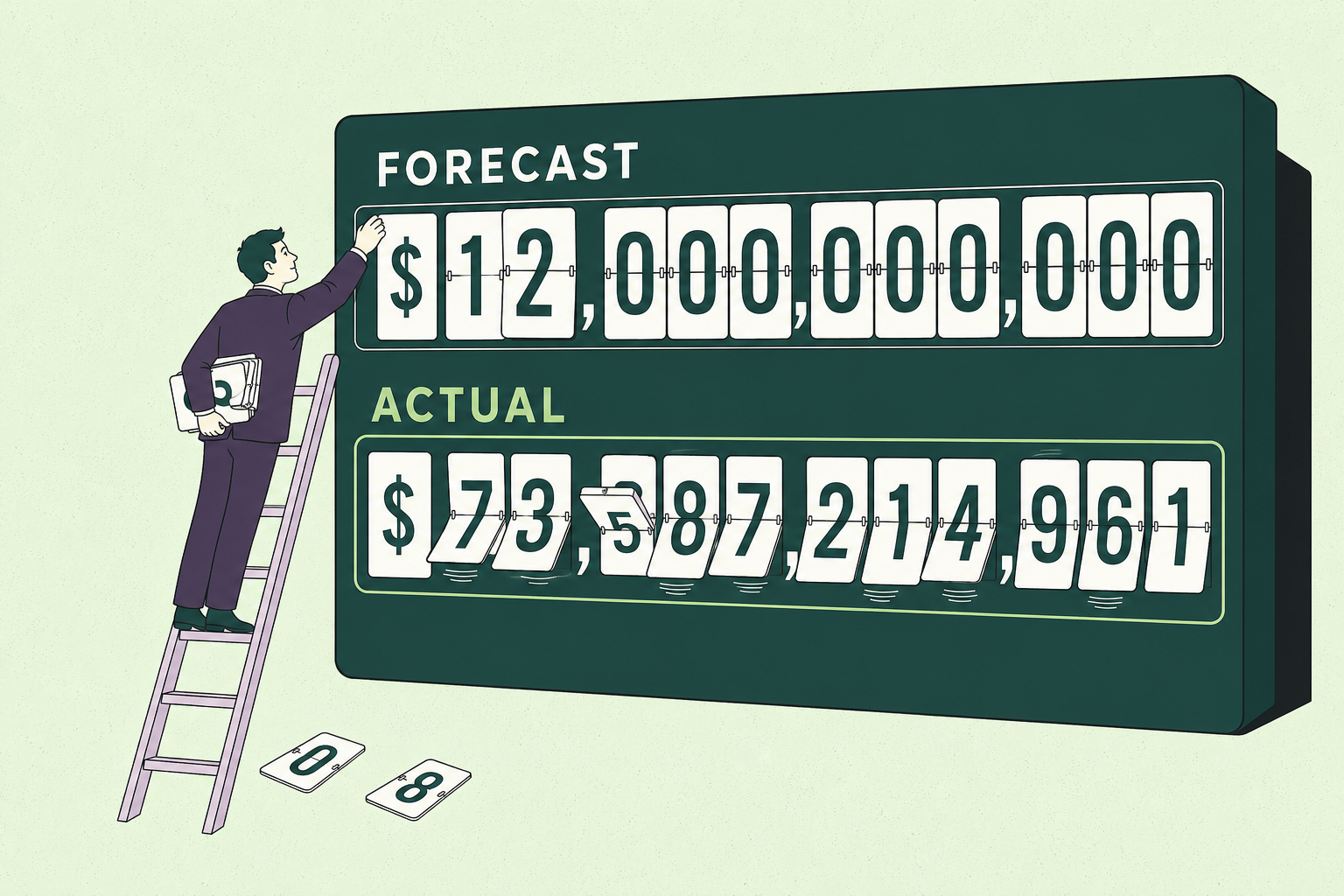
Your first sales forecast will be wrong. Not off by a rounding error either. Probably wrong enough to make you want to close the spreadsheet and pretend the whole exercise never happened.
That’s fine. Better than fine, actually, because being wrong is how forecasting works. A forecast is a feedback loop: you make a call, you watch what really happens, you adjust, you go again. Getting good at it comes down to how fast you can run that loop and shrink the gap between what you predicted and what landed.
Most beginner guides hand you a menu of methods and tell you to pick the best one. We’ll give you something more useful to hold onto: pick the method you can measure and correct the fastest. Accuracy is earned through iteration. It isn’t bought by choosing a fancier formula on day one. Get that straight and the rest of this guide clicks into place.
What sales forecasting actually is
Sales forecasting is how you estimate the revenue you’ll bring in over a set stretch of time. A week, a month, a quarter, a year. You pick the window.
That single number quietly runs a lot of the business. It tells finance how much cash to plan around. It tells ops how much inventory to hold. It tells leadership whether to greenlight three hires or sit tight. It’s the number your board points at when they ask whether you’re going to hit plan.
So a bad forecast isn’t just an awkward moment in a meeting. It cascades. Wrong revenue estimate, wrong hiring plan, wrong inventory order, wrong story for investors. One shaky number up top becomes a pile of shaky decisions underneath it.
In most companies, someone in RevOps, finance, or sales leadership owns the forecast. The inputs are usually a blend of pipeline, past performance, and whatever market signals you can pull together. The output is a revenue figure, ideally with a range around it, broken down by period.
Common sales forecasting methods
There’s no single correct way to forecast. There’s a correct way for where your business sits right now, and honestly, most beginners are better off starting simple and graduating later. Here are the approaches you’ll actually run into.
Historical forecasting. Take last year’s revenue, add a growth assumption, and call it a forecast. The classic “last year plus ten percent.” Dead simple, and useful as a gut check. Its weakness is obvious once you say it out loud: it assumes next year behaves like last year, which it never quite does.
Pipeline-based forecasting. Add up the open deals, multiply each by its odds of closing, total it up. This one is only as trustworthy as your CRM. When reps log their deals honestly and on time, it sings. When they don’t, and they mostly don’t, you’re forecasting on wishful thinking.
Opportunity stage forecasting. A close relative of the above. You attach a probability to each pipeline stage, so a deal in negotiation counts for more than one still in discovery. Cleaner than raw gut feel. Still shaped by how loosely or tightly your team defines each stage.
Length-of-sales-cycle forecasting. Predict a close date based on how long similar deals have taken. Works beautifully when your sales motion is steady. It wobbles the moment deal sizes vary a lot, because a five-figure deal and a six-figure deal rarely move at the same pace.
Multivariable analysis. Here you start combining signals: pipeline, seasonality, marketing spend, rep performance, all rolled into one estimate. More accurate, and a lot more to maintain by hand. This is usually where spreadsheets start to groan.
AI and machine learning forecasting. Train a model on your closed deals, both won and lost, and let it surface the patterns a person would never spot. Most accurate, least manual, once it’s up and running. More on how that works shortly.
If you want the deeper cut on the more sophisticated approaches, we pulled them apart in our guide to advanced sales forecasting methods.
See the pattern? Every step up the ladder swaps simplicity for accuracy. The useful question is less “which method is best in the abstract” and more “which one can I actually run and check every week without it turning into somebody’s second full-time job.”
What makes a sales forecast good
A forecast earns trust by being a handful of specific things at the same time.
Accurate, first and foremost. Measured against what actually happened, not against the number leadership was hoping to hear. If nobody compares the forecast to reality, all you’ve really got is a hope with a decimal point.
Granular. A single top-line number is close to useless for decisions. Break it out by product, segment, region, and time period. “We’ll do two million next quarter” tells you nothing about which product line needs more headcount.
Timely. A forecast frozen on day one of the quarter is a fossil by week three. Good forecasts refresh as new information arrives, weekly at the very least.
Transparent. Everyone should be able to see what’s driving the number. A forecast people can’t question is a forecast people quietly stop believing in.
Actionable. The best forecasts don’t just tell you what might happen. They point at what to do about it.
That transparency piece matters more than most beginners expect. A forecast survives or dies on whether people trust it, and trust comes from being able to see the wiring, not from the confidence of the person presenting it.
Where beginner forecasts go wrong
A few failure patterns show up again and again.
Leaning too hard on rep input. Salespeople are optimists by trade. Some sandbag to clear a soft number, some have happy ears and count every warm chat as a signed contract. Both quietly corrupt your numbers. You need a way to weigh what reps say against what the data actually shows. We got into this tension in our piece on sales pipeline forecasting accuracy.
No baseline. If you never write down what you predicted, you can’t measure how far off you were, which means you can never get less off. This is the big one, and it loops straight back to the point up top: a forecast is a feedback system, so the feedback has to exist.
Ignoring seasonality. A Q4 forecast that pretends holiday buying patterns don’t exist is just a straight line drawn across a very curvy world.
Single-source data. Using only pipeline, or only history, never both. Each one tells you half the story and hides the other half.
Quarter-only thinking. Teams that forecast monthly or weekly tend to catch problems while there’s still runway to fix them. Once-a-quarter teams find out at the finish line, when the only thing left to do is explain.
How AI changes sales forecasting
AI-based forecasting takes the best instinct behind every method above and handles the tedious parts for you. Instead of hand-building formulas or trusting stage-weighted guesses, a machine learning model studies your real closed-won and closed-lost deals and learns which signals actually predicted the outcome.
In practice at Pecan, that looks like this.
We connect to the data you already have, sitting in Salesforce, HubSpot, and your data warehouse. You don’t need to scrub it spotless first. Pecan works with your historical data the way it really is, messy edges and all, because business data is never tidy and pretending otherwise just delays the work.
The model weighs every available signal at once, not just the three or four you’d have picked for a spreadsheet formula. Forecasts then update on their own as fresh data lands, so there’s no monthly ritual of rebuilding everything from scratch.
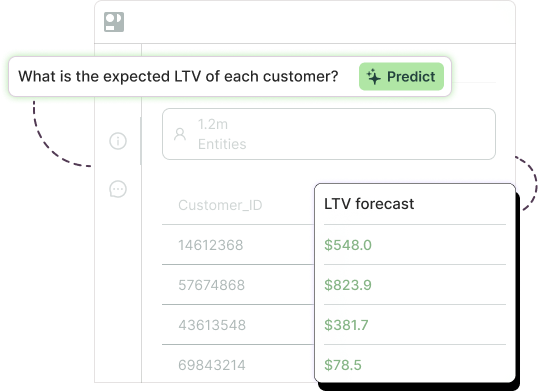
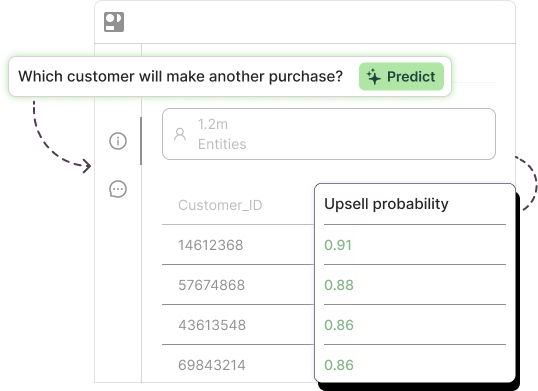
You get predictions split out by segment, rep, product, and time period, each with a confidence range. And because Pecan’s Predictive AI Agent is no-code, your team asks a business question in plain language and gets a validated answer back, with no data science hire needed to make it happen. Most teams see working forecasts in days, not a six-month build.
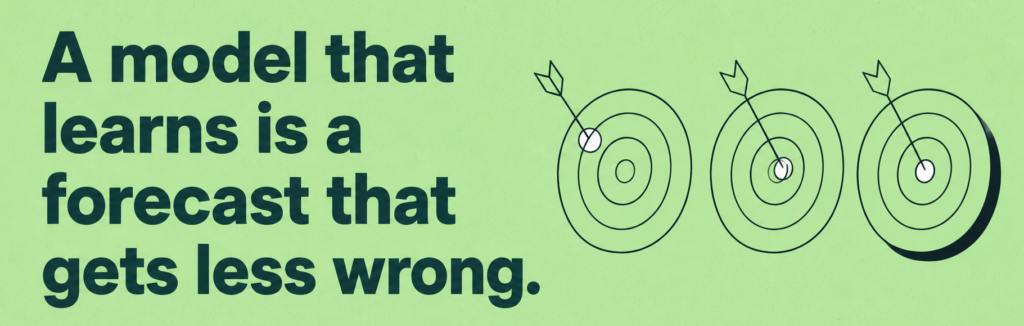
This is where the feedback-loop idea pays off hardest. A model that retrains as reality rolls in is a forecast that gets a little less wrong every cycle, on its own. That’s the whole point. For a wider view of where this fits, here’s our take on the role of predictive sales analytics.
How to get started
You don’t need much to begin. You need a loop.
Start by checking your data. Do you have roughly twelve months or more of CRM history with outcomes labeled, deals marked won or lost? That’s your raw material. It doesn’t have to be pretty. It just has to exist.
Pick your horizon. Next month, next quarter, or both. Match it to the decisions you’re actually making.
Choose a method that fits where you are. Early and scrappy? Pipeline-based is a perfectly good start. Sitting on a year or two of deal history? You’re ready for an AI-based approach, and it’s worth comparing the tools before you commit to one.
Measure accuracy from day one. Forecast against actuals, every single period, tracked over time. Treat this as step one, not a someday nice-to-have. It’s the piece that makes every other step worth taking.
The forecast that gets better
Forecasting is a skill that compounds. Your first attempt will miss. Your tenth will miss by less. Your fiftieth might actually be something you can build a plan around, but only if you’ve been keeping score the entire way.
Start simple. Measure without mercy. Upgrade your method as your data grows up. And when the spreadsheet finally buckles under its own weight, which it will, that’s your cue to hand the heavy lifting to a model that learns.
Pecan builds sales forecasting models straight from your own data, no data science team required. Book a demo and see what we can predict from your pipeline.