Supply chain teams struggle because demand changes faster than planning cycles can keep up. One week, a product category moves faster than expected. The next, margins tighten, lead times shift, or a promotion changes buying behavior across channels. When forecasts miss the mark, the consequences show up quickly in excess inventory, stockouts, rushed purchasing, and missed revenue.
With the right demand forecasting software, you can reduce the impact of these supply chain issues, optimize your pricing and stock levels, and make sure your products reach the places they need to be to delight customers.
But choosing the right solution isn’t always easy, especially with so much at stake. In this guide, we break down the must-have elements of an effective demand forecasting solution – and present seven top tools to help you run your operations smoothly.
Key highlights
- Demand forecasting tools predict consumer demand to help you manage inventory, optimize pricing, and reduce stockouts and overstocks across your supply chain.
- Legacy demand forecasting solutions have limitations, including a lack of flexibility, limited data integration, intensive manual processes, weak scenario planning, and limited transparency into forecast drivers.
- AI-powered demand forecasting tools offer benefits such as better inventory management, increased customer satisfaction, effective budgeting, greater flexibility, sustainable growth, faster revenue capture, and smarter pricing.
- The leading companies in AI-driven demand forecasting are Pecan, Cogsy, Kinaxis Maestro, Atlas, Oracle Supply Chain Planning, Anaplan Demand Planning, and SAP IBP.
What are demand forecasting tools?
Demand forecasting tools are software platforms that businesses use to estimate future product demand. They combine data, forecasting models, and planning features into a single system so you can create, review, and act on demand forecasts.
The top predictive demand forecasting solutions for enterprises can even integrate with your current workflows to deliver the numbers right inside the tools you already use.
Demand forecasting software in action
Modern demand forecasting solutions use machine learning and AI to help you meet customer demand with higher accuracy, reduce overstocks and stockouts, and improve overall cash flow. These platforms provide AI-powered demand forecasting capabilities to help you quickly and easily solve specific issues, such as:
- Predicting consumer demand: Forecast sales, orders, shipments, and other volume metrics. See which factors influence buyer behavior, including seasonality and economic realities.
- Forecasting sales and cash flow: Predict sales trends and understand their impact on cash flow, so you can better align resources across the business.
- Managing inventory and reducing overstocks and stockouts: Optimizing inventory levels can improve operational efficiency, reduce supply lead times, lower reverse-logistics costs, and increase sales through better product availability.
While accuracy and features vary based on the chosen demand forecasting software, the best demand forecasting AI tools will allow you to:
- Integrate with your existing workflows easily through APIs and connectors.
- Identify the smallest correlations in your data based on complex patterns – where even the most analytical minds only see erratic behavior.
- Determine what to look for when solving specific scenarios, so you can more easily predict what, when, and how to provide your customers with products and services.
Forecasting vs. demand planning software: What’s the difference?
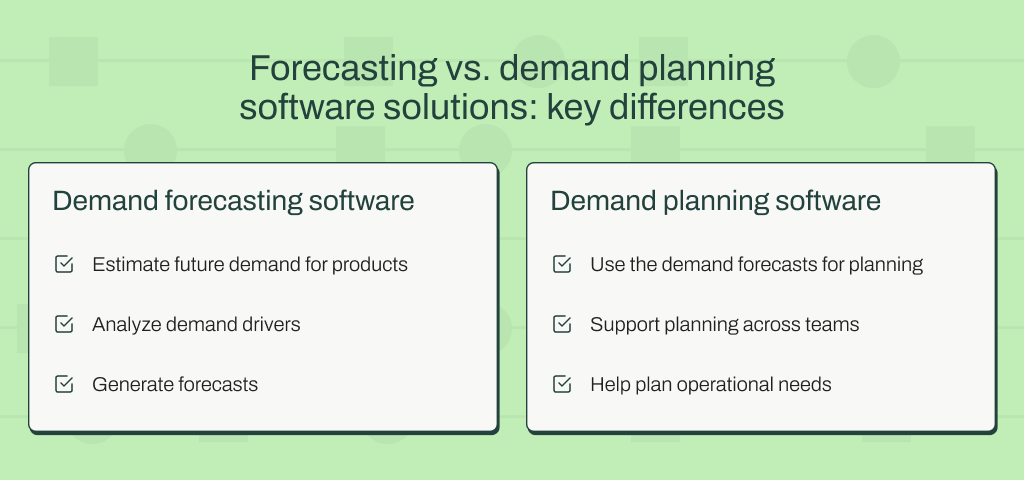
Even though demand planning and forecasting are commonly treated as the same thing, they’re not. While the main goal of demand forecasting tools is to predict demand for products and services, demand planning tools use insights from the forecasting solution to inform comprehensive, organization-wide strategies that involve many parts of the business, including analytics, finance, HR, sales, marketing, and other departments.
Demand planning KPIs and decisions go beyond stock levels and machine maintenance. They incorporate additional enterprise elements such as workforce planning and budget allocation.
Both functions matter, but supply chain forecasting tools usually serve as your starting point for smarter demand planning across the business.
One high-tech manufacturer used Pecan’s AI demand forecasting to optimize their supply and demand operations. By integrating Pecan directly into their CRM, they turned raw data into highly accurate forecasts that helped reduce labor costs by 15% and boost inventory cost savings by 25%.
Problems with legacy demand forecasting tools you’ll want to avoid
As supply chain information sources multiply and data science capabilities become more vital, the demand forecasting landscape keeps growing and adapting. Traditional forecasting solutions are still common today, but they lack flexibility, scalability, and data integration – and they still rely on manual processes.
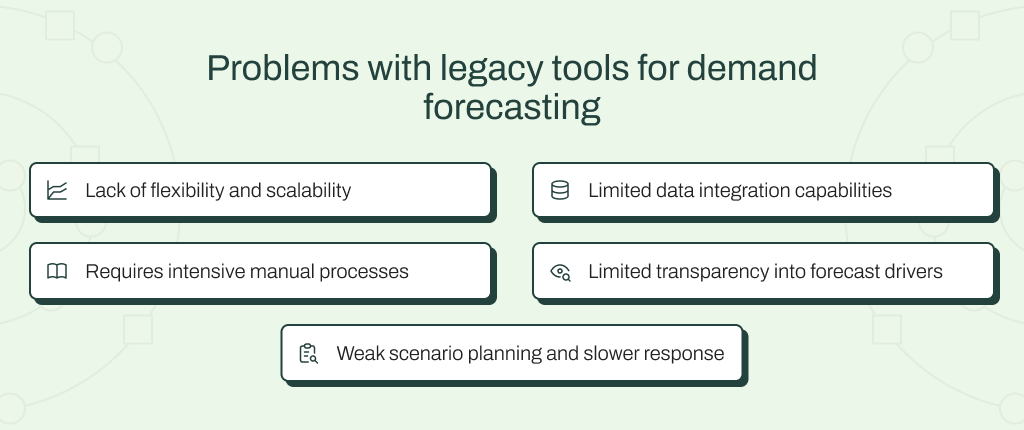
Lack of flexibility and scalability
Traditional supply chain forecasting tools rely on spreadsheets and lack the flexibility needed to react quickly to change. According to McKinsey, retail merchandisers can now do in two to three hours what used to take two to three weeks – thanks to technologies such as generative AI, predictive demand forecasting, and automated inventory management.
Because spreadsheets struggle with large data volumes and often lack cloud functionality, your team may not be able to access data or collaborate on analytics projects the way they could with newer solutions.
Limited data integration capabilities
Your supply chain forecasting software should integrate with all the programs you already use, not just one or two. Unfortunately, many legacy forecasting options have trouble connecting to other solutions, creating manual work and friction for you and your team.
AI forecasting software offers integrations with your enterprise resource planning (ERP), customer relationship management (CRM), e-commerce, and logistics platforms – all through APIs and native connectors that save your team’s precious time.
Intensive manual processes
Legacy demand forecasting solutions require heavy coding or manual data preparation before you can uncover insights. This not only takes up valuable time but also increases the risk of human error.
AI-powered demand forecasting tools change that equation by preparing data faster, automating modeling steps, and helping you move from reactive reporting to forward-looking decisions.
Weak scenario planning and slower response times
Legacy tools often make it difficult to model “what if” questions. You may want to test the effect of a promotion, a supplier delay, a tariff change, or a demand spike in one product category – but older systems require too many manual steps to produce a useful answer, slowing response times across your business.
APQC research identified scenario planning as one of the top two priorities for supply chain professionals. The study also pointed to building an effective consensus forecast to prepare for potential disruptions – something that requires fast responses traditional solutions can’t offer.
Limited transparency into forecast drivers
Legacy tools deliver a prediction without helping users understand what moved it. This lack of transparency makes it harder for planners, finance leaders, and operations teams to trust the forecast or explain it internally.
Focus on demand forecasting AI tools that show you which variables shaped the outlook, which products carry more uncertainty, and where to intervene first. When software can’t surface those drivers clearly, adoption suffers, and you’re back to manual checks and side calculations.
Read about model explainability.
Top 7 demand forecasting solutions
The leading companies in AI-driven demand forecasting use machine learning and hybrid approaches to overcome the limitations of traditional statistical models.
Think of this shift as replacing a static production schedule with a control tower. Legacy statistical models give you a baseline. Machine learning and hybrid forecasting add a broader view of what’s changing across products, channels, and demand signals, so you can respond early instead of firefighting delays and other disruptions.
Not sure where to start? Consider these seven popular demand forecasting software solutions:
| Top predictive analytics solutions for enterprise demand forecasting | Key features |
| Pecan | No-code predictive analytics platform built for business teamsPredictive AI Agent that turns a business question into a validated forecast end to end, no data scientists requiredNative connectors to data warehouses, ERP, CRM, and BI tools |
| Cogsy | DTC and e-commerce focusInventory planning coverageCommerce tool integrations |
| Kinaxis Maestro | Concurrent planning environmentScenario modelingEnterprise-scale orchestration |
| Atlas Planning Platform | Demand planningConfigurable planning workflowsBroad planning coverage |
| Oracle Supply Chain Planning | Integrated planning scopeMachine learning supportEnterprise planning within the Oracle ecosystem |
| Anaplan Demand Planning | Cross-departmental planning supportScenario and consensus planningDemand planning |
| SAP Integrated Business Planning (SAP IBP) | Broad planning coverageAI-powered forecasting featuresScenario simulation tools |
Demand forecasting software #1: Pecan
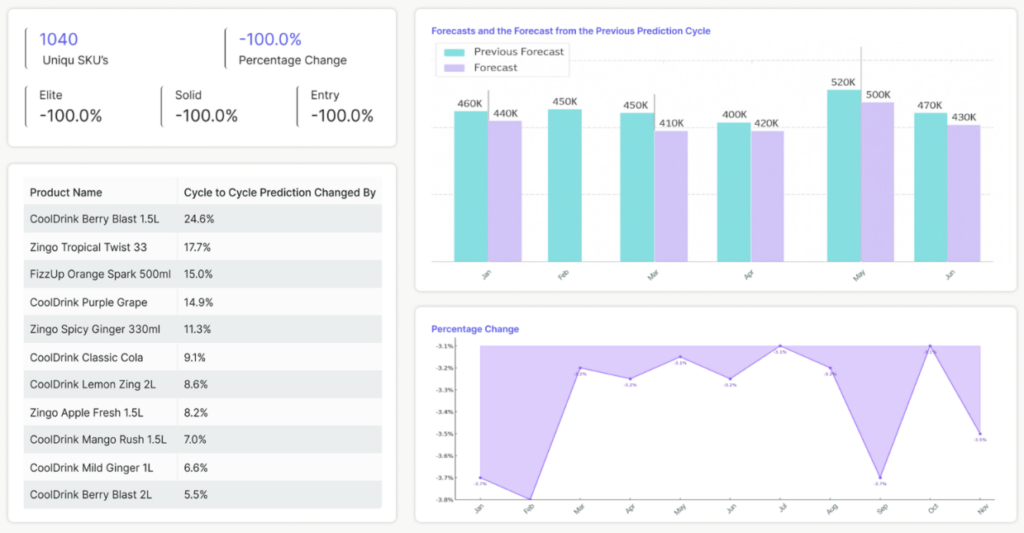
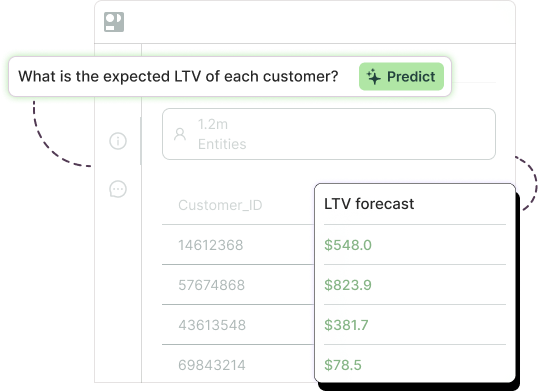
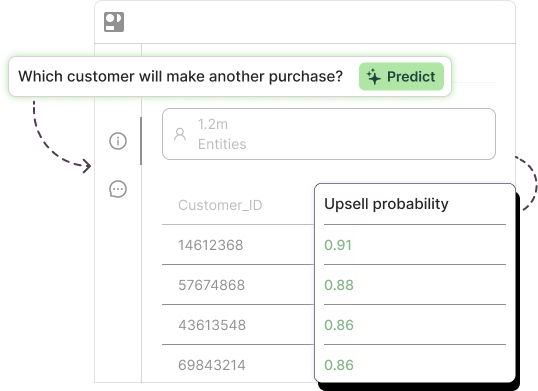
Pecan is a no-code predictive analytics platform built for business teams. You ask a forecasting question in plain language, and Pecan’s Predictive AI Agent runs the full workflow for you: data preparation, feature engineering, model building, validation, and deployment. Validated, explainable forecasts land in the tools you already use, in days, with no data science team required.
Pecan strengths:
- Self-serve, no-code platform that makes accurate forecasting accessible to business teams and analysts alike, with no dedicated data science team required
- A Predictive AI Agent that autonomously builds, validates, and deploys models from a plain-language business question.
- Machine learning that holds up under the hood: automated feature engineering, anomaly detection, and drift control that keep forecasts stable even on messy data.
- Transparent, explainable drivers so planners and finance teams can see what’s moving the forecast and trust it
- Native connectors and APIs to cloud warehouses, ERP, CRM, e-commerce, and BI platforms
Pecan pricing is available here.
Demand forecasting software #2: Cogsy
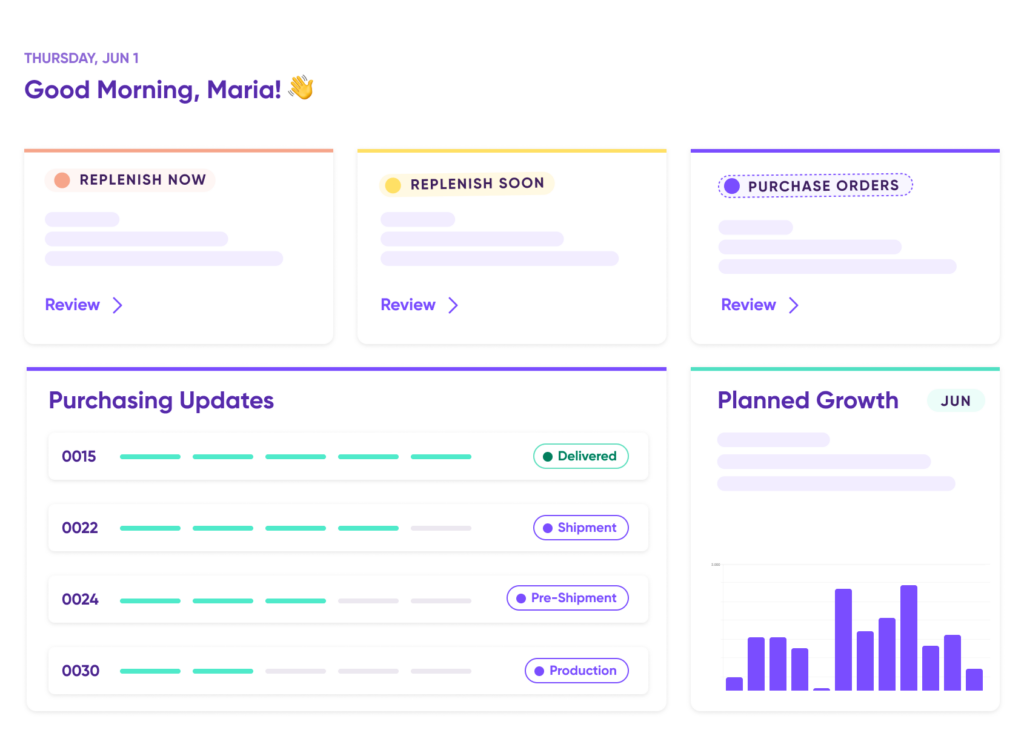
Built for direct-to-consumer merchants and sellers, Cogsy is a platform that pulls together historical data, real-time sales, and emerging demand trends to help you manage inventory and scale your business.
Cogsy strengths:
- DTC and e-commerce focus for Shopify and Amazon sellers
- Inventory planning across replenishment, backorders, purchase orders, and new-product planning
- Integrations with Shopify, Amazon, ShipBob, Google Analytics, and Extensiv Order Manager
Cogsy limitations:
- Narrower fit for enterprise supply chains with heavier operational complexity
- Commerce-first scope rather than broader cross-functional supply chain orchestration
Cogsy pricing starts at $199 per month after a 14-day free trial.
Demand forecasting software #3: Kinaxis Maestro
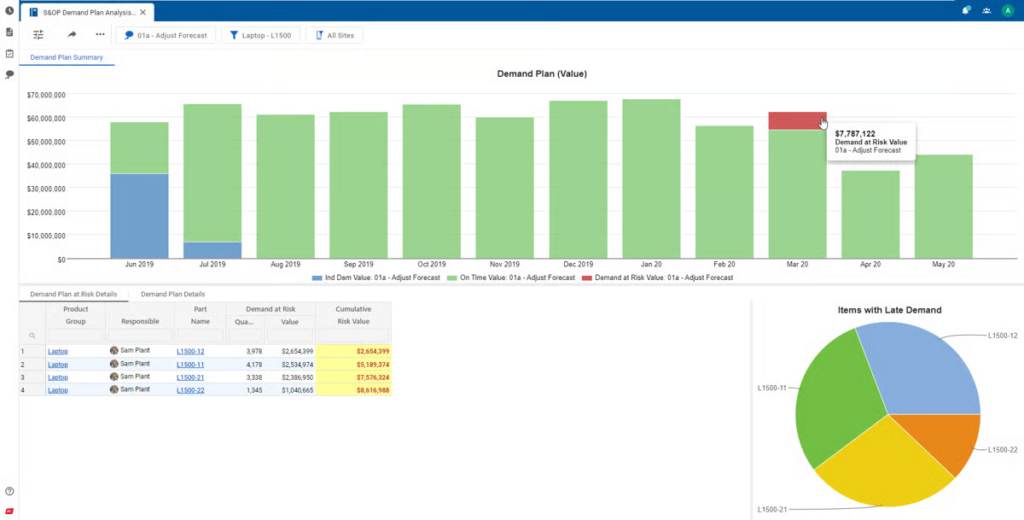
Formerly known as RapidResponse, Kinaxis Maestro is a cloud-based supply chain platform that supports supply chain management and sales and operations planning. It provides solutions for advanced supply chain needs, making it easier to overcome demand and distribution challenges by combining human knowledge with AI to improve risk mitigation and response.
Kinaxis Maestro strengths:
- Planning capabilities across complex supply chain processes
- Scenario modeling for risk analysis and tradeoff evaluation
- Enterprise-scale support
Kinaxis Maestro limitations:
- Heavier implementation demands than lighter planning tools
- Longer onboarding curve for teams without mature planning processes
- Stronger fit for large organizations than for smaller companies with leaner resources
Kinaxis Maestro pricing is available upon consultation.
Demand forecasting software #4: Atlas Planning Platform
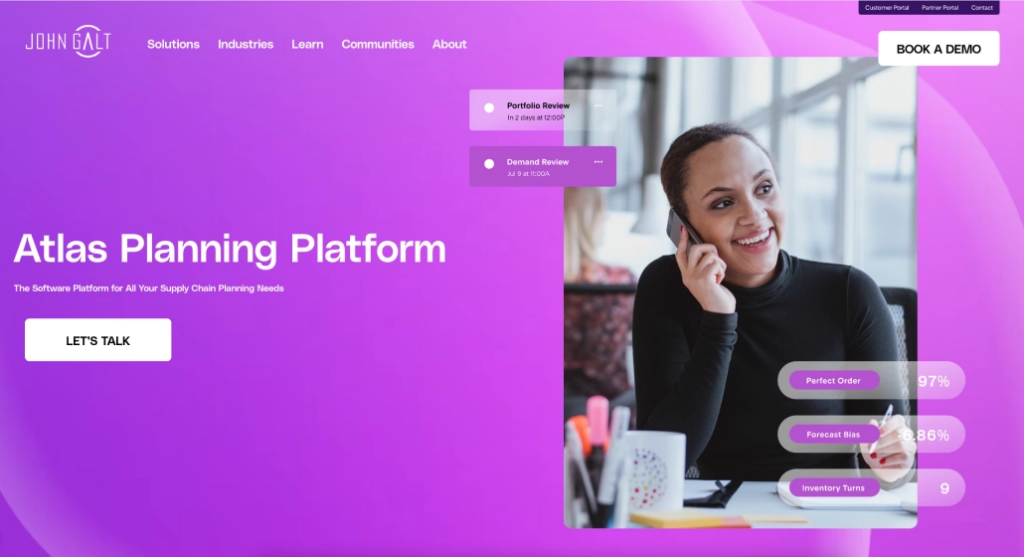
Atlas is an AI-powered SaaS platform by John Galt Solutions. The tool integrates large amounts of data from multiple sources and streamlines supply chain processes, from sales and operations to delivery scheduling.
Atlas strengths:
- Continuous demand planning approach to respond to variability
- Configurable planning environment with support for different horizons and workflows
- Broader planning coverage beyond demand-forecast use cases
Atlas limitations:
- Implementation complexity when data sits in fragmented systems
- Steeper setup requirements than more lightweight forecasting tools
- Greater need for rollout planning to get full value from the platform
Atlas pricing is available upon consultation.
Demand forecasting software #5: Oracle Supply Chain Planning
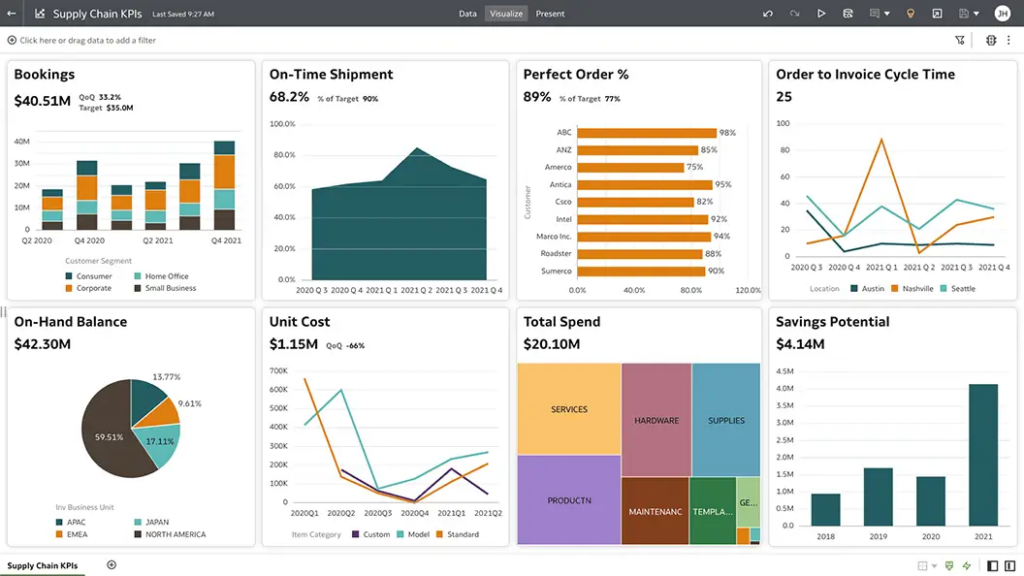
Oracle’s supply chain solution specializes in sales and operations planning (S&OP) through a cloud-based platform. The tool combines demand management, replenishment, and supply and operations planning with ML, scenario analysis, and connected planning across finance and operations.
Oracle Supply Chain Planning strengths:
- Planning scope across demand, supply, replenishment, and S&OP
- Machine learning support for forecasting, segmentation, and analysis
- Fit for organizations that want to plan within a larger Oracle environment
Oracle Supply Chain Planning limitations:
- Heavier suite complexity than point forecasting tools
- Larger implementation footprint for teams that need only demand forecasting
- Better suited to enterprise buyers than to smaller businesses that want a fast setup
Oracle Supply Chain Planning pricing is available upon consultation.
Demand forecasting software #6: Anaplan Demand Planning
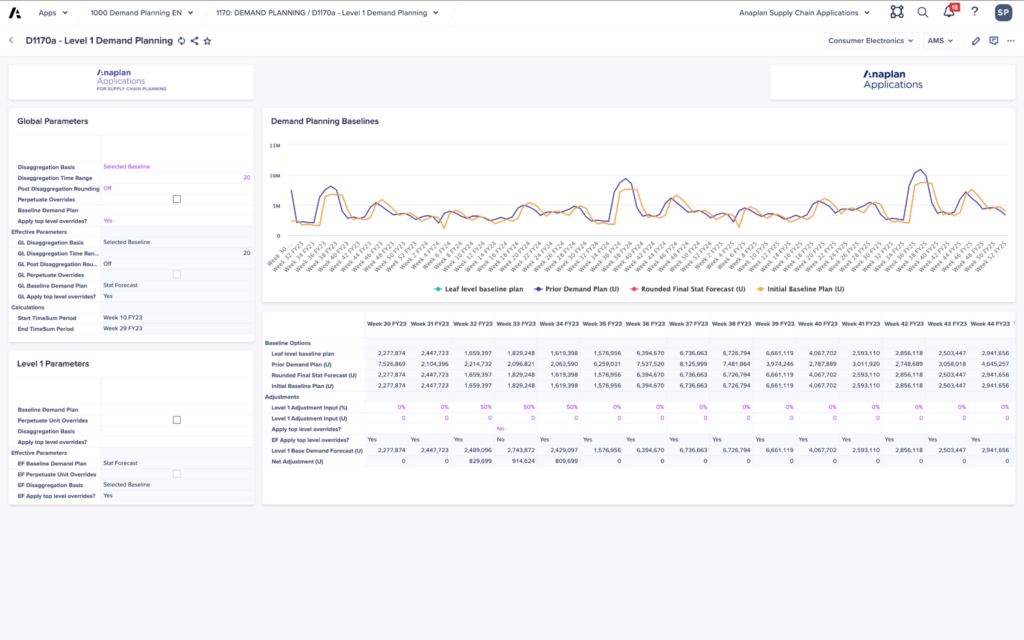
Anaplan offers AI-driven demand planning through its analysis platform. The product supports collaborative forecasting and scenario and consensus planning for supply chain teams.
Anaplan Demand Planning strengths:
- Collaborative planning support across commercial, financial, and operational teams
- Scenario planning inside a broader enterprise platform
- Demand planning application with prebuilt functionality for planning teams
- Fit for connected planning across multiple business functions
Anaplan Demand Planning limitations:
- Broader platform footprint than you might need if you want only demand forecasting
- Higher organizational overhead than simpler forecasting tools
- Limited public pricing transparency for early-stage comparison
Anaplan Demand Planning pricing is available upon consultation.
Demand forecasting software #7: SAP
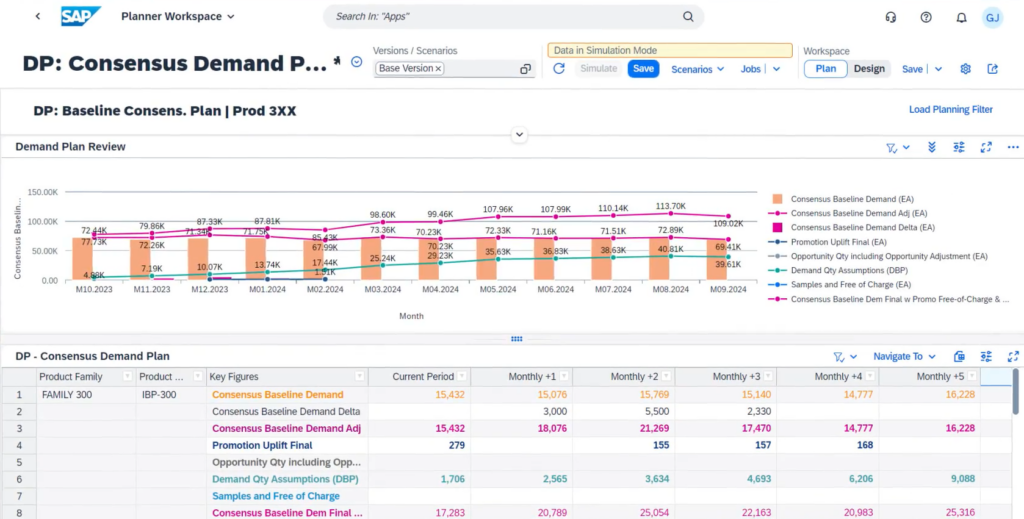
SAP Integrated Business Planning, or SAP IBP, is a cloud-based supply chain planning platform built for larger enterprises that need to connect demand planning, supply planning, inventory optimization, S&OP, and response planning in one system. For demand forecasting, SAP IBP supports statistical forecasting, demand sensing, AI-powered algorithms, automated outlier correction, and scenario simulations to help teams plan across changing demand signals.
SAP IBP is especially relevant for companies already using SAP systems or managing complex global supply chains. It helps planners bring together historical sales data, internal business inputs, external demand drivers, and collaborative feedback from sales, marketing, and finance teams. SAP also highlights features such as AI-assisted forecast analysis, demand-driver correlation, and new-product forecasting using synthetic history.
SAP IBP strengths:
- Broad planning coverage across demand, supply, inventory, response planning, and S&OP
- AI-powered forecasting, demand sensing, statistical models, and automated outlier correction
- Scenario simulation tools for testing demand and supply changes before they affect operations
- Strong fit for large enterprises already invested in the SAP ecosystem
SAP IBP limitations:
- Heavier implementation requirements than lighter demand forecasting tools
- Best suited for mature planning teams with enterprise-scale supply chain complexity
- May be more platform than needed for teams that only want fast, self-serve forecasting
- Pricing is not publicly listed, making early comparison more difficult
SAP IBP pricing is available upon consultation.
Benefits of using demand forecasting AI software
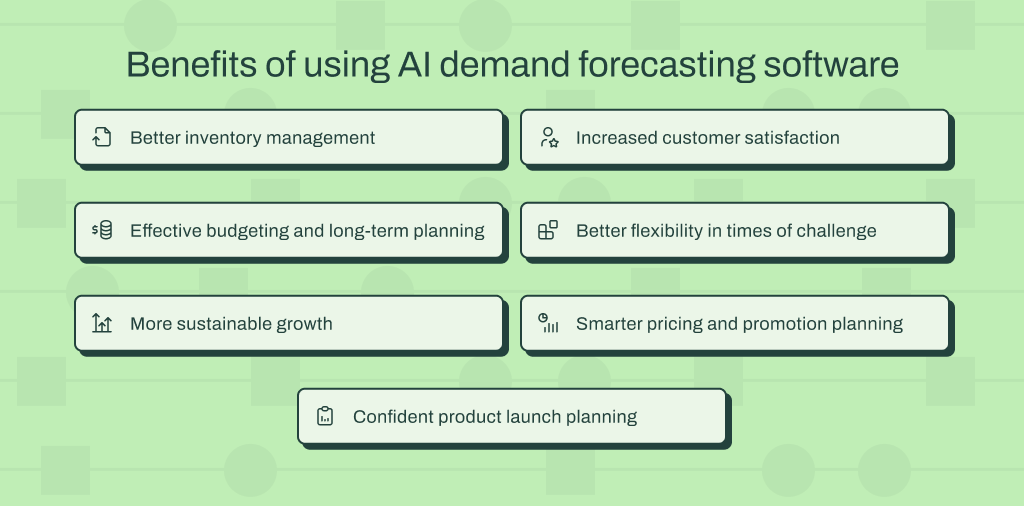
Unlike traditional solutions, AI-powered demand forecasting software can prepare data instantly, generate models in minutes, and even let you ask questions at any point through Pecan’s Predictive AI Agent.
Let’s look at more of the benefits of AI-powered demand forecasting solutions:
Better inventory management
Accurate demand forecasting solutions support your team’s inventory management process, helping you match supply and demand. McKinsey shows that AI-driven demand forecasting can reduce inventory levels by 20% to 30%, so you can enjoy less overstocking and more cases of having just the right amount.
Increased customer satisfaction
When your products and inventory better meet your customers’ wants and needs, you’ll have happier, more loyal customers. The same data that improves your supply chain can also offer buyers a more personalized experience, just by using machine learning for personalization.
Effective budgeting and long-term planning
With the right demand forecasting AI tools, you can identify patterns that lead to more lucrative long-term decisions – all while mitigating short- and long-term pitfalls related to shipping times, inventory levels, and machine maintenance.
Better flexibility in times of challenge
A platform fed a steady stream of data can pick up on small shifts in the marketplace and help you pivot your supply chain as needed. Demand signals can shift quickly when transportation routes change, tariffs affect costs, or consumer behavior cools. AI-driven demand forecasting can help reduce the stress of major incidents such as a road closure or a significant shipment loss.
More sustainable growth
Growth gets expensive when forecasting breaks down. The right platform helps you expand with more control, whether you’re entering a new market, widening a product line, or adjusting supply strategy across channels.
Faster revenue capture
Better forecasts let you stock the right products at the right time, which means fewer missed sales during promotions, launches, and seasonal peaks. Move beyond inventory planning alone and let AI show you where revenue opportunities live.
Confident product launch planning
Forecasting demand for new products isn’t as easy as forecasting for existing stock, because demand uncertainty rises fast. AI-driven forecasting helps your teams estimate initial demand, allocate stock more carefully, and avoid overcommitting too early.
Choosing the best demand forecasting software: What to look for
Before investing in a solution, determine the key criteria for your ideal demand forecasting software. These considerations can kick-start the decision-making process, helping you narrow your options based on the features and functionality your team needs most:
Functionality
First and foremost, your demand forecasting tool needs to accomplish the tasks you absolutely need it to. For example, are you forecasting demand to plan staffing needs? Or are you trying to optimize marketing budgets by focusing on your highest-converting products? Look for options that meet your business needs today – and can grow with you.
Automation and ease of use
While any program will always need some human management, seek out demand forecasting software that offers the right level of automation and ease of use for your business. If you don’t have time to prepare data or run reports manually, it may be best to find a tool that automatically cleanses your data and generates reports for you on a set schedule.
Integration
You’ll need to connect and train your AI tool with your existing programs and data streams. Some solutions take longer to integrate but offer higher customization, while others integrate quickly and easily with out-of-the-box or low-code AI. Consider your implementation timeline, who and what you’ll need to go live, and what you’ll need for ongoing maintenance.
Adaptability
Demand forecasting software should help you stay ahead of competitors and industry changes. Depending on your industry, look for a solution that keeps up with the latest technology. Prioritize vendors that consistently invest in their platform, including incorporating new technologies like generative AI.
Optimize your supply chain with the best AI-powered demand forecasting tool
Pecan is your go-to option when you want forecasting your business teams can run themselves, without hiring data scientists or replacing the systems you already use. Pecan’s Predictive AI Agent handles the modeling, your team acts on the results. The platform connects to your ERPs, CRMs, and data warehouse, then guides your analysts from raw data to a working predictive model in days. No long data science project: you build forecasts you can trust and act on, and push them straight into the tools you use every day.
Here’s what you get from Pecan:
- A self-serve predictive platform your analysts run themselves, with automated data prep, feature engineering, and model monitoring built in
- Double-digit accuracy gains over manual, spreadsheet-based forecasting – in days, not months (source)
- SKU- and location-level hierarchies to match real supply chain structures
- Automatic handling of seasonality, lead times, anomalies, and data drift
- Explainable drivers and confidence segmentation to support planner workflows
- Scalability to grow across products, channels, and locations as your operations expand
See how AI-driven demand forecasting can make your routine easier without replacing entire workflows: