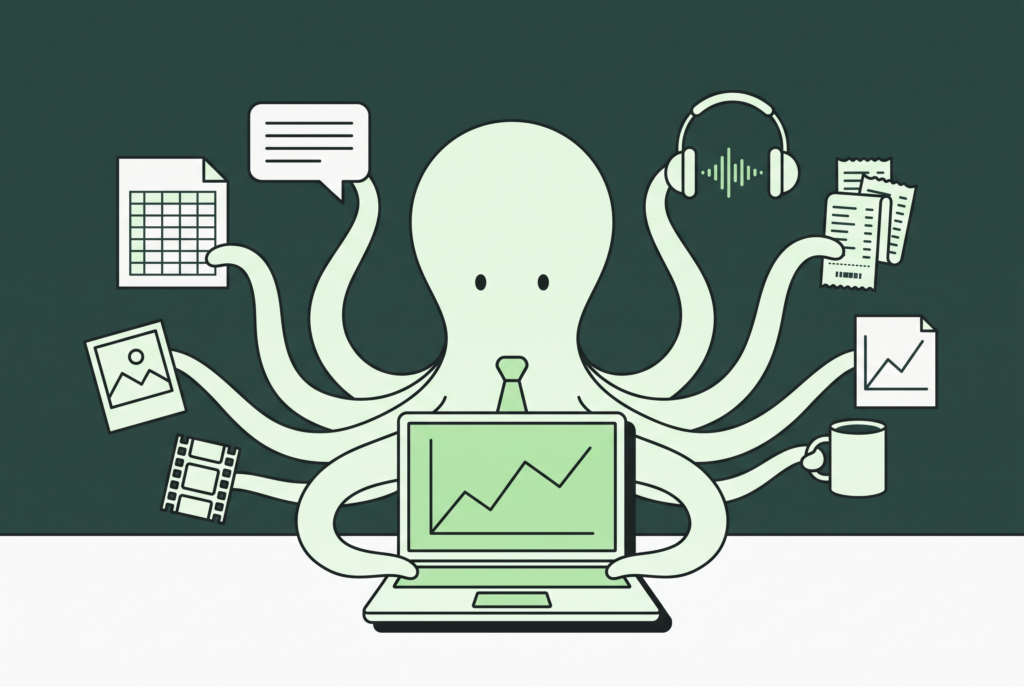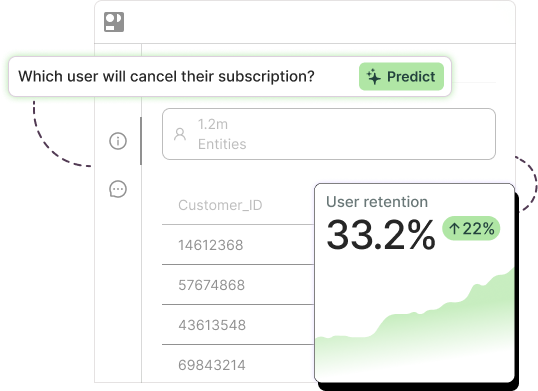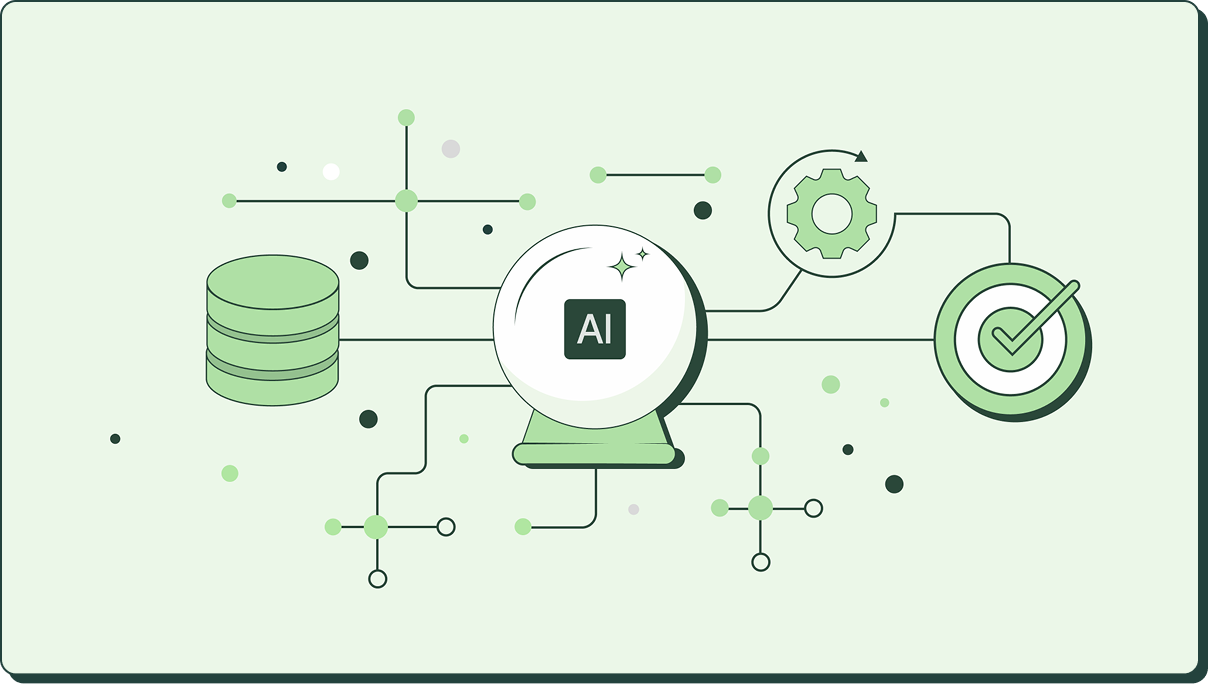
In the age of AI, relying on old-school dashboards and manual data analysis can lead you to overlook key business trends and insights, costing you competitive opportunities. To really thrive, you need to predict outcomes and act quickly. The challenge? Most of the work involved in deploying predictive tech is actually just getting the data ready.
That’s where predictive agents come in. They take on the heavy lifting of data prep and predictions, turning insights into real action. In this guide, we’ll walk you through how these tools work and show you how companies are saving the time they usually spend on building, reviewing, and adjusting forecasts.
Key highlights:
- Predictive AI agents are systems that not only forecast future events or trends, but also deliver production-ready predictions inside your workflows to help you achieve your business goals.
- The main difference between predictive AI, generative AI, and agentic AI lies in what they do. Predictive AI models predict outcomes, generative AI tools create content, and agentic AI systems automate complex analytical workflows.
- Pecan’s agentic analytics tool automates the full predictive cycle, preparing your content and building models in one week instead of months – no data team required.
What are predictive AI agents?
Predictive AI agents are specialized software systems designed to analyze historical data, identify complex patterns, and generate predictions that can be integrated into business workflows to enable better decisions.
While a predictive AI – like a weather app – tells you how the climate will be, a predictive AI agent forecasts the outcome (e.g., “85% likelihood of umbrella stockout”) and can integrate this prediction into a retail store’s inventory management workflow, empowering the relevant planner to quickly authorize an order for extra umbrellas, for example.
Generative AI vs. agentic AI vs. predictive AI: What are the differences?
Predictive AI, generative AI, and agentic AI each have their own strengths, but things get really interesting when you use them together. Predictive solutions give you the insights, generative models turn those insights into tailored content or solutions, and agents bring it all to life by orchestrating multi-step tasks across systems and tools.
Think about these tools as requirements for companies that want to grow fast. A Gartner study predicts that by 2028, 33% of enterprise software applications will include agentic AI, up from less than 1% in 2024, making the concept a mainstream component of business operations.
Here’s how the three AI approaches compare across various components:
| Component | Predictive AI | Generative AI | Agentic AI |
|---|---|---|---|
| Primary Goal | Predicting what’s next and why | Creating new content from scratch | Orchestrating multi-step tasks across systems and tools |
| Core Function | Analyzing historical data to identify trends and predict future results | Generating new content by understanding its structure | Coordinating workflows and interacting with connected applications |
| Output Type | Actionable insights (e.g., high churn risk) | Emails, summaries, and code snippets | Task plans, workflow updates, and system-level operations across connected tools |
| Value | Reducing risks, optimizing resources, and forecasting outcomes based on your data | Accelerating content creation, using machine learning personalization for communications, and prototyping ideas faster than ever | Reducing manual operational work and enabling complex processes to run across systems |
Read more on predictive vs generative AI.
What does a complete end-to-end predictive AI agent need to do?
Predictive AI agents operate by organizing your business information and creating AI models that go beyond smart forecasts using your data. They handle everything from data prep to actual predictions and can even integrate with your daily tools.
Think of this AI technology as a solution for companies that don’t have data scientists for predictive analytics.
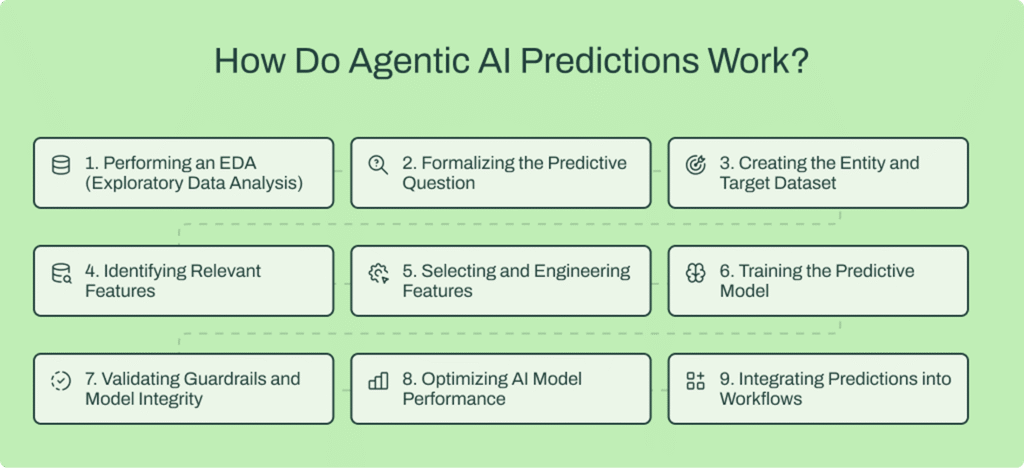
Here are the nine steps predictive AI agents execute in an end-to-end platform:
1. Perform an EDA (exploratory data analysis)
Predictive AI agents that cover end-to-end processes start by digging into your raw data with EDA (exploratory data analysis) to find patterns and anomalies. They can look at data you upload – like CSVs – or connect directly to your existing CRMs, databases, APIs, and analytics platforms. This way, you don’t even need to enter manual information to create your intelligent AI agent.
2. Formalize the predictive question
Getting the predictive question right is what protects your model from becoming “cheap analytics” in disguise. A big data survey found 92% of companies are actively trying to rightsize their analytics spend, and nearly half are doing it by compromising on query complexity (48%).
To get the predictions you need, you have to turn a big business goal into a specific math problem. A solid predictive question spells out three things: the entity (who or what is analyzing the data), the outcome (what you want to see happen), and the time window (by when it will happen).
Instead of asking how to increase revenue, try these kinds of questions:
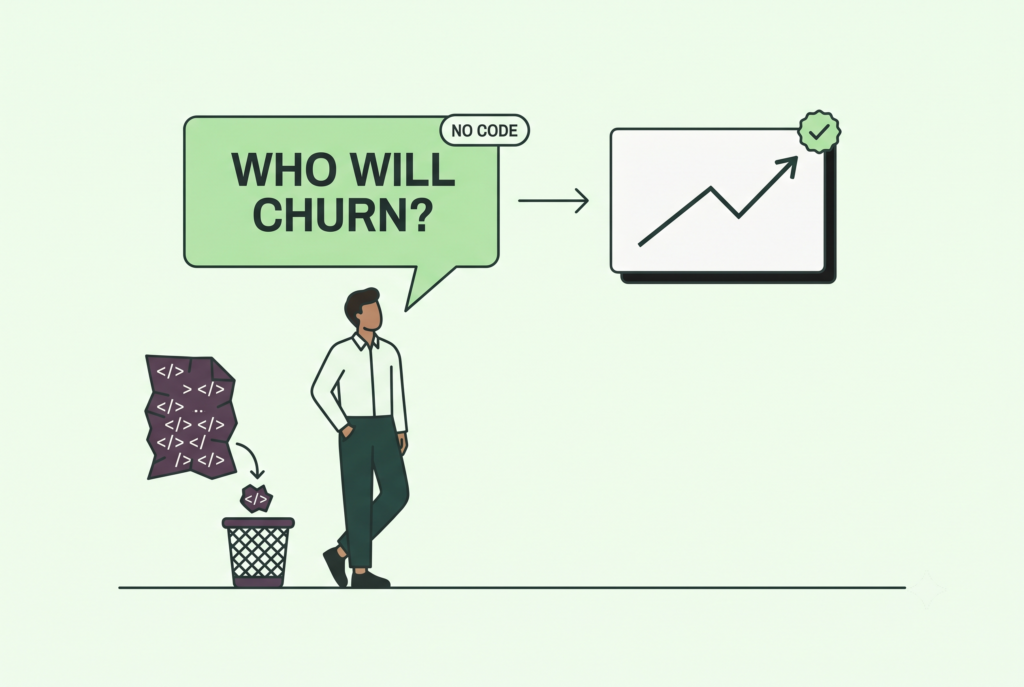
- Which customers are likely to churn in the next 30 days?
- Which trial users have a 90% chance of converting to paid plans this week?
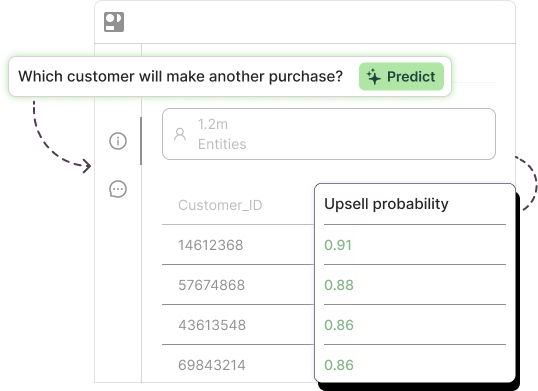
- Which current clients are most likely to accept a premium upsell offer?
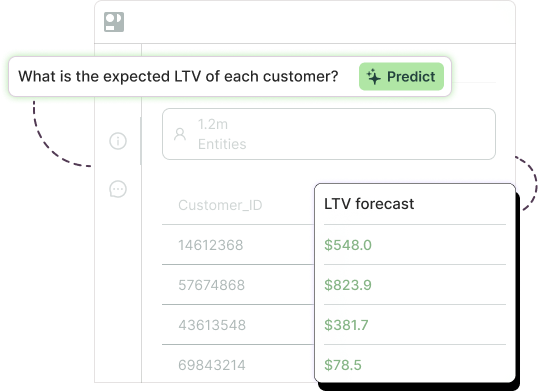
- What’s the predicted lifetime value of a lead based on their first 48 hours of activity?
Clear questions like these help your AI agent give you accurate, tailored answers rather than generic reports.
3. Create the entity and target dataset
AI agents begin by organizing your data around a specific entity, such as a customer (by ID) or a product (by SKU). Based on the chosen entity, the tool will define the target, which is the outcome you want to predict based on your predictive question.
For a predictive question like “Which customers will likely churn in the next 30 days?,” the agent will gather individual customer IDs from your database to group all historical behaviors, like login frequency, support tickets, and payment history, around each ID. This way, AI finds everyone who canceled in the past, using those examples as reinforcement learning for churn patterns and to predict which current profiles may do the same.
4. Identify relevant features
Features are the data inputs your machine learning model uses to make a prediction. When you train an agent, this is the info your AI will look into for signals that appear before the target outcome, not afterward.
For example, if you’re predicting customer churn, the agent would pull features like:
- Login count in the last 7 days.
- High-priority support tickets opened in the last 30 days.
- Days since last purchase or payment.
Finding the right features is how you spot signals showing behavior changes, product value, friction, or risk.
5. Select and engineer features
Think of feature engineering like being a detective. When you look at a raw list of events, like a customer’s entire support ticket history, it’s just a lot of noise.
The agent (your detective) comes in and says, “Let’s make this useful.” For example, your model can organize each piece of data from a giant spreadsheet of support tickets into meaningful categories, known as features, such as:
- Tickets per month, telling you how often the customer asks for support.
- Ticket severity mix, showing if clients only report small bugs or major outages.
- Days since last ticket, indicating if they’re a frequent flyer or haven’t needed help in ages.
The agent turns a big pile of scattered clues into a few clear, powerful insights that the AI can use to make meaningful predictions that indicate true business value.
6. Train the predictive model
Training is where your predictive AI agent gets smart. In this stage, your model uses historical, labeled data to figure out the relationship between what you know (features) and what you want to predict (outcomes). This step also specifies how the model will make predictions: either via binary classification (for simple yes/no answers) or via regression (to predict a numeric value).
7. Validate guardrails and model integrity
Validation makes sure your model doesn’t just look good on paper but actually works in the real world. Your predictive AI agent should spot common problems and halt the process if the risk is too high.
Here are the issues your AI intelligent agent should flag:
- Overfitting: Model memorizes old data quirks and can’t handle new data.
- Data Leakage: AI agent accidentally uses information it wouldn’t have when making a live prediction.
- Drift: Changes in data or behavior over time mean that older patterns are no longer reliable.
- Insufficient Samples: Lack of enough data prevents the model from learning stable, reliable signals.
- Unbalanced Labels: Rarity of the target event results in misleadingly high accuracy, hiding poor detection of actual positive cases.
8. Optimize AI model performance
Consistent optimization improves your AI model, enhancing your business outcomes. Your agent needs the agility to reflect real-time shifts in your operational goals and the real-world costs of errors. Think about churn: missing a real churner costs you revenue, but over-flagging low-risk customers wastes your retention budget.
When costs run high, you need a clear plan to optimize your business processes. Here’s how predictive AI solutions tackle it:
- Adjusting thresholds, setting the specific “yes/no” cutoff point that determines exactly how much predicted risk is required to trigger a business intervention.
- Calibrating probabilities, ensuring the model’s confidence scores (e.g., an 80% churn risk) accurately reflect the actual frequency of that event happening in the real world.
- Picking the right metrics to balance trade-offs, deciding whether your business should prioritize the cost of missing a real churner or the cost of wasting resources on a loyal customer.
9. Integrate predictions into workflows
Predictions are most valuable when they plug into the tools you already use. For example, AI agents can send churn risk forecasts to your CRM, writing predicted values for product marketing, or feeding supply chain demand forecasts into planning. Integrations let you act on scores and recommendations right away.
A smooth integration also tracks outcomes: what action was taken, when, and the result. These feedback loops make the next prediction cycle even sharper and ensure the AI focuses on the business results that drive the most value.Read more about AI forecasting.
Key predictive AI agent capabilities
When you’re picking a predictive AI agent, make sure it does more than just analyze information. The best options handle the heavy lifting across the data lifecycle and give you clear, reliable results you can trust.
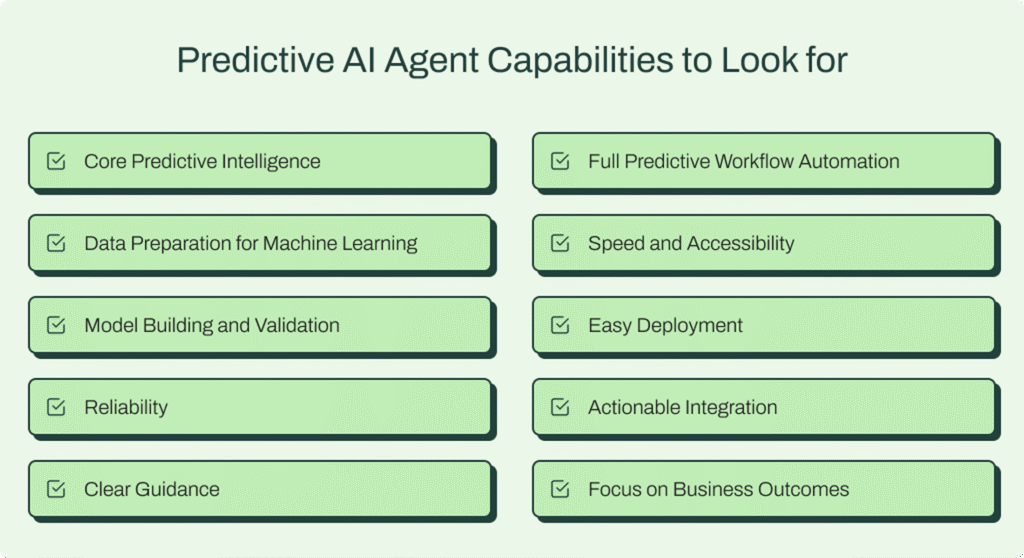
Consider this checklist of AI agent capabilities when looking for a predictive software tool:
| AI agent capabilities | How these capabilities work | Key questions to ask |
|---|---|---|
| Core predictive intelligence | The agent handles multi-step reasoning to interpret many variables and spot patterns that signal what’s likely next. | Can the agent explain why it predicts an outcome, not just output a score? |
| Full predictive workflow automation | AI runs the end-to-end workflow, starting with data prep, building a model, validating it, and providing predictions. | Can you go from raw data to predictions without stitching tools together? |
| Data preparation for machine learning | The agent cleans messy inputs, builds usable features, and gets data into a model-ready shape automatically. | Does the agent handle joins, time windows, missing values, and data quality checks on its own? |
| Model building and Validation | AI tries multiple approaches and validates results, so forecasts stay statistically sound. | Does the AI test models and show validation results you can trust? |
| Easy deployment | Your agent puts predictions into production without custom infrastructure or complex coding. | Can the agent deploy to your systems without having to build a pipeline from scratch? |
| Speed and accessibility | Business users can generate predictions quickly through a simple interface. | Can a non-specialist set up and run predictions in minutes? |
| Reliability | The agent monitors performance over time and flags drift or degradation. | Does the AI alert you when a model needs retraining or attention? |
| Actionable integration | AI connects to existing tools, so predictions go directly into business workflows. | Can your agent push predictions into your CRM/warehouse/apps where work happens? |
| Clear guidance | The AI model explains the process and results in plain language. | Can stakeholders understand the output without a data science translation layer? |
| Focus on business outcomes | AI starts the prediction process from business questions and ties the forecasts to desired outcomes, like accelerating deliveries. | Does the agent surface predictions directly within workflows for prioritization, outreach, or planning? |
Not sure if you could benefit from a forecast technology? See common signs of predictive analytics readiness.
Get the best agentic analytics tools with Pecan
Pecan gives you smart analytics tools that help you spot opportunities before they happen. Our predictive AI agent takes your business questions and turns your data into clear, actionable answers, so you’re always ready to take the next step, not just respond to what’s already happened.
Pecan customers reported 60% average reduction in planners’ time spent on building, reviewing, and adjusting forecasts. This outcome is only possible because we automate the most time-consuming parts of the predictive process:
- Performing automated data preparation and feature engineering for effective analysis of customer LTV (Lifetime Value).
- Building and validating models using your real enterprise data to enhance upsell and cross-sell opportunities.
- Delivering predictions directly into tools like Salesforce, HubSpot, and your data warehouse, enabling seamless integration for initiatives such as customer winback.
- Monitoring performance and flagging when your models need retraining to maintain the accuracy of insights, especially when it comes to predictive campaign ROAS.
Ready to start operating with foresight instead of hindsight? Book a demo and learn how Pecan’s predictive AI agent can help your organization turn existing data into high-value predictions.

Yakira is a Product Marketing Manager at Pecan AI, focused on how teams adopt predictive AI in real business workflows. She bridges product, data, and go-to-market, framing how predictions are used to create business value.