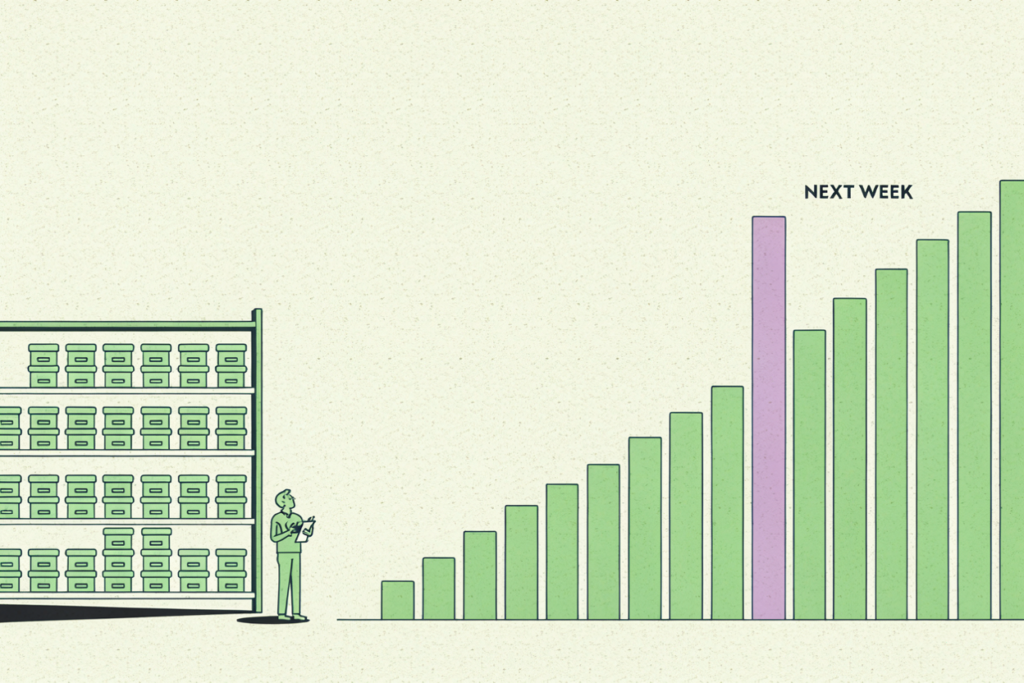
The mission of achieving accurate demand forecasting is becoming more challenging with each passing quarter. Promotional activities are changing at a faster pace than planning cycles, supply chains introduce unforeseen complexities, and data is often dispersed across multiple tools that lack standardized interpretation of product identifiers such as “SKU 123.”
Does this situation look familiar to you? If your current sales forecasts consistently fail to align with actual figures, this guide on best practices for enhancing demand forecasting accuracy will help you build more reliable outcomes for your organization.
Key highlights:
- Demand forecasting accuracy is the measurement of how closely your predicted sales match actual customer demand.
- The challenges of product demand forecasting include messy data, shifting promotions, and unexpected supply chain gaps.
- Best practices for accurate demand forecasting include automating data preparation, segmenting products, monitoring external factors, keeping teams aligned, and monitoring predictive tools.
- Pecan automates the hard parts of the demand forecasting process, bringing you a predictive solution in weeks rather than months.
What is demand forecasting accuracy?
Demand forecasting accuracy is the measure of how well your predictions line up with reality.
When your demand forecasting process is accurate, you have exactly what customers want, when they want it, without turning your warehouse into a crowded storage locker for unsold items.

Imagine you’re a retailer planning for a major summer launch. You predict you’ll sell 1,000 units of a specific SKU based on last year’s trends. If you actually sell 980, your accuracy is high. But if you sell only 400 – or if demand rises to 3,000 – you have an accuracy problem on your hands.
The lack of accuracy can affect business operations on many levels, from logistics to marketing, which is why major companies are using advanced predictive analytics to reduce forecasting errors by 20 to 30%, according to McKinsey.
Why is demand forecasting important?
Demand forecasting helps you make informed, less reactive business decisions. By eliminating the guesswork associated with sales performance, organizations can transition from perpetually addressing logistical issues to proactively managing their operations.
Having accurate demand forecasting as part of your daily business routine allows you to:
- Order proper inventory
- Schedule workload
- Manage cash flow without the constant fear of losing sales due to out-of-stock items
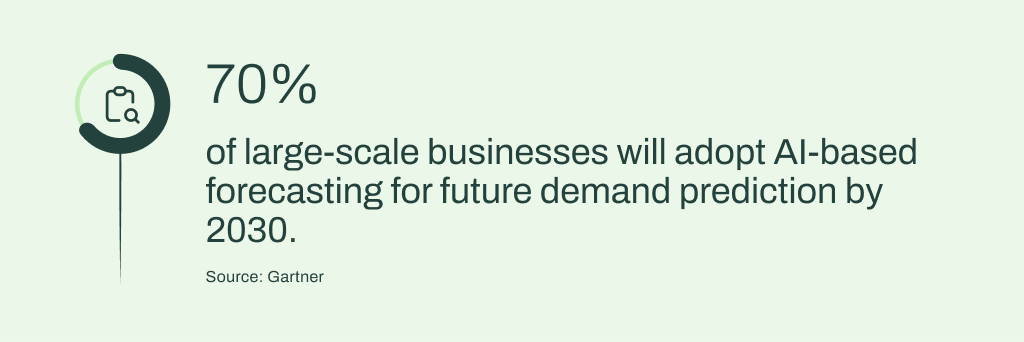
The demand forecasting importance also lies in the need for companies to remain competitive, as demonstrated by Gartner’s prediction that 70% of large-scale businesses will adopt AI-based forecasting to anticipate future demand by 2030.
What makes product demand forecasting challenging?
If product demand forecasting were simple, every shelf would maintain optimal stock levels. In reality, several specific obstacles frequently compromise the figures, ranging from data integrity issues to timing discrepancies.
- Data integrity: When the data pipeline experiences latency or information loss, the forecast becomes unreliable, attempting to estimate recent activity based on data from a previous period.
- System inconsistencies: Discrepancies in product labeling between your warehouse management system and your sales platform will lead to data fragmentation and hinder communication.
- Business drivers: Promotions and price changes can cause spikes or decreases in demand that look like a permanent trend, not a one-time event.
- Supply surprises: Shipment delays can shift demand across weeks, creating noisy data that can mislead your forecast into expecting peaks and valleys in sales that don’t correspond to reality.
- Model and process gaps: Small technical slips, such as feature leakage or weak predictive AI model validation, can undermine your results by exposing your model to information during training that doesn’t exist in the real world, leading to a false sense of security.
- Lack of model update: A model that remains un-updated for an extended period isn’t trustworthy, as market dynamics shift, consumer preferences evolve, and global events consistently change the baseline.
Demand forecasting best practices to ensure accurate predictions
To improve demand forecast accuracy, you have to move beyond the basic guess-and-check method and start using tools that help you simplify the prediction process.
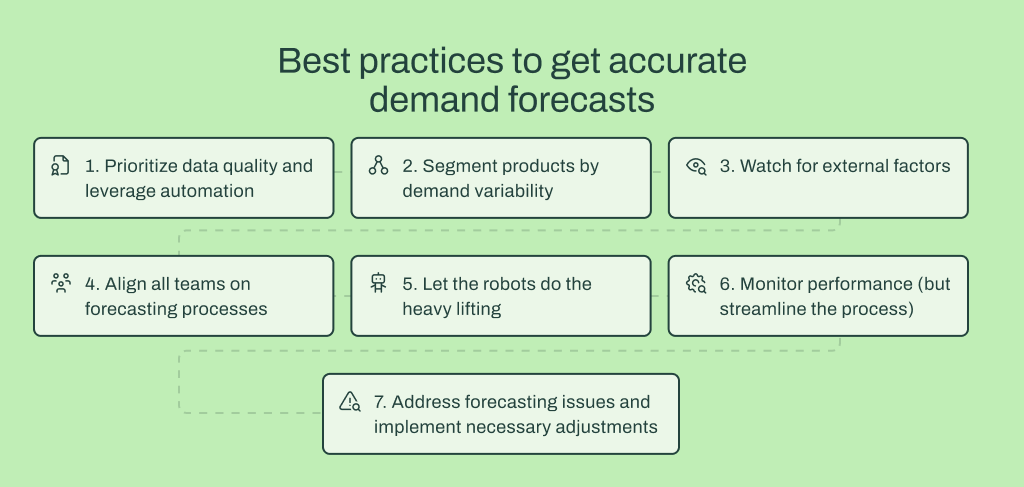
Here’s the step-by-step guide on how to improve accuracy in your forecasts:
1. Prioritize data quality and leverage automation
Accurate forecasts rely on high-quality data. Rather than spending hours manually correcting data, use automation to clean and prepare your inputs. Leading demand forecasting tools streamline data preparation and select the most relevant information, ensuring your predictions are reliable.
2. Segment products by demand variability
Not all products behave the same way. Try segmenting your inventory by velocity, grouping stable products separately from volatile, seasonal trends, so you can apply the right forecasting logic to the right products. Proper categorization prevents one SKU from negatively impacting the accuracy of others.
3. Watch for external factors
External market factors, order volume, economic shifts, and weather patterns often influence demand more than internal sales history. Recognizing these factors helps your model anticipate changes before they impact your results.
4. Align all teams on forecasting processes
Demand forecasting accuracy requires cross-functional collaboration. For example, if marketing plans a major promotion but the operations sector is unaware, forecasts will be inaccurate. Ongoing communication ensures internal business drivers are reflected in your data.
5. Let the robots do the heavy lifting
We’re past the times when you needed to spend entire days filling SKU spreadsheets by hand. Predictive demand forecasting handles the complex, multi-dimensional math much faster and more accurately than a human ever could.
Automation isn’t only about automatically grouping products or data points to organize your forecasts. According to Gartner, GenAI models will manage 25% of KPI reporting in supply chain operations. What about using the extra time to focus on strategic tasks? Enjoy the newly available bandwidth to deepen market analysis, optimize planning, or explorenew technologies.
6. Monitor performance (but streamline the process)
Performance can’t improve without consistent measurement. Establish and consistently use demand planning key performance indicators (KPIs) to track successes and failures on a weekly basis. The goal isn’t just to see errors, but to understand why they happened so you can refine the predictive process.
7. Address forecasting issues and implement necessary adjustments
No forecasting model is perfect forever. If you notice consistent bias or recurring errors in a category, address them promptly. Use these insights to adjust your inputs or retrain your model to reflect current conditions.
Explore common data analytics problems and solutions.
How to measure demand forecasting accuracy
Measuring the accuracy of your demand forecasting process is all about picking the right lens – and sticking to it.
1. Select the forecast level of detail
Before you run any numbers, decide on what you’ll measure. If you measure results at the SKU level one week and the category level the next, you’ll never see the true patterns in your data. Choose one specific level of detail for scoring, such as:
- SKU: The most granular view, essential for replenishment
- Location: Critical for logistics and regional distribution
- Time period: Typically, the week of start to align with operational and production planning cycles
2. Choose a KPI to run every week
Pick one primary KPI to evaluate through the weeks, then add one guardrail KPI to ensure you aren’t missing anything.
| KPI for demand forecasting accuracy | What the KPI answers | When you should use this metric | Watch out for |
|---|---|---|---|
| wMAPE | “How far off did forecasts run, weighted by volume?” | Executive reporting, portfolio scoring, and SKU performance reviews | Hidden pain in long-tail SKUs without segmentation |
| MAE | “How many units did forecasts miss on average?” | Replenishment and execution decisions in units | The need for context, as MAE alone does not compare across scales |
| Bias% | “Does the forecast lean high or low?” | Inventory management, service levels, and planner trust | Bias integrity, as it can look fine at the total level and still break at the segment level |
You might go with these choices:
- wMAPE for when you want a single number that reflects volume mix
- MAE for when you need unit misses to drive ordering decisions
- Bias% for when you need the direction of error, not only the size of error
- Let your demand forecasting tool handle the hard part of predictions
Demand forecasting becomes significantly easier with the right tool. Eliminate manual spreadsheets and calculations by using a predictive model that allows you to focus on higher priorities.
Here’s how it works:
- A demand forecasting tool captures a versioned snapshot to evaluate the exact forecast published by the team, not any subsequent edits.
- Every row compares the same SKU, location, and time period.
- Automated calculations address row-level errors, enabling consistent use of error fields for every KPI without additional effort.
- Consistent scoring by segment highlights where accuracy declines, whether by category, promotional status, or velocity classification.
- Automated scorecards and exception lists help planners quickly identify the largest discrepancies, eliminating the need to review every SKU individually.
- The system evaluates baselines consistently, allowing the tool to report whether the model outperforms a basic benchmark by segment as well as overall.
Get accurate demand forecasting in minutes with AI
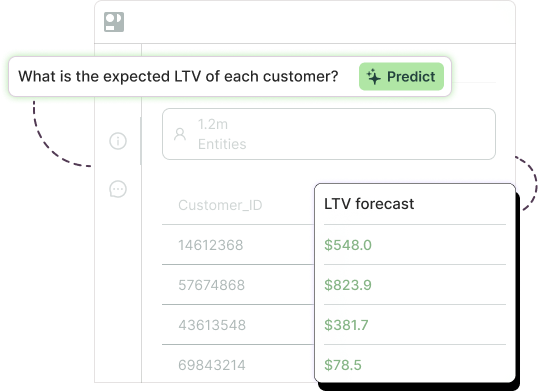
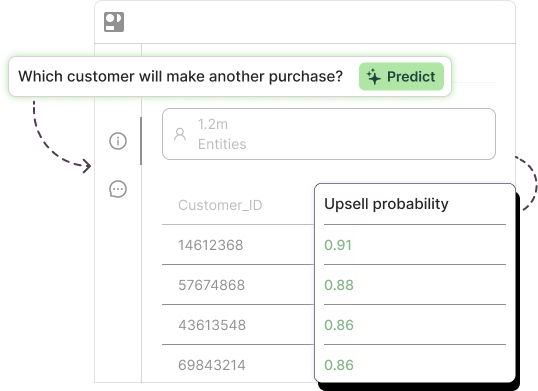
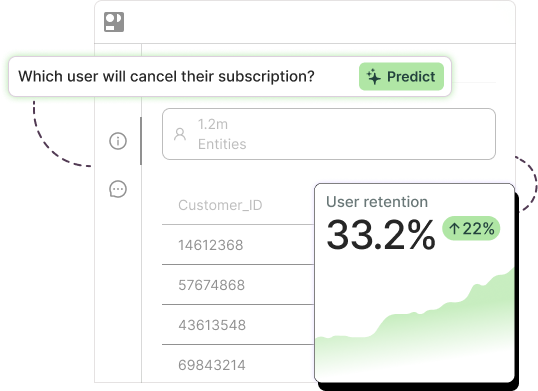
Pecan transforms complex historical business information into accurate demand forecasting, eliminating delays caused by data science backlogs. Ask a business question in plain English, and our predictive AI agent manages data preparation, model building, validation, and deployment, ensuring forecasts are available right in the workflows where you make decisions.
For supply chain executives, we present Demand Forecast AI, our product designed for those seeking reliable planning and quick time-to-value.
With Pecan and Demand Forecast AI, you can:
- Predict demand at the SKU, location, and week level, then track accuracy over time.
- Flag high-risk SKUs before planners place orders, reducing stockouts and overstocks.
- Segment forecasts by promotion flag, lifecycle stage, and velocity tier to identify areas where accuracy declines.
- Integrate forecast outputs into your existing workflows.
Want to see how Pecan fits your data stack and forecasting cadence? Book a live demo now.