You can drive your chargeback rate to almost zero tomorrow.
Decline every transaction over $200. Block every order shipping to an address that doesn’t match the billing address. Require manual review on anything from a new customer. Your dispute dashboard will go green and stay green, and your CFO will fire you by the end of the quarter, because you’ll have declined a third of your good revenue to prevent 1% of it from being disputed.
Nobody would call that a win. And yet every chargeback dashboard we’ve ever seen would.
That’s the trap in most chargeback prevention programs: the number being optimized is a rate that improves whenever you become more paranoid. The number that actually matters is net loss, which is the dispute cost plus the fraud loss plus the margin you gave up on every good order you refused. Those pull in opposite directions. Any conversation about how to avoid chargebacks that doesn’t hold both at once is going to end badly for somebody.
The second thing worth saying up front: most of your chargebacks are an operations problem that gets filed under fraud, because fraud is whose budget owns it.

What chargebacks actually cost you
The disputed transaction amount is the smallest line item.
Add the chargeback fee your processor charges regardless of whether you win. Add the shipped goods you’ll never see again. Add the staff hours to gather evidence and file representment, and the hours to argue about the ones you lose. Add the processing overhead. Chargeflow’s 2026 statistics roundup estimates the all-in cost at roughly $3.75 to $4.61 for every $1 disputed, which is their figure and worth treating as directional rather than gospel, but the direction is right and it matches what merchants tell us.
Then there’s the part that ends businesses. Card network monitoring programs. Cross a threshold on your chargeback ratio and you’re in a remediation program with fines attached. Stay there and you can lose processing entirely. For a high-risk merchant category, that’s not a hypothetical.
So chargeback management deserves real attention. It just doesn’t deserve the specific attention it usually gets, which is a fraud filter tuned tighter every quarter.
Why chargebacks happen: three buckets, three owners
Sort your last six months of disputes into three piles. The piles have different owners and different fixes, and most teams treat all three as one problem.

True fraud. Stolen card, stranger’s transaction, legitimate cardholder disputing something they never bought. This is the pile fraud tooling is built for. At most ecommerce merchants, it’s the smallest of the three.
Friendly fraud, also called first-party misuse. The cardholder bought the thing, received the thing, kept the thing, and disputed it anyway. Sometimes it’s deliberate. Often it’s a family member’s purchase they didn’t recognize, or a subscription they forgot about, or a billing descriptor that reads like a company they’ve never heard of. Chargeflow’s data puts friendly fraud at roughly three quarters of ecommerce disputes. Your fraud filter cannot catch this, because at the moment of the transaction nothing was wrong.
Service and merchant error. Items arrived late, broken, or not at all. The refund request went unanswered for nine days so the customer went to their bank instead. Subscription cancellation flow that requires an email to support. These disputes are a customer service failure that your customer escalated to Visa.
Look at the ratio. If two of your three piles are things a fraud model can’t detect, tightening your fraud rules is a strange place to concentrate.
Prevention basics that pay for themselves
Boring, cheap, and effective. Do these before you do anything clever.
Fix your billing descriptor. If your legal entity is Northgate Holdings LLC and your brand is Sprout, and the statement says NGH HOLD 4471, you’ve manufactured disputes. Put the recognizable brand name and a phone number in the descriptor. This single change removes a meaningful slice of “I don’t recognize this charge” disputes for a lot of merchants, and it costs one support ticket to your processor.
Make refunds embarrassingly easy. Every refund you grant costs you the item. Every chargeback costs you the item, the fee, the staff time, and a tick toward your monitoring threshold. Refunding a marginal complaint is cheaper than winning the dispute. Teams resist this because refunds feel like losses and chargebacks feel like fraud, which is an accounting illusion.

Answer support fast. A large fraction of disputes are what happens when a customer gives up on you. Response time is a chargeback prevention strategy, and nobody puts it in the chargeback deck.
Keep delivery proof. Tracking, signature confirmation on high-value orders, delivery timestamps. You cannot win representation on vibes.
Be explicit about subscriptions. Renewal reminders before the charge, one-click cancellation, clear terms at signup. Forgotten subscriptions are a friendly fraud engine.
Use AVS, CVV, and 3D Secure with judgment. All useful, all capable of blocking good customers when the thresholds are set by someone who only gets blamed for the fraud that gets through.
That list handles a real share of your disputes. Now the harder part.
Where static rules fall short
Almost every merchant starts with rules. If order value is over X and the shipping address doesn’t match billing and the account is under Y days old, hold for review. Rules are transparent, easy to audit, and easy to explain to a regulator, which is why we’ve argued that rules-based vs machine learning is a false choice and the right answer is usually both.
Rules do have a structural problem, and it comes from how they get written. Backwards, one incident at a time.
Every rule on your list exists because something bad happened once. The rule stops that exact thing from happening again, at the cost of blocking every legitimate customer who happens to share the pattern. Fraud adapts in weeks. Your rule list gets reviewed in quarters. The gap between those two numbers is your loss rate.
Rules are also blind to combinations. A rule can check whether the order is over $500. It can check whether the email is three days old. It struggles to notice that this specific combination of order value, email age, time of day, device type, and shipping distance is normal for your customer base at 2pm on a Tuesday and deeply abnormal at 3am on a Sunday.
And rules produce false positives that nobody counts. When a rule blocks a good customer, that customer doesn’t file a complaint. They just don’t come back. There’s no dashboard for revenue that didn’t happen.
Coinmama ran exactly this setup before working with us: a hand-written SQL script applying static business rules to incoming transactions, built from whatever the last analysis had turned up. It worked, in the sense that it caught things. It also flagged far too much. After moving to predictive scoring, they cut their false positive rate by about two-thirds and ended up manually reviewing a much smaller queue, ranked so the riskiest transactions got attention first.
That’s the shape of the win. Fewer good customers blocked, and the review team’s hours aimed at the transactions that deserve them.
How predictive chargeback scoring works
A predictive model does something a rule can’t: it reads every signal on a transaction at once and returns a probability, not a verdict.
The inputs are the things you already have. Transaction attributes like amount, currency, item mix, and time. Customer history, including tenure, prior orders, prior disputes, prior refunds. Behavioral signals from the session, such as how the order was assembled and how fast. Device and network context. Velocity patterns, meaning how many attempts from this card, this device, this address in the last hour. Address and geography relationships. Payment method details. Hundreds of features per transaction, weighed against what actually happened to millions of past transactions where you eventually learned the outcome.

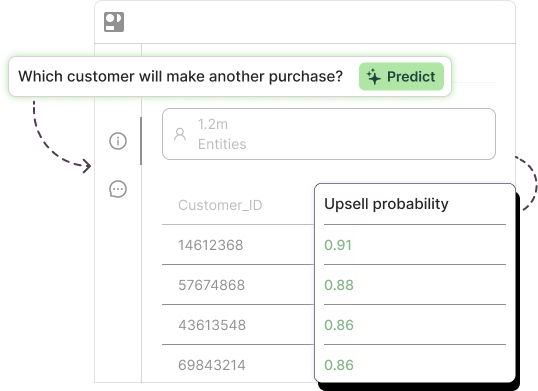
What comes back is a score between 0 and 1. That’s the part that changes your economics, because a score can be thresholded to your actual risk appetite instead of a rule’s binary yes-or-no. High scores get held or declined. Medium gets step-up verification, so 3D Secure or a quick identity check, which recovers customers from a hard decline would have been lost forever. Low score sails through untouched, which is most of your volume and most of your revenue.
The score also lets you set different thresholds for different situations. A $40 order from a four-year customer and a $2,000 order from a two-hour-old account can face different bars, automatically, without anyone writing a rule for each case.
Worth being direct about a limit: a model trained on chargeback outcomes learns to predict chargebacks, including friendly fraud, and can flag a repeat disputer or a risky order profile before it ships. What it can’t do is fix a confusing descriptor or a nine-day support queue. Prediction and operations both have to show up. If you want the broader picture of how this fits together, our overview of predictive analytics covers the pattern across use cases.
Building it without a data science team
The reason most merchants stay on rules is that the ML version has traditionally required people they don’t have. Labeling outcomes correctly, engineering features, avoiding leakage, backtesting on the right time windows, deploying to a real-time endpoint, monitoring drift, retraining.
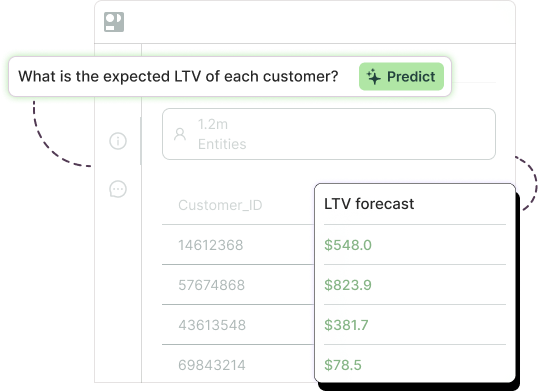
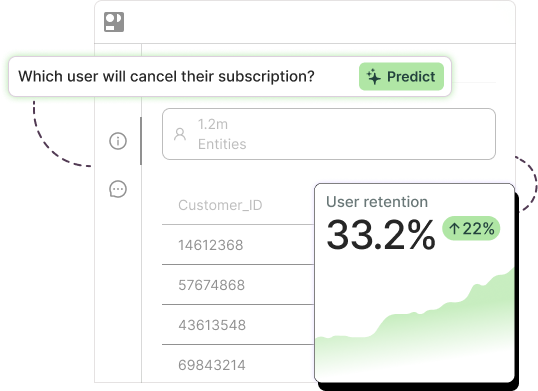
Our Predictive AI Agent takes that on. You point it at your historical transaction and dispute data, ask which transactions are likely to result in a chargeback, and the agent handles data preparation, feature engineering, model building, and validation, with guardrails against data leakage and overfitting built in rather than bolted on. Scores flow into the systems where the decision gets made, each one with the drivers behind it visible, so your risk team can explain a hold to a customer or an auditor.
No code. And no requirement to reshape your data into some ideal structure first, because transaction data is messy in every business we’ve ever seen and the agent is built for that reality.
The scorecard worth running this on
Replace your chargeback rate dashboard with four numbers, tracked together.
Net loss per 1,000 orders, combining dispute cost, fraud loss, and estimated margin on declined good orders. Your false positive rate, measured by manually reviewing a random sample of declines, which is unpleasant and irreplaceable. Approval rate on good customers, so you can see what your caution costs. And your dispute ratio against the network thresholds, because that one has teeth regardless of the rest.
Any prevention change that improves one of these while quietly wrecking another is a transfer, and it should get reported as one.
We built our Fraud & Chargeback Prevention solution around that idea: score each transaction for risk, trigger the right action, and reduce false positives instead of trading them for a prettier chargeback number.
See how we score transactions for chargeback risk.

Dror is the VP of Data and Analytics at Pecan AI, where he leads the analytics strategy that powers both customer success and Pecan’s own growth. He joined Pecan as Director of Analytics after years of data leadership roles across tech and fintech, bringing a firsthand understanding of what it takes to make data actually useful for business teams.