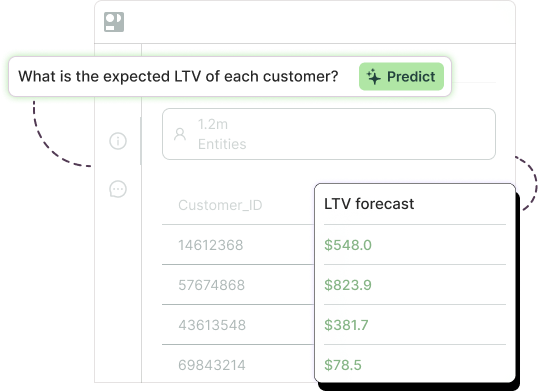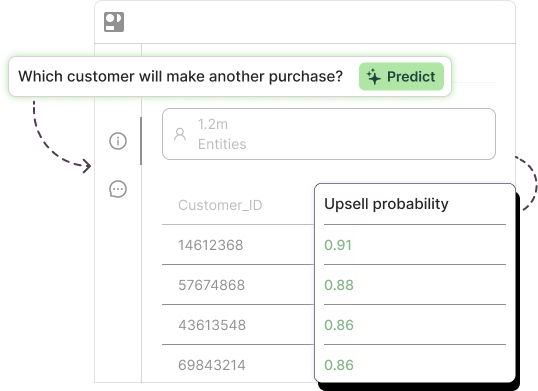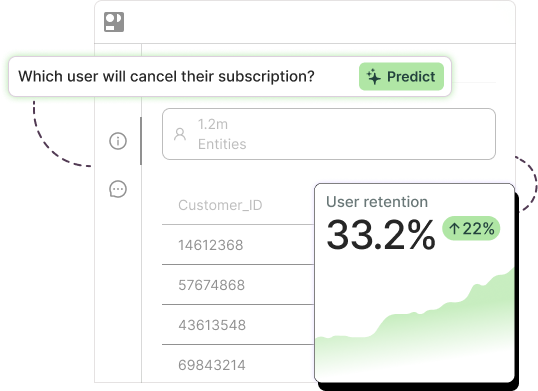
In a nutshell:
- Predictive analytics can help businesses identify customers likely to make additional purchases or upgrades.
- Cross-sell and upsell strategies can benefit different industries, such as retail, financial services, CPG, apps, and consumer services.
- Propensity modeling is used to determine conversion likelihood and prioritize outreach to customers.
- Pecan's platform offers nuanced predictions with specific propensity scores for each customer.
- Proactively planning offers based on predictive analytics can lead to increased ROI and stronger customer relationships.
Strong, sustained customer relationships are invaluable for every business. Usually, that ongoing connection means that not only do customers return to your business often. In fact, they also make repeat and additional purchases of the products or services you offer.
Fortunately, predictive analytics now helps you know in advance whether a customer is likely to be interested in additional products or an upscaled offering of your products or services.
You can use your customer data to look for meaningful patterns in what customers have bought and when. Then, those patterns can provide predictions about other customers.
With those predictions, you can provide relevant, effective offers that they’re most likely to find appealing.
And yes, your business can benefit from this predictive approach, no matter what industry you’re in. It’ll boost your bottom line and, when done right, also improve customers’ experience and the value you deliver to them.
If you’re not sure if you have enough data or the right kinds of data to use for this purpose, be sure to read about how your data is probably ready to rock and roll. Generally, if you have data for thousands of customers and thousands of transactions, you’re good to go with predictive analytics.
We’ll examine how businesses in different industries can succeed with this strategy. We’ll also go behind the scenes to give you a quick glimpse into how predictive models use your data to allow you to time travel with your customers into the future.
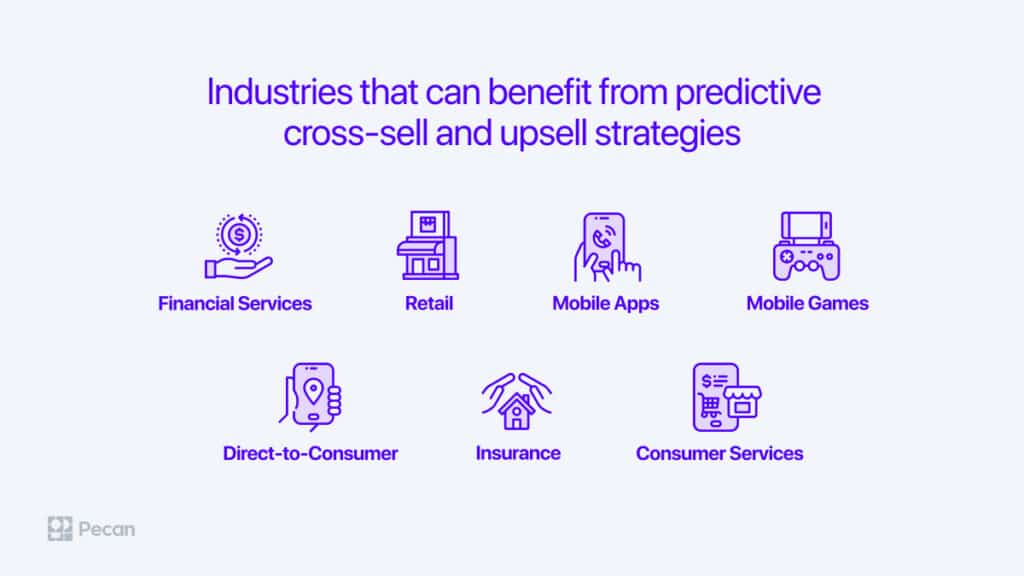
What success looks like with predictive cross-sell and upsell strategies
Retail and e-commerce
- Use sales resources efficiently to contact prioritized customers who are most likely to take advantage of a cross-sell or upsell offer
- See which customers might be more likely to purchase a higher-level model of a product with added features, in lieu of an entry-level model
- Offer personalized invitations in your mobile shopping app to entice likely high-value customers to attend events at brick-and-mortar stores
See a case study of how one of our e-commerce clients built an upsell model in under two weeks, which they then used to achieve a 12% conversion rate—increasing their past conversion rate by 5 percentage points. ➡️
Financial services and insurance
- Find out which customers who use one of your services are most likely to purchase additional services. For example, which car insurance policyholders might be most interested in home insurance?
- Provide premium account or membership opportunities to customers whose profiles match others who upgraded beyond the basic level
- Increase wallet share by offering complementary accounts (for example, home equity lines of credit for mortgage customers) or suggesting refinancing opportunities
CPG and DTC
- Give customers personalized coupons or promotions for products complementary to what they’ve already purchased
- Build bundles of items frequently purchased together by past customers whose profiles and purchasing behavior are similar to your current customers
- Suggest to likely-to-convert customers the most relevant additional and/or upgraded products and services you offer
See a case study of how one CPG company used predictive analytics to improve conversion rates among subscribers, reducing overall churn by up to 39%. ➡️
Apps and gaming
- Offer upgraded subscription opportunities to entry-level users similar to those who purchased higher-level subscriptions
- Send social proof messages to users with high lifetime value to encourage them to purchase upgraded options
- Showcase new features or game levels to consistent users of the app or game
See a case study of how a global mobile game developer identified 200% more additional VIP customers and converted the majority into high-value customers, with an average of 3X uplift of spend per user. ➡️
Consumer services
- Identify customers most likely to add supplemental in-person services — for example, adding a deep conditioning treatment to a haircut and style
- Select subscribers to whom your upgraded streaming media subscription would most likely appeal and extend an exclusive offer
- Send targeted emails to customers who haven’t yet tried an additional service you offer, but who match the profile of customers who used that service in the past
How predictive models determine conversion likelihood
With all these potential applications, it might seem magical that a bit of math can see into customers’ likely future behaviors for upsell and cross-sell prediction. The math is actually quite complex because it analyzes lots of customer data with highly accurate algorithms. So how exactly does that work?
We won’t dive into too much technical detail here, but let’s take a quick look at the overall concept. Pecan’s predictive modeling for cross-sell and upsell conversion is based on the broad idea of propensity modeling.
Propensity modeling is a general term for a variety of specific modeling techniques, all from the realm of classification models. Classification models try to determine the correct “class” or category for an individual row of data.
In propensity modeling, the mathematical model examines each row of data — in this case, representing a single customer — and runs those data points through a complex mathematical process.
The outcome of that process is a prediction of a class. In this case, the class is whether the customer fits the category of “likely to convert with the cross-sell/upsell offer” or “not likely to convert.”
Thanks to the specific way Pecan uses classification models, our platform’s upsell and cross-sell predictions are even more nuanced. Instead of a simplistic judgment of “likely” or “unlikely,” we assign each customer a specific propensity score representing how likely the customer is to buy. That score can guide how you prioritize outreach and even which offers you select for specific customers.
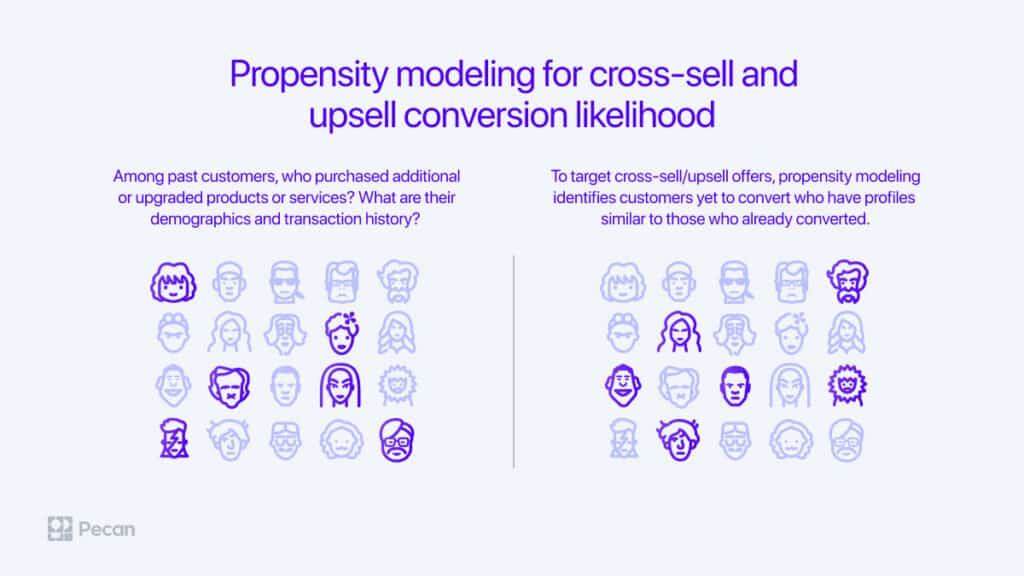
When Pecan builds models, the automated feature engineering and selection process figures out from your historical data which customer data points matter, and how much they matter, in determining a customer’s propensity to buy.
Predictions about future customer behavior are generated by looking for similar patterns in the profiles of customers who have yet to convert. Then, you can see exactly how similar they are to those who have already converted.
The way every customer characteristic contributed to each prediction is also explained for each customer. In other words, you can see exactly which factors contributed most to a specific customer’s score.
Getting proactive with predictions
With all this powerful knowledge, you can proactively plan your offers and outreach to customers. You’ll be confident that your priorities and resources are correctly aligned.
Moreover, ongoing monitoring and updating of your upsell and cross-sell predictions will ensure you’re always acting on the latest information. These dynamic, accurate predictions will positively impact your ROI across all teams where they are used.
Getting customers interested in more products and services will never have been easier. Indeed, with these predictions in hand, you’ll focus your efforts and dollars on the customers most likely to be interested.
This mutually beneficial arrangement builds your understanding of your customers and reinforces the strong relationship between them and your business.
Learn more about how to predict upsell and cross-sell opportunities on a guided tour of Pecan. Or, get your hands on our Predictive GenAI platform yourself with a free trial.