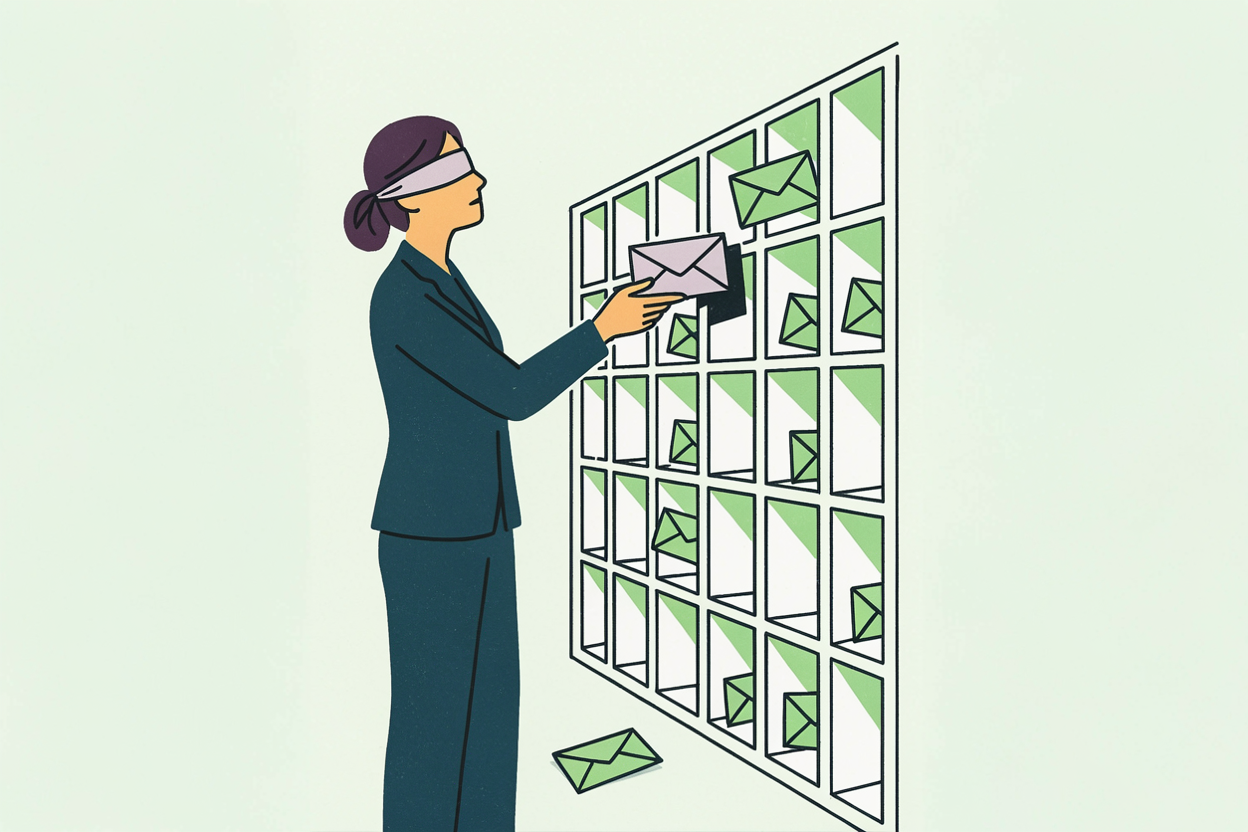
Open your marketing automation platform and look at the logic behind one of your customer journeys. If the customer opened the last email, send offer A. If they didn’t, send offer B. If they’re in the loyalty tier, add the bonus. That’s a rule. Someone wrote it during a platform migration two years ago, and it has been quietly running ever since.
Rules are good at what they do. They just can’t tell you which of your eleven available offers this particular customer is most likely to accept this week.
Here is the part almost nobody says out loud: in most next best action programs, the rules do the ranking and the model does the filtering. That order is backwards. A model should score every eligible action for every customer. Business rules should then strip out what you can’t or shouldn’t send. Get the sequence right and next-best-action starts producing lift. Get it wrong and you have a decision tree with better branding.

What is next best action marketing?
Next best action marketing is an approach where a system evaluates every available action for an individual customer and selects the one with the highest expected value at that moment. Rather than assigning people to pre-built journeys, it makes a fresh decision per customer, per moment, based on what the data says about that person right now.
A working next best action program has five parts:
- An action inventory. Every offer, message, and intervention you’re willing to send, each with a defined outcome you can measure.
- A scoring layer. A model that estimates how likely each customer is to respond to each action.
- A decision layer. The logic that ranks scored actions and applies business constraints.
- A delivery path. The channel or system that actually executes the chosen action.
- A measurement design. A holdout group that lets you prove the program did something.
What you get from it: fewer wasted contacts, sharper use of a fixed contact budget, offers that stay relevant as behavior shifts, and one decision framework that works across email, paid, and outbound instead of three different ones.
Rules-based vs model-driven: the difference that decides everything
Both approaches produce a recommended action. They differ in how that recommendation survives contact with reality.
| Rules-based | Model-driven | |
| How decisions get made | A person writes if/then logic | A score is calculated per customer, per action |
| Actions evaluated | Whatever sits in that branch | Every eligible action, at every refresh |
| A brand new customer | Drops into a default branch | Gets scored on whatever signals exist, with lower confidence |
| Adding a twelfth offer | Someone rewrites the tree | Add the action, train a score for it, it joins the ranking |
| Who maintains it | Marketing ops, by hand, forever | The team monitors performance and retrains on a schedule |

The takeaway is about scaling. Rules scale with human effort. Every new offer, segment, or channel means another branch, another QA cycle, another person who has to remember why that branch exists. Models scale with data. Adding an offer costs you a training run, not a redesign.
That doesn’t make rules useless. It makes them the wrong tool for choosing between options.
The next best action model: three scores it runs on
Most teams that move to next best action machine learning build one model, call it an engagement score, and wire it to everything. That single number can’t carry the load. A working next best action model runs on three distinct scores.
Propensity, per action. Not one general likelihood-to-engage score, but a separate probability for each offer. A customer might sit at 0.31 for the subscription upgrade and 0.04 for the accessory bundle. One score averaged across both tells you nothing actionable. This is standard propensity modeling, applied once per action rather than once per customer.
Expected value. High propensity on a low-margin offer is not the best action. Multiply each probability by what that action is worth if it lands, and the ranking changes immediately. Some teams use contribution margin, others use predicted lifetime value when the action is meant to change a long-term relationship rather than drive a single order. Either works. Using nothing does not.

Timing. The same offer sent three weeks apart can produce very different results. Two signals matter most here: churn risk, which tells you how much runway you have, and purchase window, which tells you when this person is actually in market. A retention offer to someone whose risk spikes next month is worth far more than the same offer sent after they’ve gone quiet.
How the decision actually gets made?
The mechanics are less mysterious than the category makes them sound.
Score every customer against every eligible action. Multiply each propensity by the value of that action. Rank the results. Then apply your business constraints: frequency caps, channel eligibility, margin floors, inventory availability, compliance and consent rules.
The model ranks. The rules filter. That’s the reverse of how most teams have it wired, and it’s the single change that turns a rules program into a next best action program.
Practical example. A customer scores 0.38 on a discount offer worth $12 in margin and 0.11 on a full-price bundle worth $70. Expected values come out at $4.56 and $7.70. The bundle wins, which is not the answer a rules-based setup would have reached. Then the filters run: this customer received a message yesterday and the frequency cap says one per week. The bundle gets held until Thursday. Nobody rewrote a branch to make that happen.
What you need in place before you start
Four things, and only one of them is a model.
Customer-level data with history. You need enough past behavior to learn from, which usually means transactions, engagement, and service interactions joined at the customer level. Pecan connects directly to Snowflake, BigQuery, Redshift, and Databricks and handles the joins, time windows, and feature preparation, so this is less of a starting hurdle than it used to be. Real-world data with gaps and inconsistencies is normal and workable.
Defined actions with a measurable outcome each. “Send nurture content” is not an action. “Send the free shipping offer, measured by orders within 14 days” is.
A delivery path into the channel. This is the bottleneck for most teams. A recommendation your ESP can’t receive is a spreadsheet, not a program.
A holdout group. Carve it out on day one. Once campaigns are running, you can’t reconstruct one.
A rollout that works: four phases
Phase 1: one decision, two or three actions. Pick a single decision point with real volume. Score two or three competing actions. Nothing else.
Phase 2: hold out from the start. Ten percent of the eligible population gets whatever they would have received under the old rules. This is your only honest read on whether the program works.
Phase 3: measure incremental lift, not response rate. Response rate tells you how many people who got the offer converted. Incremental lift tells you how many more converted than would have anyway. A high-propensity customer who was going to buy regardless inflates your response rate and adds nothing to revenue.
Phase 4: expand the action set. Once the loop is proven on one decision, add actions. Then add decision points. Growth here is cheap because the scoring infrastructure already exists.
Teams that try to launch with fourteen actions across six journeys tend to spend nine months in configuration and never get a clean read on anything.
Next best action marketing software: what the categories do
Three categories of next best action software show up in most evaluations, and they decide different things.
Orchestration platforms (Braze, Salesforce Marketing Cloud, Pega and similar) decide how an action gets delivered. They handle journeys, channels, timing rules, frequency caps, and execution at scale. Strong at delivery, and most of them accept an external score as an input.
CDPs decide who a customer is. They resolve identities across systems and make a unified profile available downstream. They are plumbing, and good plumbing matters, though a CDP by itself does not rank actions.
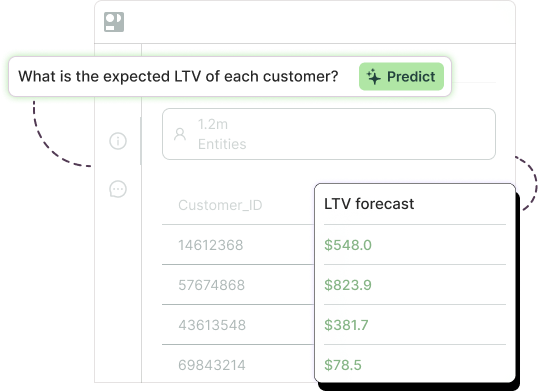
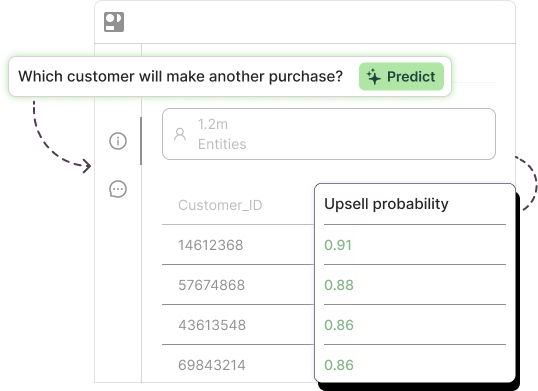
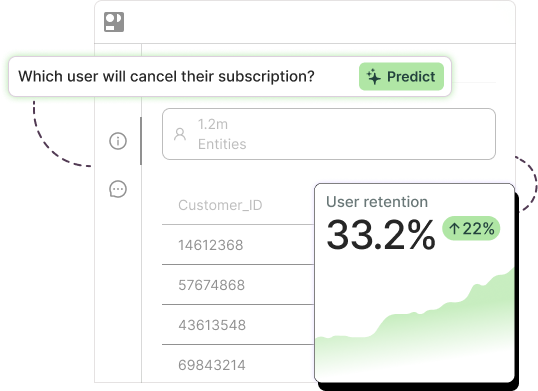
Prediction platforms decide which action is worth delivering. This is where Pecan sits. You describe the business question in plain language, the Predictive AI Agent builds and validates the model, and scores land in Salesforce, HubSpot, or your warehouse where the orchestration layer can act on them. No coding required.
Most teams end up with two of the three. The pairing that matters is prediction plus orchestration: one decides what to send, the other decides how it arrives. See it working on your use case.
Where next best action programs break
BCG’s May 2026 analysis of next-best action programs identified four structural gaps holding these programs back, and the one worth sitting with is measurement. Organizations that move from propensity to uplift modeling, BCG reports, typically discover that 20% to 40% of their active programs were delivering negligible incremental lift. Those programs looked fine on activity metrics the whole time.
Four failure patterns show up again and again:
- One general propensity score used for every action. The score is real, the application is wrong. Different offers need different models.
- No holdout, so nobody can prove lift. Every campaign looks successful when there’s no counterfactual.
- Scores refreshed monthly while campaigns run daily. By week three you’re acting on a stale picture of who your customers are.
- A recommended action nobody can execute. The model says send the loyalty upgrade, and the loyalty upgrade requires a manual CS ticket.

The fourth one is the most common and the least discussed. Prediction quality is rarely the binding constraint. Delivery usually is.
What is the next best action in marketing?
What is NBA next best action marketing?
What is the difference between next best action and next best offer?
Do you need a CDP to run next best action?