Meet Zola
Zola is a leading U.S. wedding planning and eCommerce platform that helps couples plan every stage of their wedding journey, from customizable wedding websites and invitations to registries, guest management, and vendor services.
Zola’s Data & Analytics team helps the organization make data-driven decisions. The company has worked with Pecan AI for three years.
The Challenge
Zola invests across multiple marketing channels to acquire new customers. But with couples typically taking about a year to get married, much of their value is realized long after the marketing campaigns that brought them in.
The company knew how much it spent to acquire customers, but determining how much those customers would ultimately be worth took much longer. This made it difficult to measure marketing performance against a key metric: lifetime value relative to customer acquisition cost (LTV/CAC).
Zola had rich data on what customers did in their first 7, 14, and 30 days. The question was whether that early behavior could reliably predict future value.
Zola faced several obstacles:
- Delayed visibility into customer value – Revenue could take months to materialize, making it difficult to assess acquisition quality early.
- Limited insight into expected returns – Knowing whether customers were likely to convert wasn’t enough. Marketing needed to predict their value in dollars to compare it with acquisition costs.
- Limitations of rules-based modeling – Zola’s existing approach achieved approximately 80% accuracy, leaving room for more precise predictions.
- Complexity of building machine learning internally – Developing and maintaining predictive models would require specialized talent and ongoing engineering resources.
Zola needed a more accurate and efficient way to predict customer value, without building and maintaining a machine learning operation from scratch.
The Solution
Zola partnered with Pecan AI to predict customer lifetime value using early customer behavior, giving marketing teams a more precise way to understand acquisition quality and measure performance.
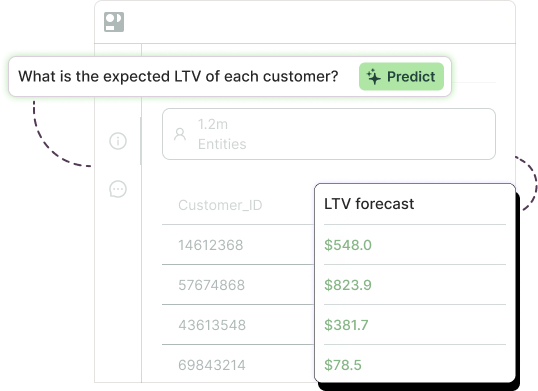
Unlike conversion predictions that indicate whether someone is likely to become a paying customer, predictive LTV estimates how much each customer is expected to be worth in dollars. That value can be compared directly with acquisition costs, giving marketing a clearer picture of expected returns.
Start simple, then expand – Zola began with a straightforward eCommerce use case in its paper business. With Pecan’s support, the team went from having no machine learning model to a production-ready model in less than three months.
After proving its first use case, Zola expanded to additional business lines. Today, the company uses four predictive models tailored to different parts of its business.
Automated predictions, delivered into existing workflows – Pecan delivers user-level predictions directly to Zola’s data warehouse on a configurable schedule. Zola then makes those predictions available through its existing business intelligence tools, where teams can analyze expected customer value across acquisition channels and other dimensions.
Automated prediction pipelines and delivery alerts reduce the operational work required from Zola’s data team.
Ongoing expertise and support – Pecan works closely with Zola to monitor model performance and identify issues as they arise.
In one instance, when Zola’s underlying data changed from the data used to train its models, Pecan flagged the issue and helped the team resolve it within 24-72 hours, preventing potential downstream problems.
How Zola Uses Pecan AI
Measure Marketing Performance Earlier – Predictive LTV helps Zola evaluate campaign performance before customers complete their wedding journey or generate their full revenue.
Optimize Marketing Budgets – By comparing predicted customer value with acquisition costs, marketing teams can make more informed decisions about where to increase or reduce spend.
Evaluate Acquisition Quality – When acquisition volumes increase, Zola can assess whether those new customers are expected to deliver strong lifetime value, rather than judging success by volume alone.
The Impact
95% LTV Prediction Accuracy – Zola moved beyond its rules-based approach to regression models delivering 95% prediction accuracy.
More Precise Marketing Decisions – Dollar-value predictions allow Zola to compare expected customer value directly with acquisition costs and make better-informed channel investment decisions.
Predictive Analytics Without a Dedicated ML Team – Automated pipelines, flexible prediction delivery, and ongoing support from Pecan allow Zola to operate predictive models at scale without hiring dedicated machine learning talent.
“We have four models with Pecan AI. We started with our simplest use case for one part of our business. We proved that to be successful, moved to another part of our business, and proved that could be highly accurate too. The Pecan team has been highly supportive in helping us achieve these successes across the whole organization.”

Key Takeaway
For Zola, Pecan AI delivers on three fronts: speed, quality, and cost.
By turning early customer behavior into predicted dollar value, Zola can measure marketing performance sooner, compare expected returns with acquisition costs, and make more informed investment decisions.
With accurate predictions, automated workflows, and ongoing support from Pecan’s team, Zola has expanded predictive analytics across its business without the cost and complexity of building machine learning internally.