You already run predictive analytics. You probably don’t call it that.
Every budget meeting where someone argues Q4 will outperform and the team should push more into paid social, that’s a forecast. Every lead a rep quietly skips because it “doesn’t feel ready,” prediction. Every reorder of next quarter’s content calendar based on what landed last spring, prediction again. Marketing has run on forecasts since long before anyone stapled the word “analytics” to the end of it.
The trouble is where those forecasts live. They live in one person’s head. They can’t be checked against what actually happened. And they walk out the door the day that person takes a new job.
Predictive analytics changes one thing about all of this. It takes the guess you were already making and gives it a number, a track record, and a reason. That’s the pitch. Not magic, not a magic eight ball for your pipeline. Just accountability for the bets you’re placing every week anyway.
What predictive analytics in marketing means
A quick definition, because the term gets stretched in a dozen directions.
Predictive analytics uses your historical data to estimate something that hasn’t happened yet. The inputs are things you already collect: customer behavior, campaign performance, purchase history, support interactions, web activity. The outputs point forward and stay specific. A score for how likely a lead is to convert. A forecast of how much a new customer will spend over two years. A ranked list of accounts most likely to cancel before they do.
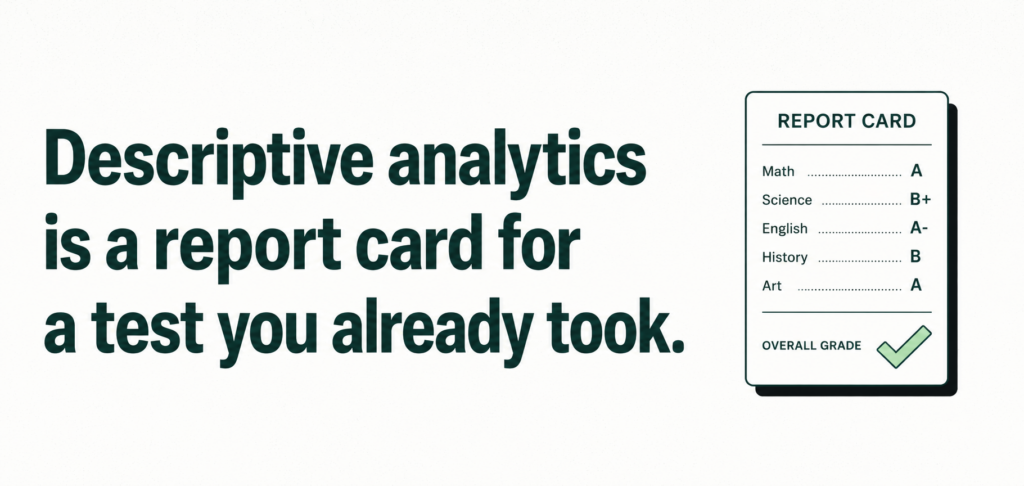
It helps to set it next to its cousins. Descriptive analytics is your dashboard. It tells you revenue dropped 8% last month, which is a report card for a test you already took. Predictive analytics tells you which customers are likely to drive next month’s drop, while you can still pick up the phone. Prescriptive analytics goes one step further and recommends the move. Most marketing teams live entirely in that first category and then wonder why they spend every Monday reacting.
The jump from descriptive to predictive is the one that changes how a team works. You stop narrating the past in standups. You start spending that hour on the customers who haven’t churned yet.
Here’s the part that surprises people. You almost certainly have the raw material already. The behavioral data sitting in your marketing automation platform, the deal history in your CRM, the transaction records in your billing system, the support tickets nobody thinks of as “marketing data.” That’s the fuel. Predictive analytics doesn’t ask you to go collect something new. It asks you to point a model at the exhaust your stack has been producing all along and never used for anything but reports.
Four use cases worth your time
There are plenty of ways to point prediction at marketing. Four of them earn their keep almost immediately.
Lead scoring
Most teams rank leads with a points system someone built two years ago. A job title is worth 10 points, a demo request 20, and nobody has checked since whether those numbers match reality.
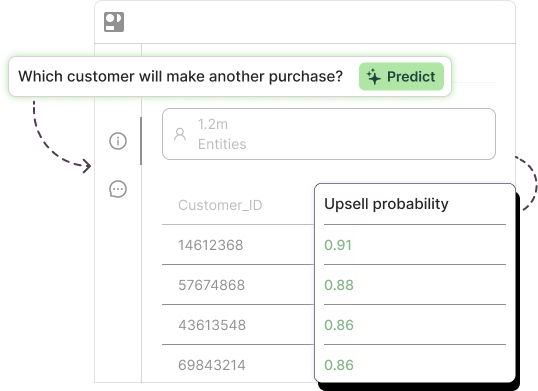
Predictive lead scoring trains on your actual conversion history instead. It looks at every deal that closed and every one that didn’t, finds the patterns that separated them, and scores new leads by how closely they resemble the winners. Inputs are behavioral (pages viewed, emails opened, minutes on the pricing page) and firmographic (company size, industry, role). The output is a probability, lead by lead, that sales can sort top to bottom. We’ve gone deeper on how AI lead scoring stacks up against the old points method if you want the mechanics.
The teams that get the most here are the ones buried in volume. If reps are working a list by hand with no real signal of who’s hot, a good score is the gap between a full calendar and a wasted week.
Customer lifetime value prediction
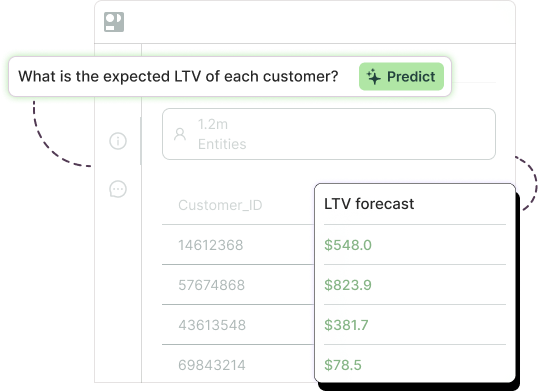
Not every customer is worth the same acquisition spend, and most teams learn that far too late. LTV prediction estimates what a given customer will be worth across their whole relationship with you, using early signals like first purchase size, acquisition channel, product mix, and how they behaved in their first thirty days.
Once you can forecast value at the moment of acquisition, your spending logic shifts under you. You bid up for the audiences that look like your high-LTV customers. You stop overpaying for the ones who buy once and disappear. Same ad budget. Aimed better. I’ve watched a DTC team cut wasted spend by reallocating toward lookalikes of their top LTV decile, and the math was almost boring once they could see it. The cleverest part was on the retention side: knowing a customer’s predicted value told them which first-time buyers were worth a white-glove onboarding and which ones a standard email flow would serve fine. Value prediction doesn’t just sharpen acquisition. It tells you how hard to fight to keep each customer you win.
Churn prevention
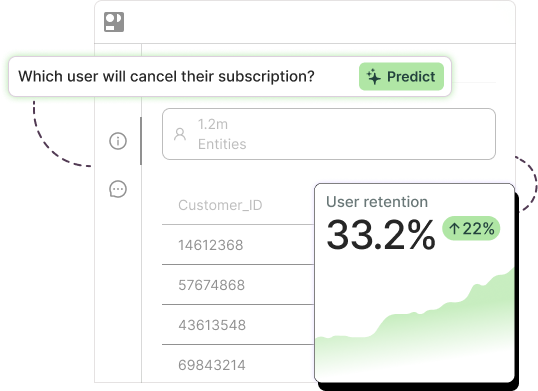
Retention runs on lag. By the time a customer formally cancels, they checked out weeks or months earlier. You’re filing the paperwork on a decision that already got made. Churn prediction scores every customer by their risk of leaving, reading patterns across usage, payment, support tickets, and engagement that no human would think to connect.
The score isn’t the prize. The head start is. A customer flagged high-risk in week three of a quiet stretch is a customer your team can still save. Our deeper guide on churn analysis and prediction covers how the modeling holds up under pressure. Across Pecan deployments, retention teams have seen churn fall by roughly 12% once they started acting on predictions instead of post-mortems.
Campaign ROI forecasting
Marketers commit budget across channels months ahead and find out whether it worked after the money’s spent. ROI forecasting predicts which campaigns and channels will return before you fund them, so the planning conversation runs on evidence instead of last year’s habits and whoever argues loudest.
This sits well next to metrics you may already track. If you’ve been working with media mix modeling or watching your marketing efficiency ratio, predictive forecasting gives those a forward-looking version. You estimate efficiency before committing the budget, not after the quarter closes and the spend is gone.
How to get started
Here’s the honest version, minus the consulting fog.
You need three things. Twelve or more months of historical data, because the model learns from your past to estimate your future, and a thin history gives it nothing to chew on. A clear prediction target, meaning one specific question with a yes-or-no or a numeric answer (“will this lead convert in 90 days,” not “how is marketing doing”). And a platform that connects to where your data already lives.
You don’t need the things people assume. No data science team. No custom code. No six-month build that’s outdated before it ships. That stack used to be the cost of entry, and it kept prediction locked inside companies big enough to staff a research bench. That stopped being true, which is most of why this category exists now.
Start narrow. Pick the one use case where a better guess would change a real decision next quarter. Lead scoring if your reps are drowning. Churn if retention is the thing keeping you up. Build that single model, check its calls against what actually happens over a few weeks, and expand once you trust it. Teams that try to predict everything at once tend to predict nothing well.
One note on tools, since you’ll be shopping. A lot of platforms market themselves to marketers and then quietly assume a level of technical fluency the average marketing ops lead doesn’t have and shouldn’t need. If you’re sizing up the field, our rundowns of AI marketing tools and companies already using AI for marketing are a fair place to calibrate before anyone gets on a sales call.
What the first 90 days actually feel like
A quick reality check, because expectations are where these projects live or die.
The first model rarely lands perfect, and it isn’t supposed to. You build it, you watch its predictions against what really happens for a few weeks, and you learn where it’s sharp and where it’s soft. A churn model might nail your enterprise accounts and stumble on your self-serve tier, which tells you something useful about both. That feedback loop is the work. Treat the first 90 days as calibration, not a launch.
The mistake I see most often is teams expecting the model to tell them something shocking. It usually doesn’t. It tells them something they half-suspected, with enough confidence to finally act on it. The value isn’t a surprise. It’s permission to move on a hunch you couldn’t defend before, now backed by your own numbers in front of a CFO who wanted proof.
The shift worth making
Marketing has always been a prediction business. The teams pulling ahead didn’t start predicting. They stopped keeping their predictions in a single person’s gut and started backing them with their own data.
That’s a change you can make this quarter, with the data already sitting in your CRM. One question, one model, one decision you’d make differently if you could see it coming.
Pecan’s Predictive AI Agent was built for that exact handoff. You ask a business question in plain language, it builds and validates the model on your data, and the prediction shows up in Salesforce, HubSpot, or wherever your team already works. No code. No new hire.
See how Pecan brings predictive analytics to marketing teams – book a demo now.

Omer is a Data Scientist at Pecan AI with an M.Sc. in Industrial Engineering, bringing a strong analytical foundation built across multiple industries. He combines structured problem-solving with cross-disciplinary collaboration to drive meaningful impact through data.