Enterprise generative AI spending hit $37 billion in 2025, more than tripling from the year before. Gartner projects total worldwide AI spending will top $2.5 trillion in 2026. Those are staggering numbers. And yet, according to PwC’s 2026 Global CEO Survey, only 12% of CEOs report that AI has delivered both cost savings and revenue gains so far.
So what gives? Are companies pouring money into hype, or is there real value hiding in the noise?
The short answer: both. The longer answer is more interesting. GenAI’s productivity gains at the individual task level are well-documented and often dramatic. The challenge is scaling those wins across an entire organization. And that’s exactly where most businesses are stuck right now.
This guide breaks down the 12 generative AI use cases that are actually producing measurable results in 2026, backed by data from McKinsey, Deloitte, Stanford, and real-world deployments. We’ll also look at how pairing GenAI with predictive AI closes the gap between impressive demos and genuine business impact.
Let’s get into it.
The GenAI landscape, early 2026: A quick recap
If you wrote your last GenAI strategy doc in 2023 or early 2024, you might as well have written it in a different century. The pace of change has been relentless, and the landscape looks completely different now. A few highlights worth knowing before we dive into use cases:
GPT-5 unified reasoning and speed. Released in August 2025, OpenAI’s GPT-5 merged the fast conversational models and the slower “thinking” models into a single system. It slashed factual errors by roughly 45% compared to GPT-4o, introduced a 256K-token context window, and actually dropped prices. Subsequent updates (GPT-5.1, 5.2, 5.3-Codex) kept pushing the envelope, with the Codex variant reportedly being used to debug its own training code. Meta.
“Nano Banana” became GenAI’s viral moment. Google’s Gemini 2.5 Flash Image model was tested anonymously on a public leaderboard. Users loved it so much they gave the mystery model a playful nickname. When Google revealed it was theirs, the moment went massively viral, attracting 13 million first-time users to the Gemini app in four days and generating over 5 billion images by mid-October 2025. Google has since released Nano Banana 2 as its default image generation model.
Sora 2 brought AI video to the mainstream. OpenAI’s second-generation video model, launched September 2025, featured synchronized dialogue and sound effects, with over a million videos generated on launch day alone. A $1 billion deal with Disney unlocked 200+ copyrighted characters. We’re still in the early innings, but it’s clear that AI-generated video is no longer a novelty.
DeepSeek R1 triggered a pricing earthquake. The Chinese lab’s open-source reasoning model matched leading proprietary models at a reported training cost of roughly $5.6 million. Its release in January 2025 wiped $593 billion from Nvidia’s market value in a single day and kicked off an industry-wide pricing war that made AI models dramatically cheaper for everyone.
AI agents moved from concept to category. Gartner predicts 40% of enterprise applications will integrate task-specific AI agents by the end of 2026, up from less than 5% in 2025. The shift from “copilot” (AI assisting a human) to “agent” (AI executing multi-step workflows autonomously) is the defining enterprise AI trend right now. Platforms like Pecan’s Predictive AI Agent exemplify this shift, turning plain-English business questions into validated predictive models without requiring data science expertise.
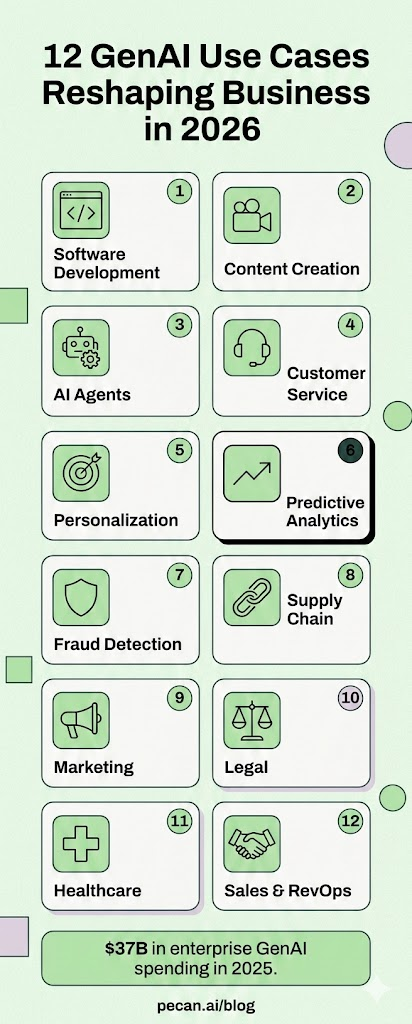
12 GenAI use cases that are actually delivering in 2026
1. AI-powered software development
This is, by a wide margin, the single largest enterprise GenAI spending category. Coding-related AI now accounts for roughly $4 billion in departmental spend, representing about 55% of all departmental AI budgets. GitHub Copilot alone has 20 million users across 77,000 enterprises (including 90% of the Fortune 100), and developers report coding up to 51% faster on certain tasks.
Cursor, a newer AI-first code editor, reached $200 million in revenue before hiring a single enterprise sales rep. Google’s CEO Sundar Pichai disclosed that 25% of Google’s code is now AI-assisted. Industry-wide, an estimated 41% of all code is written with some form of AI help.
The caveats are real, though. Code duplication has increased 4x, and security flaws show up in up to 45% of AI-generated code. The lesson: AI coding tools accelerate output dramatically, but they require experienced developers to review and validate the work. Speed without quality control is just faster bugs.
ROI snapshot: Up to 55% reduction in development time (Accenture). An estimated 40% of enterprise software may be built using natural-language “vibe coding” by 2026.
2. Multimodal content creation (image, video, audio)
Remember when creating a professional marketing video meant six-figure budgets and months of production? That world is eroding fast. Between Sora 2, Google’s Veo 3 (the first AI video model with native synchronized audio, now with 70+ million videos generated), and image models like Nano Banana 2 and DALL-E 3, businesses can generate visual assets at a pace and cost that would have seemed absurd two years ago.
Coca-Cola’s $1.1 billion, five-year partnership with Microsoft is the marquee example here. Their AI-generated holiday campaigns produced 70,000+ video clips, compressing what used to be a year of production into about a month. The results: 20% higher social media engagement, 15% higher email conversion rates, and a 25% boost in online sales during targeted campaign windows.
This isn’t just for Fortune 500 budgets, either. Small and mid-size marketing teams are using tools like Veo for short-form video ads, Midjourney for campaign visuals, and ElevenLabs for voiceovers, all at a fraction of traditional production costs. The democratization of content creation is real, and it’s happening now.
ROI snapshot: Agencies report 4-5x productivity improvements for AI-assisted content. Production timelines compressed from months to days.
3. AI agents for business process automation
If 2024 was the year everyone talked about AI agents, 2026 is the year they actually started showing up at work. The global AI agent market hit $7.6 billion in 2025 and is projected to grow at nearly 50% annually. Major frameworks are proliferating: OpenAI’s Agents SDK, Google’s Agent Development Kit, LangChain, CrewAI, Microsoft AutoGen, and specialized platforms like Salesforce Agentforce.
What makes agents different from chatbots? Agents don’t just answer questions. They execute multi-step workflows, make decisions, call APIs, loop in other tools, and report back with results. Think of the difference between asking a coworker “what’s the weather?” and asking them to “plan the offsite, book the venue, send the invites, and follow up with anyone who hasn’t RSVP’d.”
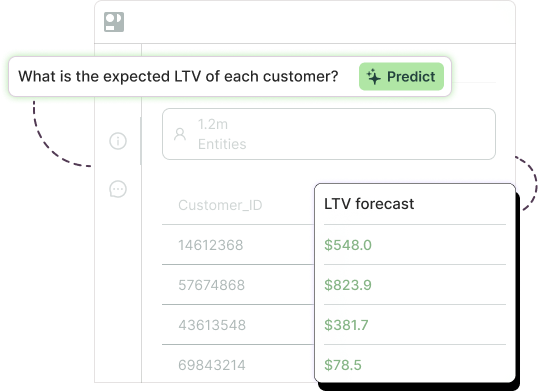
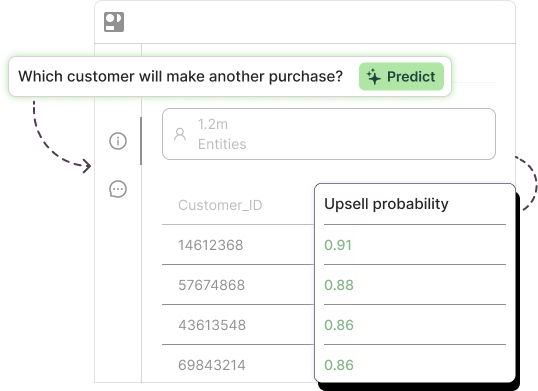
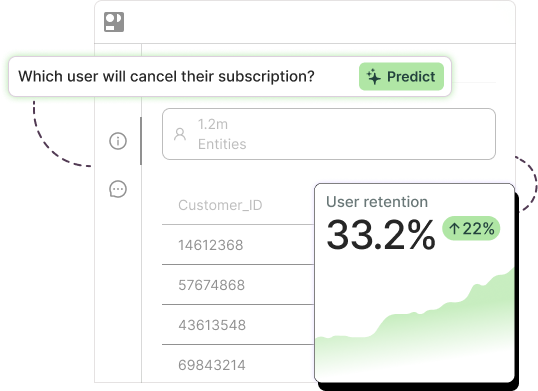
In predictive analytics, this shift is especially powerful. Pecan’s Predictive AI Agent lets business teams ask a question in plain English (“Which customers are likely to churn next quarter?”), and the agent handles everything: data preparation, feature engineering, model building, validation, and deployment. What used to take a data science team weeks now happens in days, sometimes hours.
ROI snapshot: Gartner predicts 40% of enterprise apps will integrate AI agents by end of 2026. Pecan customers see predictive models reach production up to 32x faster than traditional approaches.
4. Customer service & conversational AI
This might be the most instructive use case in the entire GenAI landscape, because it comes with a built-in cautionary tale.
Klarna, the fintech company, deployed an OpenAI-powered assistant that handled 2.3 million conversations in its first month, doing the equivalent work of 700 full-time agents. Resolution time dropped from 11 minutes to under 2 minutes. The company projected $40 million in annual savings. The headlines were electric.
Then reality caught up. Customer satisfaction started slipping. Complex issues got botched. By 2025, Klarna was quietly rehiring human agents and repositioning toward a hybrid model. The takeaway isn’t that AI customer service doesn’t work. It’s that replacing humans entirely is a trap. The best results come from AI handling routine queries at scale while escalating complex or emotional interactions to people.
On the positive side, Alibaba’s AI chatbots handle over 2 million customer sessions daily during peak seasons, saving roughly $150 million annually. The difference? They designed for hybrid from the start.
The smartest move here is pairing conversational AI with churn prediction. When you know which customers are at risk of leaving, you can route them to human agents proactively, before they even complain. That’s the kind of forward-looking approach that turns customer service from a cost center into a retention engine.
ROI snapshot: AI chatbots can handle 60-80% of routine queries. Average resolution time cuts of 50-80%. But watch customer satisfaction closely if you scale too aggressively.
5. Personalized customer experiences at scale
Personalization has been a marketing buzzword for over a decade, but GenAI is finally making it operationally feasible at real scale. The numbers tell the story: AI-generated personalized product descriptions drive 34% higher conversions, personalized recommendations increase average order value by 40%, and retailers implementing AI personalization see 10-15% revenue increases on average (with top performers hitting 25%, per McKinsey).
Amazon’s Rufus AI shopping assistant, now used by 250 million consumers, achieves a 60% conversion rate. L’Oreal saved 120,000 hours of manual work using GenAI for automated product tagging and description generation.
The key insight here is that personalization works best when it’s predictive, not just reactive. Showing someone products “similar to what you just viewed” is fine. Showing them products they’re likely to want next month, based on predicted lifetime value and purchase patterns? That’s where the real uplift lives. (If you’re curious about that distinction, we wrote a whole piece on why predicting customer lifetime value matters.)
ROI snapshot: 10-25% revenue increases for retailers. 87% of retailers report positive AI revenue impact. 94% see reduced operating costs.
6. Predictive analytics & forecasting
Here’s an uncomfortable truth: most companies are still making critical business decisions based on what already happened. Retention efforts begin after customers have already decided to leave. Demand spikes after inventory runs out. Revenue gaps appear after the quarter has already closed.
This isn’t because teams are bad at their jobs. It’s because most tools only explain the past. Dashboards are rearview mirrors. GenAI can summarize and describe what happened beautifully, but understanding the difference between generative and predictive AI matters enormously here. Generating a summary of last quarter’s churn isn’t the same as predicting who’s going to churn next quarter.
That’s why forward-looking businesses are combining GenAI’s accessibility with predictive AI’s precision. Pecan’s Predictive AI Agent automates the full predictive workflow (data prep, feature engineering, model building, validation, deployment) so that marketing ops, RevOps, customer success, and finance teams can get reliable forecasts without writing a line of code. Across customer deployments, Pecan has delivered roughly 12% average churn reduction, 10% average increase in customer lifetime value, 15% improvement in ROAS for marketing teams, and predictive models reaching production in about a week.
If you want to go deeper on measuring the financial impact, our guide on how to measure (and increase) the ROI of AI initiatives is a good starting point.
ROI snapshot: Up to 32x faster time-to-production vs. traditional data science. ~12% average churn reduction. ~60% reduction in planners’ time spent on forecasting.
7. Fraud detection & intelligent risk management
GenAI in financial services is a fascinating double-edged story. On one hand, it’s supercharging fraud detection: Mastercard deployed GenAI that doubled its detection rate of compromised cards, reduced false positives by up to 200%, and tripled the speed of merchant fraud detection. Global AI spending in financial services now exceeds $20 billion annually, and McKinsey estimates AI’s value potential in banking at $200-340 billion.
On the other hand, fraudsters are using GenAI too. A staggering 92% of financial institutions report that bad actors are now using generative AI for deepfakes, synthetic identities, and AI-generated phishing. Deepfake incidents in fintech have increased 700% since 2023. It’s an arms race, and the institutions investing in AI-powered detection are the ones keeping pace.
The intersection with predictive analytics is natural. GenAI can synthesize and summarize suspicious activity patterns. Predictive models can score transactions in real time and flag anomalies before they result in losses.
ROI snapshot: Mastercard: 2x detection rate, 200% fewer false positives, 300% faster merchant fraud detection. McKinsey estimates $200-340B annual AI value in banking.
8. Supply chain & demand planning
If the pandemic taught supply chain leaders anything, it’s that historical averages are fragile. Demand forecasting based on “what happened last year” breaks down when the world changes fast, and the world keeps changing fast.
GenAI is entering this space in two ways. First, it’s making demand signals more accessible by synthesizing unstructured data (news, social trends, weather forecasts, economic indicators) that traditional models couldn’t easily ingest. Second, AI agents are automating the forecasting workflow itself, from data preparation through model selection and validation.
Pecan’s customers in this space have seen roughly 15% average reduction in overstock, approximately 8% reduction in inventory costs, and a 60% reduction in the time planners spend building, reviewing, and adjusting forecasts. Those aren’t flashy consumer-facing numbers, but for a supply chain team managing millions in inventory, a 15% overstock reduction translates directly to the bottom line.
ROI snapshot: ~15% reduction in overstock. ~8% reduction in inventory costs. 60% less time on manual forecasting.
9. Marketing & advertising at scale
Content creation is used by 89% of enterprises, making it the single most common GenAI application. And the use case has matured well beyond “write me a blog post.” Marketing teams are now using GenAI for campaign ideation, ad copy variations at scale, dynamic email personalization, social content calendars, and, increasingly, full creative production with AI-generated visuals and video.
The Coca-Cola example we mentioned earlier is the high end of this spectrum. But mid-market teams are seeing outsized gains too. Dentsu Digital built an AI service brand adopted by 100+ companies, cutting the typical launch timeline from two years to six months.
Where marketing GenAI really shines is when it’s paired with predictive intelligence. Generating 50 versions of an ad is easy. Knowing which audience segment will respond to which version, and predicting the ROAS before you spend the budget? That requires predictive lead scoring and customer propensity modeling.
ROI snapshot: 4-5x productivity gains for AI-assisted creative. 89% of enterprises use GenAI for content. Coca-Cola saw 25% boost in online sales during AI-powered campaigns.
10. Legal document analysis & compliance
Legal AI might be the fastest-growing vertical AI category, and honestly? It makes perfect sense. Law is fundamentally a language-heavy, document-heavy profession. It’s almost tailor-made for large language models.
The market has grown to roughly $650 million. Harvey AI, the most prominent legal AI startup, raised $150 million at an $8+ billion valuation and generates over $100 million in annual recurring revenue. KPMG found that AI contract interpretation has reached 98% accuracy, compared to 92% for human reviewers. Lawyers report saving up to 32.5 working days per year with GenAI assistance. And Garfield.Law became the first AI-driven law firm authorized by the UK’s Solicitors Regulation Authority in May 2025.
For businesses, the practical applications include contract review and redlining, regulatory compliance monitoring, due diligence automation, and patent/IP analysis. Citigroup, for example, uses GenAI to analyze over a thousand pages of capital rules for compliance purposes.
ROI snapshot: 98% AI accuracy on contract interpretation (vs. 92% human). Lawyers save up to 32.5 working days per year. Legal AI market: $650M and growing fast.
11. Healthcare & drug discovery
The GenAI healthcare market sits at $1.55 billion in 2025 and is projected to reach $45.82 billion by 2034. That growth trajectory reflects how deeply GenAI is embedding itself across the healthcare value chain, from clinical documentation to drug discovery.
Pfizer equipped 1,500 scientists with generative AI tools, expecting to save 16,000 scientist hours annually and cut infrastructure costs by 55%. Sanofi boosted target identification in immunology and oncology by 20-30% and deployed more than 750 internal GPTs. Generate Biomedicines moved a drug candidate from computer to clinic in just 17 months, a timeline that would traditionally take years. Recursion merged with Exscientia to create an AI platform that predicted targets for 36 billion compounds, research that would have taken 100,000 years using conventional methods.
On the clinical side, ambient documentation tools (Abridge, Augmedix) are now used by 200+ health systems, letting physicians focus on patients instead of typing notes.
ROI snapshot: Pfizer: 16,000 scientist hours saved/year, 55% infrastructure cost reduction. Drug-to-clinic timelines compressed from years to ~17 months. Market projected at $45.82B by 2034.
12. Sales lead scoring & revenue operations
Sales teams are drowning in leads but starving for signal. That’s been the refrain across Reddit forums, industry surveys, and RevOps communities for years. And while GenAI can help summarize lead data and draft outreach emails, the core problem isn’t content generation. It’s prioritization. Which leads are actually going to convert? Which accounts deserve the most attention this quarter?
This is fundamentally a predictive lead scoring problem, not a generative one. GenAI drafts the emails. Predictive AI tells you who to send them to. The combination is powerful: use predictive models to rank and segment leads by conversion likelihood, then use GenAI to personalize outreach at scale. Morgan Stanley gave 16,000 financial advisors AI-powered instant access to 100,000+ research reports, blending generative summarization with predictive intelligence about client needs.
The best-performing revenue teams in 2026 aren’t choosing between generative and predictive AI. They’re using both together.
ROI snapshot: Predictive lead scoring can increase conversion rates by 260%+ (Pecan case study). Morgan Stanley: 16,000 advisors with AI-powered research access.
The GenAI ROI reality check: what the data actually says
We promised real ROI data, so let’s be honest about the full picture. The numbers tell a nuanced story that every business leader should understand before their next budget cycle.
| Metric | Data Point |
| Enterprise GenAI spending (2025) | $37 billion (3.2x YoY increase) |
| CEOs reporting both cost savings + revenue gains | Only 12% (PwC 2026) |
| CEOs reporting neither benefit | 56% (PwC 2026) |
| Organizations using AI in at least one function | 78% (McKinsey 2025) |
| Organizations attributing any EBIT impact to AI | 39% (McKinsey 2025) |
| Daily GenAI users reporting productivity gains | 92% (PwC) |
| Avg. ROI payback period (leading use cases) | 4.5 months in 2026 (down from 18 months in 2024) |
| Customer service productivity gain (Fortune 500 study) | 14% more issues resolved/hour (Brynjolfsson et al., QJE 2025) |
| Software development time reduction | Up to 55% (Accenture) |
| Projected GDP increase from AI by 2035 | 1.5% (Penn Wharton) |
The pattern here is clear. Task-level productivity gains are consistent and sometimes dramatic: 14% more customer service issues resolved per hour, up to 55% faster coding, 92% of daily users reporting real productivity benefits. These aren’t contested numbers.
The challenge is at the enterprise level. Scaling individual productivity gains into organization-wide financial impact requires more than deploying tools. It requires workflow redesign, training mandates, strategic transformation, and critically, connecting GenAI outputs to downstream decisions. Companies that apply AI broadly to products, services, and customer experiences achieve nearly 4 percentage points higher profit margins (PwC 2026).
This is exactly why the combination of generative and predictive AI matters. GenAI creates, summarizes, and communicates. Predictive AI forecasts, scores, and prioritizes. Together, they close the loop between generating insight and acting on it. (We’re biased, of course, but the data backs it up.)
What GenAI can’t do alone (and why predictive AI fills the gap)
Generative AI is extraordinarily good at creating things: text, images, video, code, summaries, conversations. That’s why it’s captured the world’s imagination. But there’s a category of business questions where generation isn’t what you need. You need prediction.
“Which customers are about to leave?” isn’t a content generation problem. “What will demand look like next month?” isn’t a summarization problem. “Which leads will actually convert?” isn’t a copywriting problem. These are prediction problems, and they require a fundamentally different kind of AI, one that’s trained on your company’s unique data, validated for accuracy, and integrated into the systems where your team makes decisions.
Pecan exists to make those predictions accessible to every team that needs them. The Predictive AI Agent turns business questions into reliable, validated forecasts, delivered right into Salesforce, HubSpot, your data warehouse, or wherever your team works. No coding. No data science bottleneck. No waiting weeks for answers.
The most valuable thing your data can do for your business is tell you what’s coming next. GenAI helps you communicate. Predictive AI helps you anticipate. The companies winning in 2026 are doing both.
Ready to move from reacting to predicting?
GenAI helps you understand what happened and create content about it. Predictive AI helps you see what’s coming next and act before it’s too late. The businesses pulling ahead in 2026 aren’t choosing one or the other. They’re combining both.
Pecan’s Predictive AI Agent lets your team ask a business question in plain English and get a validated, production-ready prediction, no data science team required. Whether it’s churn, lead scoring, demand forecasting, or customer lifetime value, your data already contains the signals. Pecan puts them in the hands of the people who can act on them.
Get a demo and see your own data in action.

Yakira is a Product Marketing Manager at Pecan AI, focused on how teams adopt predictive AI in real business workflows. She bridges product, data, and go-to-market, framing how predictions are used to create business value.