In a nutshell:
- Predictive modeling uses AI and machine learning to turn your historical business data into forward-looking answers you can actually act on.
- In 2026, AI agents and conversational interfaces have transformed the process. You no longer need to code, wrangle data, or wait months for a data science team.
- The predictive analytics market is projected to reach over $91 billion by 2032, growing at roughly 22% annually, and businesses that adopt predictive tools early are seeing measurable advantages in retention, revenue, and operational efficiency.
- Common use cases include churn prediction, customer lifetime value modeling, lead scoring, and demand forecasting, all of which are now accessible to non-technical business teams.
- Choosing a platform that automates the hard parts (data prep, model validation, deployment) while keeping you in control of the business decisions is the fastest path to real ROI.
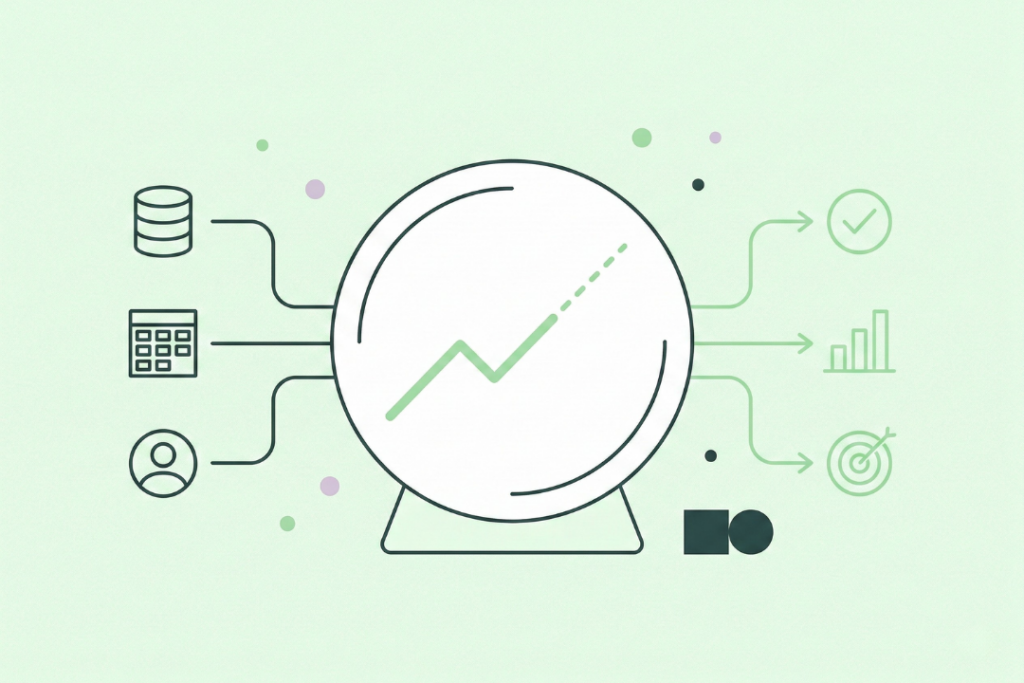
Every business generates data. Transactions, clicks, support tickets, shipments, logins, cancellations. It piles up relentlessly. And for a long time, the best most companies could do with all that information was look backward: What happened last quarter? Which campaign performed best? How many customers did we lose?
Those are useful questions. But they’re also a little like driving by staring into the rearview mirror. You can see where you’ve been, and that’s nice, but it doesn’t tell you much about the curve up ahead.
Predictive modeling flips that equation. Instead of explaining what already happened, it uses your data to estimate what’s likely to happen next, giving your team enough time to do something about it.
And in 2026, the way companies build and deploy predictive models has changed dramatically. What used to require months of work from specialized data science teams can now happen in days, sometimes less, thanks to AI agents and automated machine learning platforms that handle the technical complexity behind the scenes.
This guide walks through everything you need to know: what predictive modeling actually is, how it works today, where it delivers the biggest business impact, and how to get started without needing a PhD or a six-figure consulting contract.
What Is Predictive Modeling?
At its core, predictive modeling is a technique that combines statistical algorithms, machine learning, and historical data to forecast future outcomes. You feed it information about what has happened in your business, it identifies patterns, and then it applies those patterns to make educated estimates about what’s coming next.
Think of it this way. If you’ve been tracking customer behavior for the past two years, a predictive model can analyze the signals that preceded previous cancellations and flag which current customers are showing similar patterns, before they actually leave.
That’s a simplified version, but the principle holds across use cases. Whether you’re trying to forecast revenue, prioritize sales leads, anticipate demand spikes, or figure out which marketing campaigns will drive the highest return, predictive modeling is the engine that turns raw data into forward-looking intelligence.
What’s changed in 2026 isn’t the core idea. It’s the accessibility. According to Gartner, 40% of enterprise applications now feature task-specific AI agents, up from less than 5% just a year earlier. These agents can interpret your data, build models, validate results, and deploy outputs, all without requiring you to write a single line of code. McKinsey’s 2025 State of AI survey found that 62% of organizations are already experimenting with AI agents, and nearly a quarter are scaling them across business functions.
The gap between “we have data” and “we have answers” has never been narrower.
How Does Predictive Modeling Work?
The process has gotten significantly more streamlined, but the fundamentals remain the same. Here’s what happens under the hood, whether a data scientist is doing it manually or an AI agent is handling it automatically.
1. Define the Business Question
Every good predictive model starts with a clear question. Not “let’s see what the data says” (that rarely ends well), but something specific and actionable. Which customers are most likely to churn in the next 90 days? What will demand look like for our top product line next month? Which leads in our pipeline have the highest probability of converting?
The sharper the question, the more useful the answer. This is actually one of the areas where conversational AI interfaces have made a real difference. Instead of translating a business question into technical specifications for a data team, you can now just ask the question in plain English, and the system guides you toward the right predictive framing.
2. Gather and Connect Your Data
Predictive models run on historical data. Customer records, transaction logs, behavioral signals, engagement metrics, CRM data, marketing touchpoints. The more relevant data you can bring together, the stronger the model’s ability to spot meaningful patterns.
This step used to be one of the biggest bottlenecks. Preparing data for machine learning has historically consumed 60-80% of the total project timeline. In 2026, automated data preparation tools handle the heavy lifting: joining tables, managing time windows, checking data quality, and flagging issues before they compromise the model. If you’ve dealt with the “swivel chair” problem of bouncing between platforms trying to stitch data together, you know how valuable that automation is. (And if your data is a bit messy? That’s more normal than you’d think.)
3. Build and Train the Model
This is where the machine learning happens. The system tests different algorithms against your data, looking for the approach that best captures the relationship between your input variables and the outcome you’re trying to predict.
Common model types include:
Classification models sort outcomes into categories. Will this customer churn or stay? Is this lead hot or cold? Is this transaction legitimate or fraudulent?
Regression models predict continuous values. What will this customer’s lifetime value be? How much revenue will we generate next quarter?
Time series and forecasting models predict how a metric will change over time. What will demand look like in Q3? How will inventory needs shift heading into the holiday season?
Clustering models group similar data points together. Which customer segments behave similarly? Where are the natural groupings in our user base?
The algorithms that power these models, including gradient-boosted trees, random forests, logistic and linear regression, neural networks, and ensemble methods, are well-established. What’s new in 2026 is how they’re selected and optimized. Modern AutoML platforms, now increasingly augmented by large language models, can test dozens of algorithm and hyperparameter combinations in minutes, a process that would take a human practitioner days or weeks. KDnuggets recently identified the convergence of AutoML with generative AI as one of the defining trends of 2026, with LLMs automating everything from feature engineering to synthetic data generation.
4. Validate for Reliability
A model that looks good on paper but falls apart in the real world is worse than no model at all. It gives you confidence in answers that are wrong.
Validation is the safety net. It ensures the model actually generalizes to new data rather than just memorizing patterns in the training set. Key validation steps include:
Holdout testing: Setting aside a portion of data the model has never seen and checking how well it performs on that fresh data.
Cross-validation: Rotating through multiple train/test splits to make sure results are consistent, not just lucky.
Guardrails against common pitfalls: Checking for data leakage (where future information accidentally sneaks into the training data), overfitting (where the model is too tailored to historical noise), and class imbalance (where one outcome is dramatically more common than another).
This matters more than ever. Forrester’s 2026 outlook emphasizes that enterprises are moving past the AI hype cycle and demanding measurable results. As their chief research officer, Sharyn Leaver, put it, the pressure to deliver real, measurable outcomes from AI initiatives is intensifying. Validation is how you make sure your predictive models actually earn their keep.
5. Deploy and Act on Results
A prediction that lives in a spreadsheet nobody opens isn’t really a prediction. It’s a fun math exercise.
The final step is getting predictions into the systems where your team actually works. That means pushing churn scores into your CRM so customer success can act on them. Routing lead scores into your sales platform so reps know who to call first. Embedding demand forecasts into your supply chain tools so planners can adjust inventory before shortages or overstock happen.
Integration is the piece that turns a model from interesting into valuable. And according to the market research, it’s also one of the strongest buying triggers for business teams. They want predictions that show up where decisions get made, not in a separate dashboard they have to remember to check.
Where Predictive Modeling Delivers the Biggest Impact
Predictive modeling applies across virtually every business function, but a few use cases consistently deliver outsized returns. Here’s where teams are seeing the most tangible results in 2026.
Churn Prediction and Customer Retention
Losing customers is expensive. Acquiring new ones costs five to seven times more than keeping the ones you have. And by the time a customer has formally canceled, the window for intervention has usually closed.
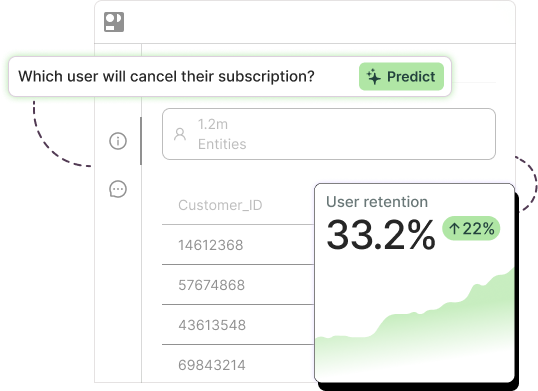
Predictive churn models identify at-risk customers while there’s still time to act, analyzing behavioral signals across hundreds or even thousands of data points to surface the people who are quietly disengaging before they leave. Across retention use cases, companies using predictive analytics see an average churn reduction of around 12%, and the best implementations go much further.
One example: Hydrant, a DTC wellness brand, used churn prediction paired with targeted retention campaigns and saw a 260% increase in conversion rates and a 310% increase in revenue per customer. Those aren’t incremental numbers. That’s a fundamentally different business outcome.
Customer Lifetime Value (CLV) Modeling
Not all customers are created equal. Some will buy once and disappear. Others will stick around for years, spending consistently and referring their friends. The problem is that those two customers can look nearly identical on Day 1.
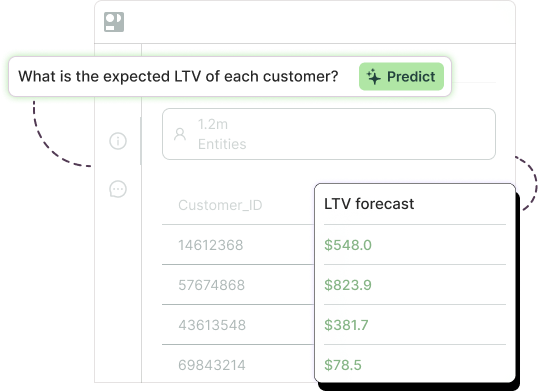
Predictive CLV models estimate the total future value of each customer based on their behavior patterns, purchase history, engagement level, and dozens of other signals. This lets marketing and CRM teams allocate their budgets where they’ll generate the highest return, investing more heavily in acquiring and retaining high-value customers while spending less on segments that are unlikely to pan out.
Companies using predictive CLV modeling report an average 10% increase in customer lifetime value and share of wallet, according to data from organizations already running these models in production.
Predictive Lead Scoring
If you’ve ever watched a sales team work through a list of leads from top to bottom, calling them in the order they came in, you’ve witnessed the pre-predictive era of sales. It’s not great.
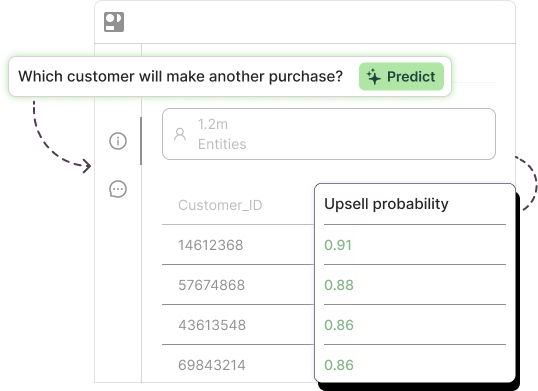
Predictive lead scoring replaces gut instinct and arbitrary rules with a machine-learned score that reflects each lead’s actual likelihood to convert. The model looks at firmographic data, behavioral signals, engagement patterns, and historical conversion data to rank leads by probability, so your team can focus their limited time on the opportunities most likely to close.
The results can be dramatic. B2B companies using predictive lead scoring have reported doubling their SDR lead-to-appointment conversion rate and achieving a 5x increase in appointment-to-opportunity rate. RevOps teams are increasingly becoming the orchestration hub for these AI-driven models, with Gartner projecting that 75% of RevOps tasks will be executed by AI agents by 2028.
Demand Forecasting
For any business that sells physical products or manages inventory, accurate demand forecasting is the difference between healthy margins and costly waste. Overstock ties up capital and leads to markdowns. Understock means lost sales and frustrated customers.
Predictive demand forecasting models incorporate historical sales data, seasonal patterns, market trends, promotional calendars, and external signals to generate forward-looking demand estimates at the SKU, category, or store level. McKinsey research indicates that AI-driven forecasting reduces error rates by 30-50% compared to traditional methods. And for planning teams, the productivity gains are just as meaningful: organizations using automated forecasting report an average 60% reduction in the time planners spend building, reviewing, and adjusting their forecasts.
Marketing Mix Modeling and ROAS Optimization
Marketing teams are under constant pressure to prove ROI, and in a world where privacy regulations and cookie deprecation have made attribution harder than ever, predictive modeling offers a data-driven path forward.
Marketing mix models analyze the relationship between your spending across channels and business outcomes, helping you understand not just what happened but what would happen if you shifted budget from one channel to another. Predictive analytics teams report an average 15% improvement in ROAS, and broader McKinsey research finds that organizations implementing AI across marketing functions report 15-25% revenue increases within 18 months.
The 2026 Predictive Modeling Landscape: What’s Changed
If you looked at predictive analytics even two years ago, the landscape was… different. The technology worked, but the barrier to entry was high. You needed data scientists, specialized infrastructure, and patience. Lots of patience.
Three major shifts have reshaped the field.
AI Agents Are Doing the Heavy Lifting
The most significant change is the rise of AI agents purpose-built for predictive workflows. Instead of a human data scientist manually cycling through data preparation, feature engineering, model selection, and validation, agentic systems now handle this entire pipeline autonomously.
These aren’t the generic chatbots of 2023. They’re specialized agents trained to understand business data structures, ask clarifying questions, build statistically valid models, and explain results in plain language. Gartner projects that agentic AI spending will hit $201.9 billion in 2026, growing 141% year-over-year, and will surpass chatbot spending entirely by 2027.
For business teams, this means you can genuinely ask a question like “Which of our customers are most likely to churn next quarter?” and get a validated, production-ready answer without ever touching a Jupyter notebook.
AutoML Has Grown Up
Automated machine learning was already useful a few years ago, but it’s matured considerably. The AutoML market reached $2.35 billion in 2025 (up 43.6% from the prior year) and is on pace to hit nearly $11 billion by 2029.
The biggest evolution is the integration of large language models into the AutoML pipeline. LLMs now assist with data preparation, generate and evaluate features, create synthetic training data to overcome scarcity issues, and provide natural language explanations of model behavior. Researchers describe this convergence as ushering in an era of context-aware, domain-specific automated modeling that adapts to each company’s unique data landscape.
Business Teams Are in the Driver’s Seat
Perhaps the most consequential shift: predictive modeling is no longer a data science team activity. It’s becoming a business team activity.
Gartner predicts that by 2026, 90% of current analytics content consumers will become content creators, enabled by AI. And outside of traditional IT departments, 80% of people using low-code and no-code platforms now work in business roles. Organizations adopting these tools report 60-80% reductions in model development time.
The implications are massive. Marketing ops managers can build churn models. RevOps leads can create lead scoring pipelines. Demand planners can generate forecasts directly. The expertise hasn’t disappeared. It’s been embedded into the tooling.
As Brandon Sammut of Zapier described the shift, AI democratization is about giving people and organizations broad access not just to tools, but to the know-how and conditions needed to convert AI into real impact.
Common Challenges (and How to Navigate Them)
Predictive modeling isn’t magic. (We’d never claim it was.) There are real challenges that trip teams up, and being honest about them is the fastest way to avoid them.
The ROI Measurement Problem
This might be the biggest issue in the industry right now. Forrester found that only 15% of AI decision-makers reported EBITDA lift from AI in the past 12 months. Fewer than one-third can tie AI value to P&L changes. McKinsey’s data tells a similar story: 88% of organizations are using AI in some capacity, but only about 6% of respondents attribute more than 5% of their EBIT to it.
The disconnect isn’t necessarily that predictive models don’t work. It’s that many organizations haven’t built the measurement infrastructure to prove that they do. A growing practice in 2026, sometimes called “model P&L thinking,” involves treating predictive models like business assets with quarterly reviews that validate outcomes against actual results. If you can’t measure the impact, you can’t improve it.
Data Quality and Preparation
Garbage in, garbage out remains as true as it was decades ago. Many teams underestimate how much effort goes into getting data into a usable state, and historically, that effort consumed the majority of any predictive project.
The good news is that automated data preparation has made this dramatically less painful. AI agents can now handle joins, manage time windows, detect quality issues, and flag potential problems before they compromise model accuracy. But you still need to have data worth preparing. If critical fields are empty, records are duplicated, or your systems are completely siloed, no amount of automation can conjure insights from nothing.
Governance and Regulation
This is the new challenge that wasn’t on most teams’ radar a few years ago. The EU AI Act takes major effect in August 2026, and the Colorado AI Act follows in June 2026. Forrester predicts that 60% of Fortune 100 companies will appoint a dedicated head of AI governance this year.
For predictive modeling, this means increased scrutiny on how models make decisions, what data they use, and whether their outputs are explainable and fair. It’s not a reason to avoid predictive analytics. It’s a reason to choose platforms with built-in validation, explainability, and audit trails.
The Expertise Gap
Even with more accessible tools, there’s still a learning curve. Across the EU, roughly 71% of enterprises that considered adopting AI but didn’t cited lack of expertise as the primary barrier. Deloitte’s 2026 State of AI survey found similar patterns globally, with 60% of AI leaders naming talent gaps and legacy system integration as their top challenges.
The solution isn’t hiring an army of data scientists. It’s choosing tools that compress the expertise requirement, platforms that guide non-technical users through the process while maintaining rigorous standards underneath.
How to Choose a Predictive Analytics Platform
Not all platforms are built for the same users. Here’s what matters most, depending on where your team sits.
For business teams without data science resources:
Look for platforms that offer conversational interfaces, automated data preparation, built-in model validation, and direct integration with the tools you already use (Salesforce, HubSpot, your data warehouse). Speed to value matters. If it takes months to see your first prediction, something’s wrong. The best AutoML solutions get you from question to validated model in days, not quarters.
For organizations with existing data teams:
Flexibility and depth matter more. You may want platforms that support custom coding alongside no-code workflows, offer robust MLOps capabilities, and integrate with your existing data infrastructure. The Gartner Magic Quadrant leaders in data science and ML platforms (Databricks, Dataiku, DataRobot, Google Vertex AI, AWS SageMaker, Microsoft Azure ML, and IBM watsonx) all serve this segment, though with varying degrees of complexity and cost.
For everyone: key questions to ask
How fast can we get to a production-ready model? Weeks is good. Days is better. Months is a red flag.
Does it integrate with our existing systems? Predictions that don’t reach the people making decisions are predictions that don’t drive results.
Can we explain the outputs? Stakeholders, regulators, and your own team all need to understand why a model is making the recommendations it makes.
What validation and guardrails are built in? You need protection against data leakage, overfitting, and other common pitfalls that produce models that look great in testing and collapse in production.
What’s the total cost of ownership? Factor in not just subscription fees but the internal time required for implementation, maintenance, and ongoing management.
The Bottom Line
The most valuable thing your data can do for your business is tell you what’s about to happen next. Not what already happened. Not what’s happening right now. What’s coming.
That’s been true for a while. What’s new is that getting there no longer requires a specialized team, a massive budget, or a six-month timeline. Predictive modeling in 2026 is faster, more accessible, and more integrated into everyday business workflows than it’s ever been.
The predictive analytics market is projected to grow from roughly $22 billion today to over $91 billion by 2032, and for good reason. Companies that can reliably predict customer behavior, market shifts, and operational risks don’t just react faster. They act first.
If you’ve been waiting for the right moment to bring predictive modeling into your team’s toolkit, the technology has caught up with the ambition. The tools are ready. Your data is already full of signals about what’s coming next.
Time to start listening to them.
Ready to see what predictive modeling can do with your data? Get started with Pecan and go from business question to validated prediction in days, not months.

Team Pecan is what happens when you put a bunch of data geeks in a room and tell them to make machine learning suck less. We’ve built models, broken models, fixed models, and occasionally questioned our life choices at 2am debugging feature pipelines. Now we write about it so you don’t have to learn the hard way. Think of us as your slightly unhinged data science friends who actually want you to succeed.