Somewhere around 88% of marketers now use AI tools in their daily workflow. That’s a wild number, and it’s only going up. But there’s a quiet little asterisk attached to that stat: according to McKinsey’s 2025 State of AI report, only about 6% of organizations are actually seeing meaningful financial returns from their AI investments.
Let that sit for a second. Nearly everyone’s experimenting. Almost nobody’s winning.
The gap between “we bought an AI tool” and “AI transformed our marketing performance” is enormous. And it almost always comes down to the same thing: the companies getting real results aren’t just generating content faster or automating email sends. They’re using AI to answer forward-looking questions. Which customers are about to leave? Which leads will actually convert? What will demand look like next month?
That shift, from reactive reporting to predictive, proactive decision-making, is where the money is.
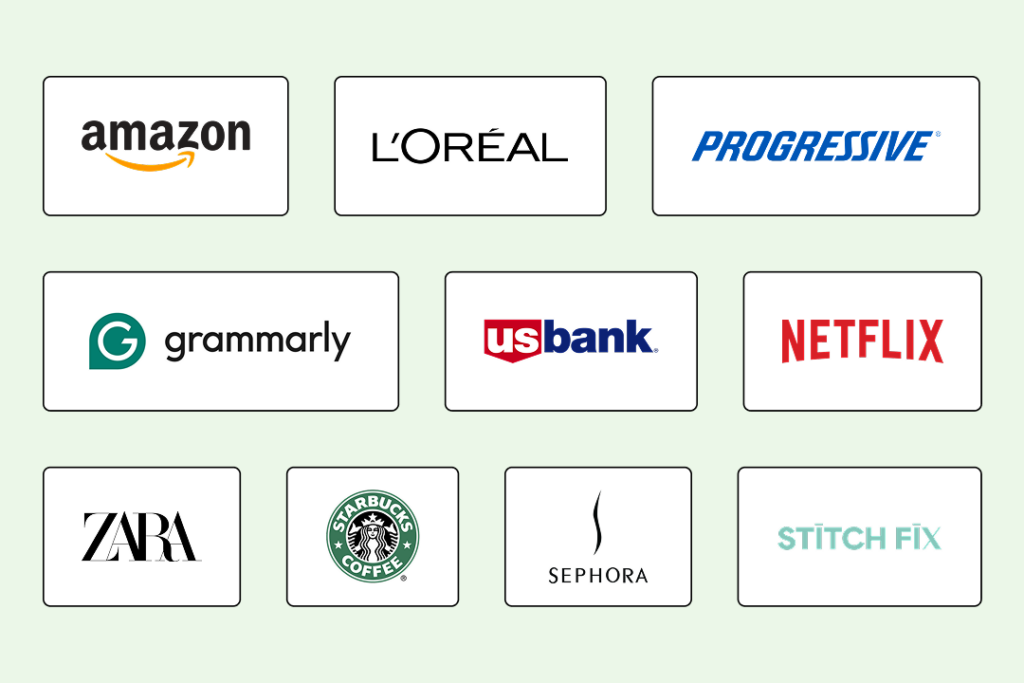
So we dug into the data. What follows are 10 companies that aren’t just dabbling with AI in marketing. They’re pulling measurable, significant ROI from it. And the patterns in how they do it? Those are worth paying attention to.
1. Starbucks: Personalized Offers + Demand Forecasting
Industry: Quick-service restaurant / B2C retail Primary AI use case: Predictive personalization and store-level demand forecasting Key ROI: 30% ROI uplift globally; 14% increase in average check size
Starbucks has been quietly building one of the most sophisticated predictive marketing engines in consumer retail through its “Deep Brew” AI platform. The system analyzes individual customer behavior, purchase history, location data, and contextual signals (weather, time of day, local events) to trigger hyper-personalized offers through the Starbucks app.
The results have been, frankly, staggering. Rewards members receiving AI-driven personalized offers spend roughly 3x more than those who don’t. App engagement in the U.S. climbed 23%, and loyalty program participation in China jumped 35%. On the operations side, their AI-powered supply chain optimization reportedly generates $125 million in annual financial benefits, including $50M in preserved revenue and $40M in cost savings.
What makes Starbucks especially interesting for marketing teams is how tightly their demand forecasting connects to their promotional strategy. They’re not just predicting what you’ll order. They’re forecasting demand at the store and product level so the right inventory is in place when personalized campaigns drive customers through the door.
| Metric | Result |
| Global ROI uplift from AI | 30% |
| Average check size increase | 14% |
| App engagement lift (US) | 23% |
| Loyalty participation lift (China) | 35% |
| Annual supply chain savings | $125M |
2. Sephora: Customer Lifetime Value Prediction + Virtual Try-On
Industry: Beauty retail / ecommerce (B2C) Primary AI use case: CLV prediction, personalized recommendations, AR virtual try-on Key ROI: 29% increase in customer lifetime value; 3x conversion on virtual try-on
Sephora’s “Beauty OS” platform represents one of the most complete AI marketing ecosystems in retail. The system integrates predictive customer lifetime value modeling, AI-driven product recommendations, ModiFace virtual try-on technology, and Skin IQ diagnostics into a unified experience across web, app, and in-store.
The numbers tell the story. Customers who use the virtual try-on feature convert at 3x the rate of those who don’t. Cross-category purchases increased 47% since the Beauty OS rollout. And the big one: customer lifetime value jumped 29% across their Beauty Insider loyalty program.
On the efficiency side, AI reduced their marketing content production costs by 38%. And shoppers who engage with personalized suggestions are 3.2x more likely to complete a purchase, which helps explain why AI-powered recommendations boosted average order value by 25%.
The takeaway for marketing ops teams? CLV prediction isn’t just a “nice to know” metric. When Sephora uses it to segment audiences, personalize offers, and allocate budget toward high-value customers, it compounds across every channel.
| Metric | Result |
| Customer lifetime value increase | 29% |
| Conversion rate (virtual try-on users) | 3x baseline |
| Cross-category purchase increase | 47% |
| AOV increase from AI recommendations | 25% |
| Content production cost reduction | 38% |
3. Netflix: Churn Prediction + Personalized Retention
Industry: Subscription streaming (B2C) Primary AI use case: Churn prediction, content recommendations, dynamic creative Key ROI: $1B+ saved annually through AI-driven retention
Netflix is probably the most cited example of AI in marketing, and for good reason. Their recommendation engine, which influences over 80% of the content people watch on the platform, saves the company an estimated $1 billion or more per year in reduced churn.
But the recommendation engine is only part of the story. Netflix runs a dedicated predictive churn modeling system that identifies at-risk subscribers and triggers targeted retention campaigns. A recent program focused on high-risk users produced a 6% drop in cancellations over three months. Their monthly churn rate hovers around 2.5%, significantly lower than most competitors in the streaming space.
And then there’s the creative optimization piece. Netflix uses AI to generate and test personalized thumbnails for every title, with variants tailored to individual viewing habits. This alone drives engagement lifts of up to 30%.
Perhaps most impressively, their AI-driven content commissioning process has pushed their original content success rate to roughly 93%, compared to an industry average around 35%. That’s predictive analytics applied not just to marketing, but to the product itself.
| Metric | Result |
| Annual savings from AI retention | $1B+ |
| Content influenced by recommendations | 80%+ |
| Cancellation reduction (high-risk cohort) | 6% |
| Engagement lift from personalized thumbnails | Up to 30% |
| Original content success rate | ~93% vs. ~35% industry |
4. Grammarly: Predictive Lead Scoring That Actually Works
Industry: SaaS / AI writing assistant Primary AI use case: AI-powered lead scoring to convert free users to paid plans Key ROI: 80% increase in account upgrades; sales cycle cut by 50%+
If you’ve ever been skeptical about whether predictive lead scoring really moves the needle, Grammarly’s story might change your mind.
With over 30 million daily active users on their free tier, Grammarly’s marketing ops team faced a classic problem: they were drowning in potential leads but couldn’t tell which free users were genuinely ready to upgrade. Their old process sent 400+ leads per month to sales, many of which turned out to be spam bots.
They deployed Salesforce Einstein to analyze engagement patterns, feature usage frequency, document types, and collaboration behaviors. The AI identifies the signals that actually predict an upgrade and scores each account accordingly.
The before-and-after is dramatic. Account upgrades jumped 80%. MQL conversions increased 30%. The sales cycle shrank from 60-90 days down to about 30. Marketing ops now sends roughly 200 high-quality leads per month instead of 400+ noisy ones. And their email unsubscribe rate? Just 0.04%, compared to the ~2% industry average.
As Grammarly’s Sr. Marketing Ops Manager Kelli Meador put it, the shift was from volume to precision. And precision, it turns out, is worth a lot more.
| Metric | Result |
| Account upgrades | +80% |
| MQL conversions | +30% |
| Sales cycle reduction | 50%+ (60-90 days to ~30) |
| Lead quality improvement | 200 targeted vs. 400+ noisy |
| Email unsubscribe rate | 0.04% vs. ~2% industry |
5. Progressive Insurance: $2 Billion From ML-Powered Propensity Modeling
Industry: Insurance / financial services Primary AI use case: ML lead scoring and propensity modeling using telematics data Key ROI: $2B in new premiums from AI-powered purchase triggers
Progressive trained machine learning models on more than 10 billion miles of Snapshot telematics data to build one of the most effective propensity scoring systems in financial services. The system identifies when a prospect or existing customer shows the highest purchase intent and triggers a “buy” button in the mobile app at precisely the right moment.
The result: $2 billion in new premiums generated from that single ML-powered feature in one year. Their models achieve roughly 90% accuracy in identifying high-intent leads.
On the marketing creative side, Progressive partnered with Claritas on a GenAI campaign optimization initiative that delivered a 197% lift in campaign performance when AI-driven creative was compared against a control group.
For marketing teams, Progressive illustrates something important: the most valuable thing predictive AI can do isn’t generate a report. It’s trigger an action at the right time, in the right channel, for the right person.
| Metric | Result |
| New premiums from ML feature | $2B in one year |
| Lead identification accuracy | ~90% |
| Campaign performance lift (AI vs. control) | 197% |
| Net premiums written (Q1 2025) | $22.21B (+17% YoY) |
6. U.S. Bank: AI Lead Conversion + Cross-Divisional Churn Prediction
Industry: Banking / financial services Primary AI use case: Predictive lead scoring, cross-divisional lead sharing, churn prediction Key ROI: 2.35x increase in lead-to-conversion rates
U.S. Bank rolled out Salesforce Einstein across its entire enterprise, covering wealth management, retail banking, and mortgage divisions. The AI scores and prioritizes leads in real time, sharing qualified prospects across divisions that previously operated in silos.
The headline number: lead-to-conversion rates increased by 2.35x (that’s a 235% improvement). Manual lead screening dropped by over 60%, freeing up significant time for relationship managers to focus on high-value conversations.
They also deployed Einstein Discovery for explainable churn prediction, giving retention teams clear visibility into which customers are at risk and, crucially, why. That “why” matters enormously. A churn score by itself is useful, but a churn score with actionable explanations? That’s what gets teams to actually change their behavior.
| Metric | Result |
| Lead-to-conversion rate increase | 2.35x (235%) |
| Manual lead screening reduction | 60%+ |
| Cross-divisional lead sharing | Real-time across all divisions |
7. Stitch Fix: AI-Driven Demand Forecasting + CLV Optimization
Industry: Online personal styling / ecommerce fashion (B2C) Primary AI use case: AI-powered styling, demand forecasting, CLV modeling Key ROI: 9% AOV increase (earnings-verified); 7 consecutive quarters of AOV growth
Stitch Fix is, at its core, a machine learning company that happens to sell clothes. Their algorithms analyze style preferences, purchase history, body measurements, seasonal trends, and return behavior to predict which specific items each customer will keep.
About 75% of box selections are now driven by AI. And the financial results, verified through public earnings reports, show 9% year-over-year AOV growth from AI merchandising in Q2 FY2025, with average order value increasing for seven consecutive quarters. Revenue per active client rose to $542, up 3.2% year-over-year.
What’s notable about Stitch Fix is how they’ve layered multiple predictive capabilities. They acquired Zodiac for CLV prediction and Celect for demand-sensing analytics, then integrated both into their proprietary styling engine. More recently, they launched Stitch Fix Vision, a generative AI virtual try-on tool, and an AI Style Assistant for conversational product discovery.
Their Q3 FY2025 earnings marked a return to revenue growth ($325M, +0.7% YoY), a turnaround largely attributed to their expanded AI capabilities.
| Metric | Result |
| AOV increase (AI merchandising) | 9% YoY |
| Consecutive quarters of AOV growth | 7 |
| Revenue per active client | $542 (+3.2% YoY) |
| Box selections driven by AI | 75% |
| Customer retention improvement | 15% |
8. L’Oréal: AR-Powered Conversion + Media Buying Optimization
Industry: Beauty / consumer packaged goods (B2C) Primary AI use case: AI/AR virtual try-on, trend prediction, automated media buying Key ROI: 3x conversion rates on virtual try-on; 22% media efficiency gain
L’Oréal isn’t just the world’s largest cosmetics company. It also employs over 2,000 IT and beauty tech experts alongside 800 data analysts, making it one of the most AI-invested consumer brands on the planet.
Their ModiFace AI virtual try-on technology crossed 100 million sessions in a single year (up 150% year-over-year), and users who engage with it convert at 3x the baseline rate. Campaigns featuring AR experiences deliver conversion lifts between 20% and 80%, according to L’Oréal’s Chief Digital Officer. Stores deploying ModiFace saw approximately 30% sales increases in featured categories.
On the media side, L’Oréal’s proprietary “Tidal” tool automates paid media buying and optimization. A Nordic pilot delivered 22% improvements in media efficiency and 14% better campaign effectiveness. Their “TrendSpotter” AI analyzes over 3,500 online sources to identify emerging beauty trends 6-18 months ahead, informing both product development and marketing strategy.
| Metric | Result |
| Virtual try-on conversion lift | 3x baseline |
| AR campaign conversion range | 20-80% above baseline |
| Annual virtual try-on sessions | 100M+ (150% YoY growth) |
| Media efficiency improvement (Tidal) | 22% |
| Campaign effectiveness improvement | 14% |
9. Zara: Predictive Demand Forecasting That Keeps 85% of Inventory at Full Price
Industry: Fast fashion retail / ecommerce (B2C) Primary AI use case: Real-time demand forecasting and inventory optimization Key ROI: 85% full-price sell-through vs. 60% industry average
Most fashion retailers sell about 60% of their inventory at full price. Zara sells 85%.
That gap is worth billions, and it’s powered almost entirely by predictive AI. Zara’s system ingests real-time sales data from RFID tracking across 6,000+ stores, customer behavior analytics, and social media trend signals to forecast demand at the product-SKU level. Their design-to-store turnaround is 10-15 days, compared to an industry average of 3-6 months.
MIT research confirmed that Zara’s forecasting system reduced forecast error from 21% to 17%, with the potential to reduce lost sales by 24%. Inventory management costs dropped roughly 20%. And customers visit Zara stores an average of 17 times per year, an unmatched frequency in fashion retail, driven in part by the fact that the right products are consistently in stock when customers show up.
For marketing teams, Zara’s story illustrates why demand forecasting isn’t just a supply chain concern. When you can predict what customers want before they ask, your promotions become smarter, your markdowns shrink, and your margins widen.
| Metric | Result |
| Full-price sell-through | 85% vs. 60% industry avg |
| Forecast error reduction | From 21% to 17% |
| Potential lost sales reduction | 24% |
| Inventory management cost reduction | ~20% |
| Design-to-store turnaround | 10-15 days vs. 3-6 months |
10. Amazon: 35% of Revenue From AI Recommendations
Industry: Ecommerce / retail (B2C) Primary AI use case: Deep learning recommendation engine for hyper-personalization Key ROI: 35% of total revenue (~$70B+) driven by AI recommendations
It would feel incomplete to leave Amazon off this list. Their recommendation engine, powered by deep learning models that process over 150 billion customer data points daily across 600+ million products, drives roughly 35% of total revenue. At Amazon’s scale, that’s more than $70 billion annually.
Beyond the headline number, the operational metrics tell a compelling story about what recommendation AI can do at scale. Shoppers who click personalized recommendations show 31% higher average order values. Amazon’s bounce rate sits at about 35%, compared to 50% for Walmart and 45% for Target. And checkout recommendations alone reduce cart abandonment by 4.35%.
Amazon’s approach to personalization is relentless. Every surface, from homepage to product pages to email to Alexa, serves a different personalized experience. It’s the kind of infrastructure most companies can’t replicate in-house. But the underlying lesson is transferable: when you make accurate predictions about what a customer wants next, everything else gets easier.
| Metric | Result |
| Revenue from AI recommendations | ~35% of total (~$70B+) |
| AOV lift from personalized recs | 31% |
| Bounce rate vs. competitors | 35% vs. 50% (Walmart) |
| Cart abandonment reduction (checkout recs) | 4.35% |
AI-Driven vs. Traditional Marketing: The Numbers
Across industries, the performance gap between AI-driven and traditional marketing approaches keeps widening. Here’s what the aggregated data shows:
| Metric | AI-Driven Marketing | Traditional Marketing | Improvement |
| Campaign ROI | Higher | Baseline | +20-30% |
| Click-through rates | Higher | Baseline | +47% |
| Conversion rates | Higher | Baseline | +14-32% |
| Customer acquisition cost | Lower | Baseline | 23-29% lower |
| Campaign launch speed | Faster | Baseline | 75% faster |
| Content engagement | Higher | Baseline | +30% |
| Forecasting accuracy | Higher | Baseline | +47% |
Sources: McKinsey, AllAboutAI, SAS, Averi.ai, SQ Magazine (2025)
It’s worth noting that these improvements aren’t evenly distributed. The companies seeing 20-30% ROI lifts tend to be the ones investing in predictive capabilities, not just generative AI for content. Generating blog posts faster is nice. Knowing which customers are about to churn and intercepting them before they leave? That’s where the real money is.
What Separates AI Marketing Leaders From Everyone Else
After studying these 10 companies and the broader market data, a few patterns jump out.
They focus on predictions, not just automation. Every company on this list uses AI to answer forward-looking questions. Not “what happened last quarter” but “what will happen next quarter.” That distinction is everything. Gartner reported in January 2026 that 60% of brands will use agentic AI for one-to-one customer interactions by 2028. The companies that get there first will have a significant head start.
They connect predictions to actions. A churn score sitting in a dashboard doesn’t reduce churn. Progressive’s system triggers a purchase button at the right moment. Netflix’s model fires a retention campaign automatically. Sephora’s CLV predictions reshape which customers get which offers. The prediction is only as good as the workflow it triggers.
They start with business questions, not technology. None of these companies began their AI journey by evaluating tools. They started with a question: “How do we retain more customers?” or “Which leads should sales focus on?” The technology came second. That’s a pattern Gartner’s 2025 CMO survey reinforced: the teams getting results from AI are the ones tying it to specific business outcomes, not experimenting with AI for its own sake.
They close the loop. AI high performers (McKinsey’s term for the top 6%) are 3x more likely to have redesigned their workflows around AI outputs. They don’t bolt AI onto existing processes. They rebuild processes around what AI makes possible.
Where This Is All Headed
The market stats paint a clear picture of where things are going. AI in marketing is projected to grow from about $21-27 billion in 2025 to $82 billion by 2030. Marketing and sales is already the #1 business function adopting generative AI, with 42% of businesses regularly using it.
But the real shift isn’t about adoption rates. It’s about the type of AI being adopted. Predictive analytics usage surged 57% year-over-year according to Twilio Segment’s 2025 CDP Report. Organizations are moving beyond content generation toward the harder, more valuable work of forecasting customer behavior, predicting revenue, and optimizing spend before campaigns go live.
And yet, McKinsey found that not a single one of roughly 50 senior marketing officers at Fortune 500 companies could quantify the ROI of their martech investments. The opportunity for teams that can draw a straight line from “predictive insight” to “business outcome” is enormous.
The companies in this list figured that out early. The question for everyone else is whether they’ll catch up before the gap gets any wider.
Making Predictions Accessible to Every Marketing Team
If there’s one theme that runs through all 10 of these examples, it’s this: the companies winning with AI for marketing aren’t necessarily the ones with the biggest data science teams. They’re the ones that made predictive capabilities accessible to the people actually making decisions.
That’s exactly what Pecan was built to do.
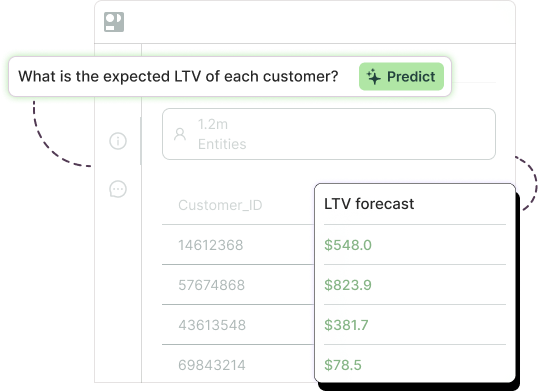
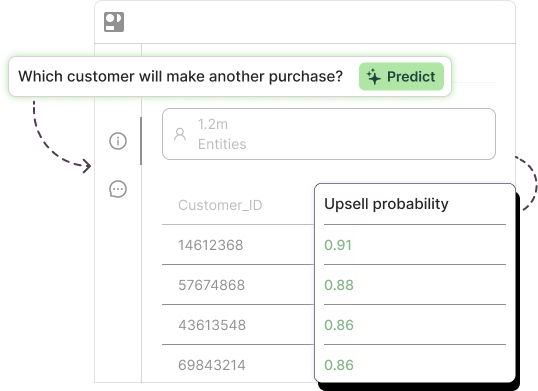
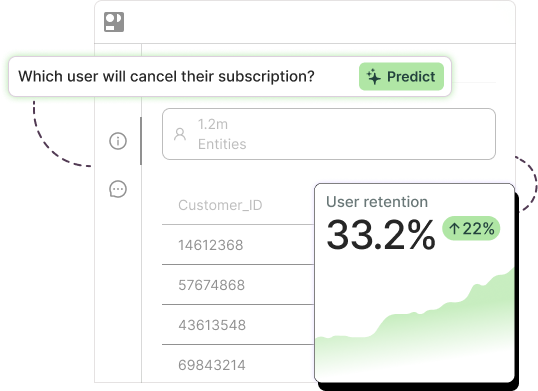
Pecan’s Predictive AI Agent lets marketing ops, RevOps, customer success, and growth teams ask business questions in plain English and get validated, production-ready predictions back. No coding. No waiting weeks for a data science team to build a model. No expensive consultants.
Whether you’re trying to predict which customers are about to churn, score leads by likelihood to convert, forecast next quarter’s demand, or maximize customer lifetime value, Pecan handles the data preparation, model building, and validation automatically. Predictions flow directly into Salesforce, HubSpot, your data warehouse, or wherever your team actually works.
Across existing deployments, Pecan customers see an average 12% churn reduction, 10% CLV increase, 15% ROAS improvement, and predictive models reaching production up to 32x faster than traditional approaches.
The companies in this article invested millions in custom AI infrastructure over many years. You don’t have to.
Get a demo and see how fast your team can go from business question to validated prediction.

Team Pecan is what happens when you put a bunch of data geeks in a room and tell them to make machine learning suck less. We’ve built models, broken models, fixed models, and occasionally questioned our life choices at 2am debugging feature pipelines. Now we write about it so you don’t have to learn the hard way. Think of us as your slightly unhinged data science friends who actually want you to succeed.