Retail runs on guesses. Educated ones, sometimes. But guesses.
A buyer guesses next quarter’s demand. A merchandiser guesses which products to feature. A marketing manager guesses which customers are about to disappear. Even the best teams I’ve worked with admit a chunk of their planning rests on intuition, gut feel, and “what we did last year.” That’s not a knock on retailers. It’s just the reality of running a business in 2026, when consumer behavior shifts faster than reports can refresh.
Predictive analytics in retail changes the math. Instead of looking back at what already happened, you get a credible read on what’s coming next: which customer is about to churn, which SKU is about to spike, which campaign is going to underperform. Retailers using AI predictive analytics for retail aren’t smarter than everyone else. They’re earlier.

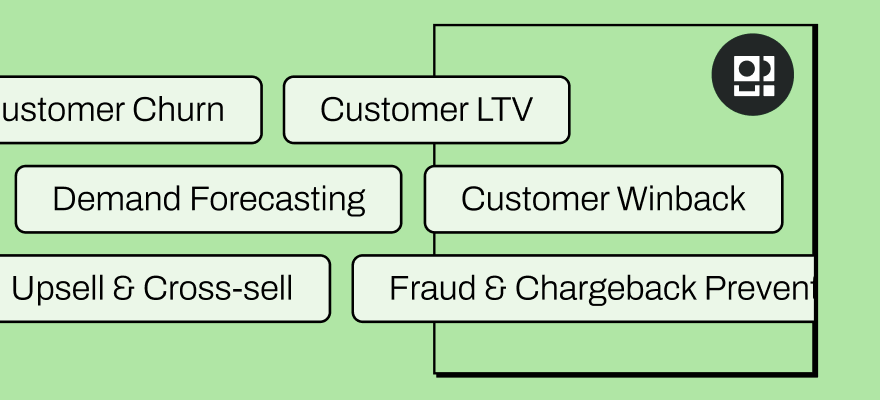
Here are the seven use cases of predictive analytics in retail I’d actually tell a team to start with, plus what each one looks like in the real world.
1. Demand forecasting
This is the one almost everyone needs and almost no one gets right. Traditional forecasting leans on rolling averages, seasonality charts, and a planner sanity-checking the output. It works until it doesn’t, which is usually right when something interesting happens (a heatwave, a TikTok moment, a competitor stocking out).
AI-powered demand forecasting pulls in dozens or hundreds of signals at once: weather, search trends, promotional history, day-of-week effects, regional patterns, even macroeconomic data. The output is a forecast that flexes with reality.
Real example: Little Spoon, a children’s nutrition brand, used predictive demand modeling to plan inventory across SKUs with much higher confidence than spreadsheets allowed. Their team got hours back every week and cut costly overstock.
Our demand forecasting solution walks through how this works in practice.
2. Customer churn prediction
Retail churn is sneaky. Subscription brands see it directly. Everyone else sees it as “someone who used to buy and just, stopped.” By the time most teams notice, the customer is long gone.

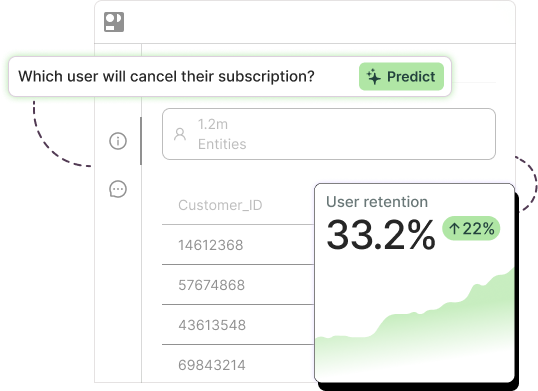
Churn prediction flips the timing. You identify the customers statistically likely to leave before they actually do, while there’s still time to intervene with a retention offer, a personalized email, or a service touchpoint.
The catch: most churn models are too generic to be useful. They tell you who’s at risk but not why or what to do. A good predictive model gives you the signal, the explanation, and the customer-level next action.
ALTHERR, a European retailer, used Pecan to identify high-risk customers and run targeted retention plays. Their team head Benedict Schweiger described the shift as moving from running post-mortems on lost customers to actually saving accounts in time.
If churn is your priority, our customer churn solution page goes deeper.
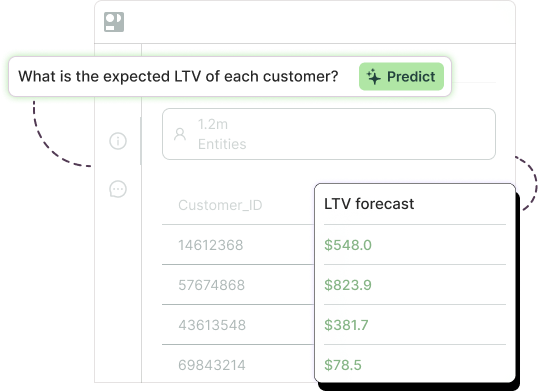
3. Customer lifetime value (CLV/LTV)
Most retailers measure CLV using historical averages. That’s fine for a board slide. It’s terrible for actually deciding which customer is worth a $40 acquisition cost and which is worth $400.
Predictive LTV uses each customer’s behavior, product mix, and engagement patterns to estimate their future spend with a real confidence interval. That changes how you think about acquisition (you can pay more for high-LTV lookalikes), retention (you protect the right accounts), and merchandising (you know which categories build long-term value).
Allivet, a pet pharmacy, used predictive LTV to redirect ad spend toward customer profiles that actually paid back over time. Mandy Herrmann on their team has been pretty vocal about how it changed the way they thought about every dollar of media.
4. Personalization and next-best-product
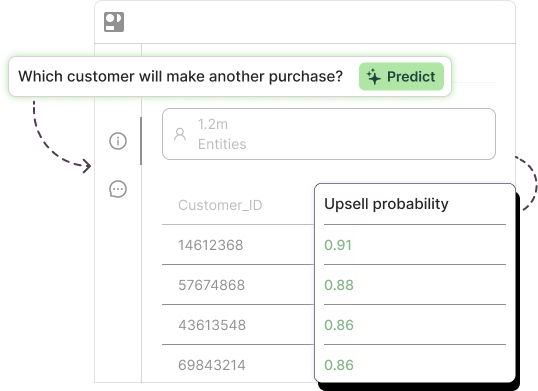
Generic recommendations are over. Customers expect that the products surfaced to them, the emails they get, and the offers they see actually relate to them. Predictive analytics for retail personalization works by ranking, for each customer, which item they’re most likely to buy next, which message will land, and which offer will move them.

This isn’t a recommendation widget bolted onto your homepage. It’s a layer running across email, paid media, on-site experience, and merchandising decisions. Done well, it lifts conversion measurably without spamming the customer into the unsubscribe button.
5. Pricing and promotion optimization
Retail pricing is one of the highest-impact decisions a team makes and one of the easiest to mess up. Discount too much and you train customers to wait. Discount too little and you sit on inventory.
Predictive models help by estimating elasticity at the SKU and customer-segment level: how does demand actually respond to a 10% off promotion, a free shipping threshold, a bundle? This is where retailers see fast wins, because the comparison case (last year’s same promotion, last quarter’s pricing experiment) is usually right there in the data.
A useful starting question: which of our promotions actually drove incremental revenue, and which just discounted demand we would have captured anyway? Predictive models can answer that directly.
6. Marketing ROAS and channel optimization
If you run paid media in retail, you’ve felt the pain of post-iOS attribution. The signal is messier, the windows are shorter, and the platforms each tell their own self-flattering story. Predictive ROAS modeling cuts through that by predicting which campaigns, audiences, and creative concepts are likely to perform before you commit budget.
This is one of the highest-ROI use cases of predictive analytics in retail because the cost of being wrong is so visible. A 15% lift in ROAS, which is roughly the average we see across customer deployments, compounds across every dollar spent.
Our ROAS solution gets specific about how this works for brands running on Meta, Google, and TikTok at the same time.
7. Loss prevention and fraud detection
Less glamorous, equally valuable. Retail fraud (returns abuse, account takeovers, payment fraud, employee theft) is a real margin killer. Predictive models flag suspicious transactions and behaviors close to real time, often catching patterns that rule-based systems miss entirely.
For omnichannel retailers, this also extends to operational anomalies: a sudden spike in returns from a single zip code, an inventory shrinkage pattern across stores, a price-glitch buying spree on the website. The predictive layer notices it before a human dashboard reviewer would.
How to actually start
The instinct, looking at a list like this, is to want all of it. Don’t.
Pick one use case where the cost of being wrong is high and the data exists. For most retailers I talk to, that’s either churn or demand forecasting. Run it for a quarter. Measure the lift against your baseline.
Once you’ve proven that one works, the rest gets easier. Internal trust grows. Other teams want in. The data infrastructure you built for one model serves the next.

A few practical pointers for how to use predictive analytics in retail without burning a year of effort:
- Start with a use case that ties to a specific decision someone is already making weekly or monthly.
- Don’t wait for perfect data. Modern predictive platforms can handle a lot of mess.
- Get the prediction into the tool the decision-maker already uses, not a dashboard nobody opens.
- Define ROI in business terms before you start, then measure against that.
If you want to see what a predictive model on your own data looks like before committing to anything, you can browse more retail predictive analytics examples in our resources library, or book a 15-minute demo and we’ll show you a tailored model on your data.

Ori is a Customer Engagement Manager at Pecan AI, where he’s helped customers adopt predictive analytics from first demo to real business impact. He’s grown through Pecan support and customer success, wearing hats across CSM, solutions engineering, and customer onboarding, and turning complex ML concepts into simple, actionable workflows.