See why teams choose Pecan.ai over Google Vertex AI and Snowflake
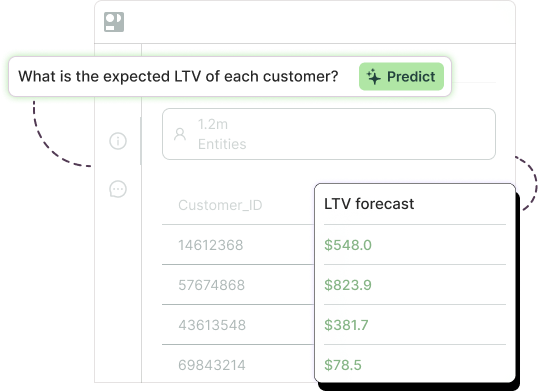
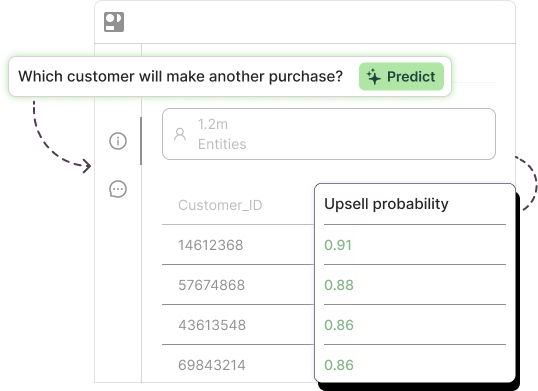
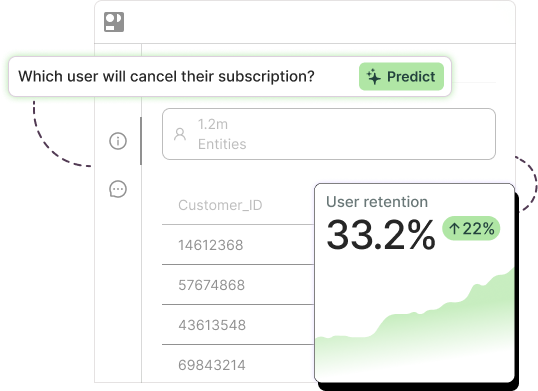
Google Vertex AI and Snowflake are powerful platforms for building and running data and machine learning workflows, but they’re designed for teams that already know how to structure data, define predictive problems, and get models into production. Pecan is built for data analysts and business teams. It turns business questions directly into predictions your team can act on, powered by the Pecan Agent, from raw data to production-ready outputs without relying on data science expertise.



Approach
How each solution is fundamentally designed to work.

Turns business questions into predictions and actions, powered by the Pecan Agent

Managed ML platform combining AutoML and custom training for building and deploying models - users are responsible for turning business questions into working predictions
Data platform for storage, transformation, and analytics - ML capabilities exist via Cortex and Snowpark, but building predictive workflows requires significant engineering effort
Who it’s for
Who can successfully use the product.
Data analysts and business teams
Data scientists and ML engineers
Data engineers, analysts, and data platform teams
Framing the Business Question
Predictive use cases aren’t as simple as they sound. Poorly defined use cases can lead to misleading predictions
Guided by the Pecan Agent to define the right predictive goals
Assumes the problem is already defined
No native support for defining predictive use cases
Picking the Right Data
Selecting the correct data is critical because your predictions rely on it.
Automatically identifies and prepares the right data from raw sources
Requires users to select, connect, and prepare datasets
Requires users to model, join, and prepare data manually
Creating the Training Set
A good training set isn’t just about combining tables, it’s where most ML work actually happens, and it’s easy to get wrong.
Start with raw data, no training dataset needed. The Pecan Agent builds a complete training set based on the predictive question, including all required aggregations and feature engineering
Requires prepared datasets - users must handle data preparation, feature engineering, enrichment, and structuring before modeling can begin
Requires users to build and structure datasets manually before applying ML, or rely on external tools
Enhancing the training set
Simply using raw data isn't enough. Additional insights significantly improve predictive accuracy.
Pecan automatically extracts behavioral patterns and key insights from the historical data, improving model's accuracy
Supports feature engineering and AutoML, but requires configuration and iteration
Feature engineering via SQL or Snowpark - requires manual setup and iteration
Protecting Against ML Pitfalls
Issues like data leakage and overfitting can make models look accurate but fail in production.
Built-in safeguards maintain reliable, production-ready predictions that stay that way over time, by proactively identifying data leakage, overfitting, and data drift
Provides post-deployment monitoring tools, but users are responsible for identifying and preventing issues like data leakage and overfitting during model creation
Monitoring available, but no built-in safeguards during model creation
Evaluating Your Model's Performance
Evaluating an ML model goes beyond statistical scores—you need to understand its real-world impact.
The Pecan Agent evaluates predictions and provides clear guidance with actionable insights
Provides metrics and explainability tools, but no guidance or recommendations - understanding performance and improving models is entirely up to the user
Limited native evaluation - understanding performance typically requires external tools or custom logic
From Prediction to Action (Operationalization)
Predictions only create value when used in workflows.
Predictions are deployed directly into business systems and workflows
Deployment supported, but requires engineering integration
Requires additional engineering to move predictions into business systems and workflows
Pricing
Multiple iterations may be required to reach production quality, making cost efficiency essential.
Built for cost-effective experimentation, allowing quicker iterations toward production
Pay-as-you-go across training, prediction, storage, and API calls - costs scale with usage and can become difficult to manage as workloads grow
Usage-based pricing across storage and compute - ML workloads add complexity and can significantly increase costs
Training and support
Predictive modeling isn’t just about the tech. There is know how on how to take predictive models and drive actual impact
Dedicated success teams, with vast experience and domain expertise
Documentation and Google Cloud support, but no guidance on building or improving predictive models
Documentation and data platform support, no predictive workflow guidance
Most platforms help you build models, Pecan helps you get answers. Instead of stitching together tools and workflows, Pecan delivers predictions your team can actually use, directly in the systems where decisions happen.