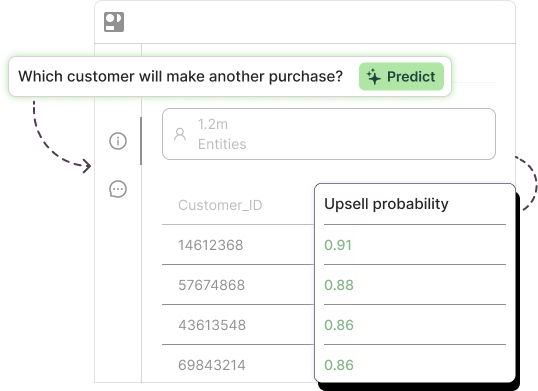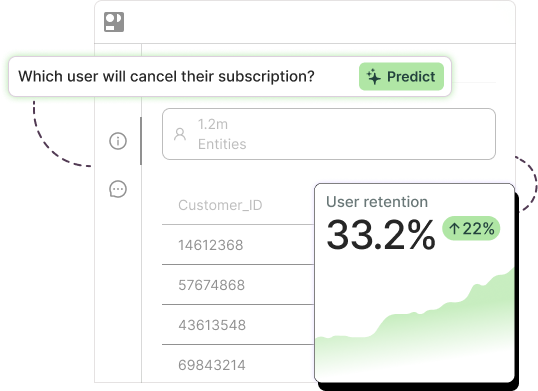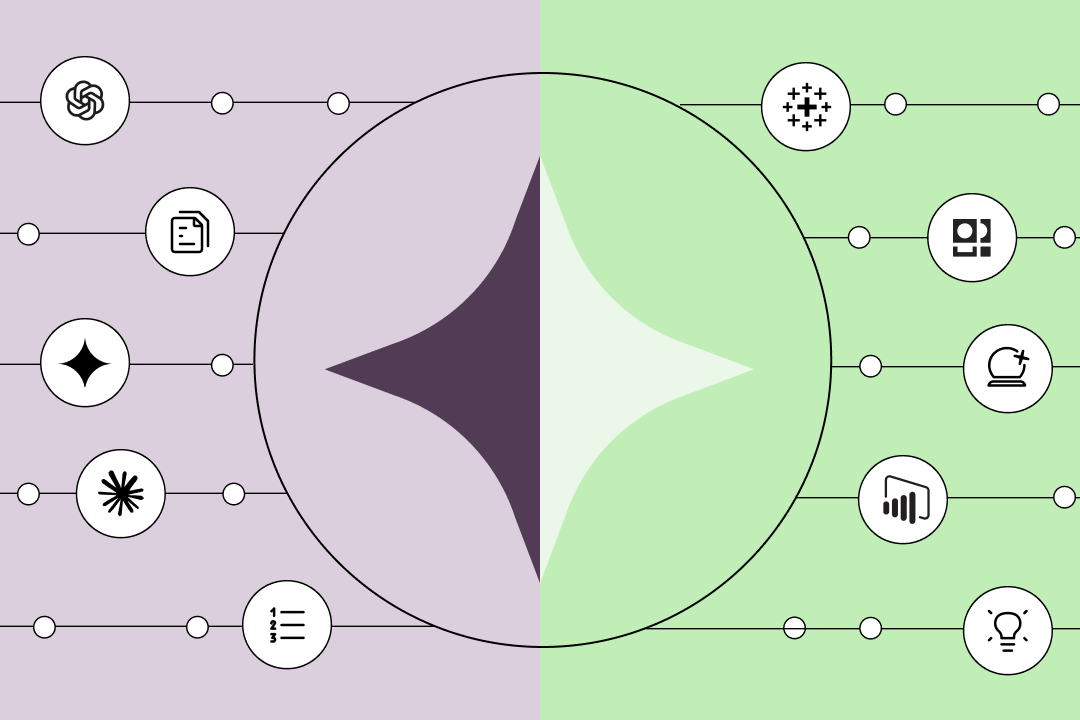
AI isn’t one thing. It’s at least two very different things, and understanding the difference will save your team time, money, and a lot of frustration. Generative AI (think ChatGPT, Claude, Gemini) creates new content from prompts. Predictive AI analyzes your data to forecast what’s likely to happen next. Generative AI excels at writing, brainstorming, and summarizing. Predictive AI excels at churn prediction, lead scoring, demand forecasting, and revenue planning. Most businesses need both, but for different jobs. And the companies pulling ahead in 2026? They’re the ones that figured out which type to use where.
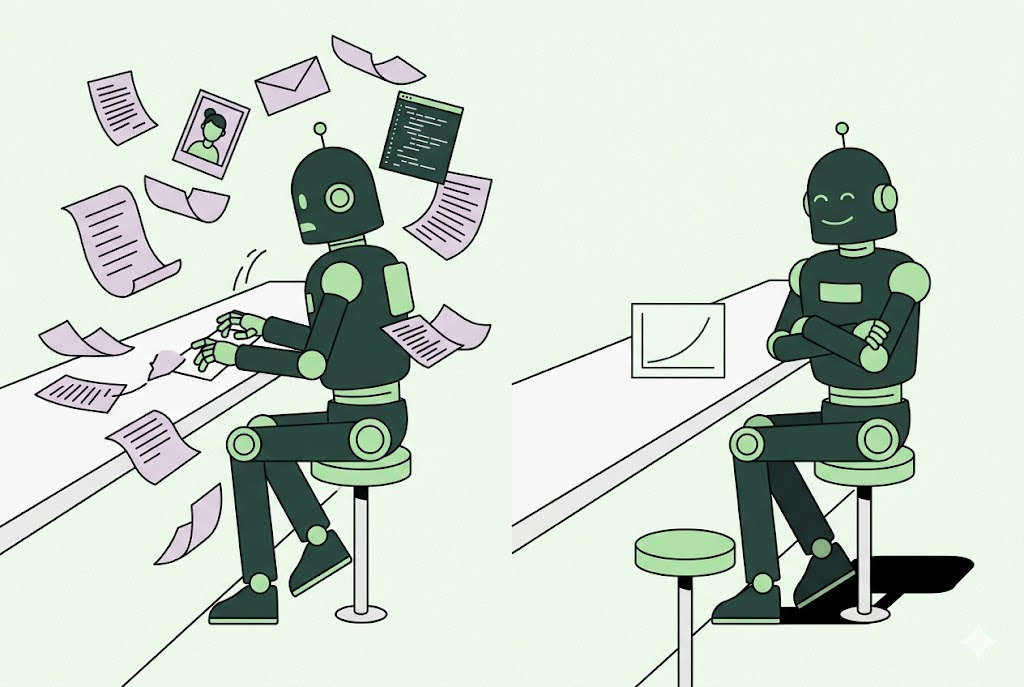
What is the difference between generative AI and predictive AI?
Generative AI produces new content (text, images, code, audio) based on patterns it learned during training. Predictive AI analyzes historical and real-time data to forecast future outcomes, like which customers will churn or what demand will look like next quarter. They solve fundamentally different problems: one creates, the other anticipates.
Here’s how they compare across the dimensions that matter most for business teams:
| Generative AI | Predictive AI | |
| Core function | Creates new content from prompts | Forecasts outcomes from data |
| Typical input | Text prompts, documents, images | Structured business data (CRM, ERP, transaction logs) |
| Typical output | Text, images, code, summaries | Scores, probabilities, forecasts, classifications |
| Learns from | Massive public datasets (internet-scale) | Your company’s proprietary data |
| Best business use cases | Content creation, customer support drafts, code assistance, document summarization | Churn prediction, lead scoring, demand forecasting, CLV modeling, revenue planning |
| Accuracy concern | Hallucinations (outputs can sound right but be factually wrong) | Model drift (predictions degrade if not retrained on fresh data) |
| ROI timeline | Quick wins in productivity | Measurable revenue and cost impact over weeks/months |
| 2026 maturity | Widespread adoption, but ROI still unclear for many use cases | Proven ROI in retention, sales, and planning, with growing accessibility |
That table gives you the quick version. The rest of this post is the honest, slightly longer version for people making real decisions.
The generative AI reality check: what 2025 taught us
Let’s rewind for a second. Two years ago, it felt like generative AI was going to change everything overnight. Boardrooms were buzzing. Every vendor slapped “AI-powered” onto their homepage. CMOs were told to “figure out AI” by Q3.
And then reality showed up.
By mid-2025, the data told a sobering story. An MIT study found that the vast majority of enterprise GenAI pilots delivered no measurable impact on the bottom line, even as companies spent tens of billions collectively. Gartner placed generative AI firmly in its “trough of disillusionment” and projected that at least 30% of GenAI projects would be abandoned after proof-of-concept. McKinsey’s 2025 State of AI report found that over 80% of organizations saw no meaningful impact on enterprise-wide earnings from their AI initiatives.
None of this means generative AI is useless. Far from it. The tools have gotten remarkably good at specific jobs: drafting marketing copy, summarizing long documents, generating code, building first drafts of almost anything. Coding assistance alone is a multi-billion dollar market. Enterprises that use vendor-built GenAI tools (rather than trying to build custom solutions internally) are seeing real productivity gains.
The problem was never the technology itself. It was the expectations. People expected ChatGPT to do everything, including things it was never designed to do, like accurately predict next quarter’s revenue or identify which customers are about to leave.
Which brings us to the other kind of AI.

Why predictive AI quietly delivers real business results
While generative AI grabbed the headlines, predictive AI has been doing something less flashy but arguably more valuable: producing measurable outcomes that show up in revenue, retention, and operational efficiency.
The predictive analytics market is expected to reach somewhere around $21 to $25 billion in 2026 and could grow to over $80 billion by the early 2030s, depending on which analyst you ask. The no-code AI platform market alone is projected to grow from about $6.5 billion in 2025 to over $75 billion by 2034. These aren’t hype numbers. They reflect real enterprise spending on tools that produce demonstrable ROI.
So what does predictive AI actually do for business teams? A few examples:
Churn prediction is probably the most straightforward win. Instead of finding out a customer left after they’ve already canceled, predictive models flag at-risk accounts weeks or months in advance, giving retention teams time to intervene. Companies using predictive churn modeling have seen average churn reductions of around 12% across use cases.
Lead scoring is another area where predictions outperform gut feel. When your sales team has hundreds (or thousands) of leads in the pipeline, predictive lead scoring ranks them by likelihood to convert, so reps spend their time on the deals most likely to close. Research suggests companies using AI for sales forecasting see significant improvements in accuracy compared to manual methods.
Demand forecasting helps planning teams stop guessing. Rather than building spreadsheets based on last year’s numbers plus a percentage bump, AI-driven demand forecasting considers hundreds of variables to predict what demand will actually look like. That means fewer stockouts, less overstock, and happier finance teams.
Customer lifetime value modeling helps marketing and CX teams figure out which customers are worth investing in over the long term. Knowing a customer’s predicted lifetime value changes how you allocate budget, design campaigns, and prioritize support.
The common thread? Predictive AI doesn’t just tell you what happened. It tells you what’s likely to happen next, with enough lead time to do something about it.

Can ChatGPT make accurate business predictions? (Not really.)
This is the question that comes up more than almost any other, so it’s worth addressing directly.
ChatGPT and similar large language models are brilliant at generating text. They’re designed to predict the next most likely word in a sequence. That’s a very different thing from predicting the next most likely business outcome based on your company’s proprietary data.
Here are the core reasons why generative AI falls short for business predictions:
It doesn’t know your data. ChatGPT has never seen your CRM, your transaction history, your churn patterns, or your customer segments. It can only work with what you paste into the chat window, and even then, it’s processing that information as text, not as structured data with statistical relationships. There’s simply no way for it to build a robust model of your business from a conversation.
It hallucinates. AI hallucinations (confidently stated outputs that are factually wrong) remain a real problem. Estimates vary, but hallucinations occur in a meaningful percentage of outputs, and generative AI presents wrong answers with the same confident tone as correct ones. For content drafts, that’s an inconvenience. For financial forecasts or customer predictions, it’s a liability.
Language models aren’t statistical models. Predicting the next word in a sentence and predicting next quarter’s churn rate are fundamentally different tasks. The first requires pattern matching over language. The second requires regression, classification, time-series analysis, and careful validation against structured tabular data. ChatGPT wasn’t built for the second job. (Pecan has a deeper dive on the risks of using ChatGPT for predictive modeling if you want the full picture.)
No validation or guardrails. When a data scientist builds a predictive model, there’s a whole process around training, validation, testing for overfitting, checking for data leakage, and monitoring performance over time. When you ask ChatGPT to “predict” something, none of that happens. The model might give you a number, but there’s no way to know if that number is remotely reliable.
This doesn’t mean you shouldn’t use ChatGPT. It’s incredible for a ton of tasks. Just not this particular one.
BI tools, AI chatbots, and predictive platforms: how to choose
If your team is trying to figure out where to invest, it helps to understand what each category of tool is actually good at. Because BI and predictive analytics are not the same thing, and AI chatbots are something else entirely.
Here’s a simple framework:
| What you need | Best tool | Why |
| Understand what already happened | BI tools (Tableau, Looker, Power BI) | Great at dashboards, reports, and historical analysis |
| Create content, summarize docs, brainstorm | Generative AI (ChatGPT, Claude, Gemini) | Excellent at language tasks and creative work |
| Predict what will happen next | Predictive AI platform (Pecan, or traditional AutoML) | Purpose-built for forecasting, scoring, and classification on your data |
| Automate complex multi-step workflows | AI agents | Combine reasoning with action, but still early-stage for most enterprises |
A lot of the frustration teams feel with AI comes from using the wrong tool for the job. Asking your BI dashboard to predict churn is like asking a rearview mirror to show you the road ahead. And asking ChatGPT to forecast demand from your ERP data is like asking a novelist to audit your books. Both are talented. Neither is suited for that particular task.
When should you invest in predictive AI specifically? If your team regularly asks questions like “which customers will churn next quarter?”, “which leads should we prioritize?”, “what will demand look like in 90 days?”, or “where should we allocate budget for the biggest return?”, those are all prediction problems. BI tools can’t answer them (they only look backward), and generative AI can’t answer them reliably (it doesn’t have access to your data or the right modeling architecture).

AI agents and the convergence of generative + predictive
One of the biggest shifts in enterprise AI right now is the rise of AI agents. Gartner predicts that around 40% of enterprise applications will embed some form of AI agent by the end of 2026, up from under 5% just a year earlier. Deloitte’s 2025 tech trends report highlighted agentic AI as a defining theme, and inquiries about multi-agent systems surged by over 1,400% between early 2024 and mid-2025.
So what does this have to do with the generative vs. predictive question?
Everything, actually.
The most useful AI agents aren’t purely generative or purely predictive. They combine both. A generative layer handles the communication: understanding your question in plain English, explaining results, guiding you through a workflow. A predictive layer handles the analysis: building models on your data, validating them, scoring customers, forecasting demand.
This convergence is where generative and predictive AI work best together. Generative AI makes the experience accessible. Predictive AI makes the output trustworthy.
Still, the agentic space is early. Deloitte’s 2025 survey found that only about 14% of organizations have deployment-ready agentic solutions, and just 11% are in active production. The potential is enormous, but most teams are still figuring out how to get started.
How Pecan AI brings both types together
This is where Pecan fits into the picture, and we’ll keep it honest about what we do.
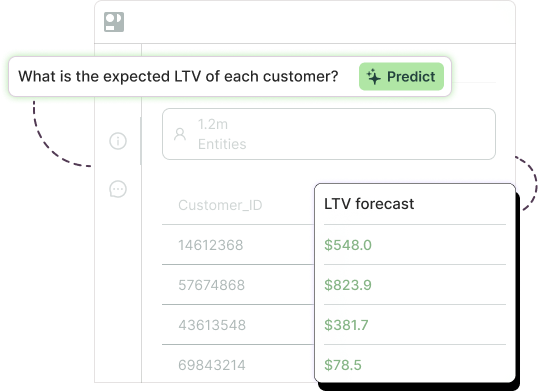
Pecan built a Predictive AI Agent that sits at the intersection of generative and predictive AI. You ask a business question in plain English (“Which customers are likely to churn next quarter?” or “What will demand look like for this product next month?”), and the agent handles everything from there: data preparation, feature engineering, model building, validation, and deployment.
No coding. No waiting weeks for a data science team. No black box.
Behind the scenes, Pecan’s predictive engine (refined through thousands of real-world deployments) does the heavy statistical lifting. The generative interface is what makes it usable for anyone who can type a question. Predictions flow directly into the tools your team already uses, whether that’s Salesforce, HubSpot, or your data warehouse.
Across existing customer deployments, Pecan has delivered results like ~12% average churn reduction in retention use cases, ~15% improvement in ROAS for marketing teams, and predictive models reaching production up to 32x faster than traditional data science approaches.
For teams in Marketing Ops, RevOps, Customer Success, Finance, and Planning who need forward-looking intelligence but don’t have a bench of ML engineers, that’s the whole point. You shouldn’t have to learn Python to know which customers are about to leave. You should be able to ask a question and get a trustworthy forecast, quickly and clearly.
Your next move
The generative vs. predictive question isn’t really about picking a side. It’s about matching the right type of AI to the right business problem. Use generative AI for the creative, language-heavy tasks it’s great at. Use predictive AI when you need reliable, data-driven answers about what’s coming next.
And if your team is spending more time reacting to problems than anticipating them, that’s probably a sign it’s time to explore what predictive AI can do.
Get a demo of Pecan’s Predictive AI Agent and see how quickly you can go from a business question to a validated prediction.

Team Pecan is what happens when you put a bunch of data geeks in a room and tell them to make machine learning suck less. We’ve built models, broken models, fixed models, and occasionally questioned our life choices at 2am debugging feature pipelines. Now we write about it so you don’t have to learn the hard way. Think of us as your slightly unhinged data science friends who actually want you to succeed.