Most rankings of AI platforms score capability. Model support, deployment targets, governance controls, integration counts. It’s all useful. None of it tells you whether the platform will still be producing value in month seven.
We’ve watched the same pattern play out for years. A company picks the tool with the deepest feature set, runs a promising pilot, and then the work stalls in a queue somewhere. The model was fine. The trouble is that the person who asked the original business question sits four hand-offs away from the person who can push an answer into production. Every hand-off is a backlog, a translation, and one more chance for the project to quietly stop mattering.
DataRobot’s own 2026 Unmet AI Needs survey puts numbers on the damage. Across 413 AI practitioners and leaders in regulated industries, 94% reported Day 2 operational problems after deploying agentic AI, and 71% said running the system costs more than building it. DataRobot pegs the average path from idea to production at 7.3 months.
So this ranking starts from a different first question. Who has to operate the platform, and how far does a business question have to travel before someone can act on the answer?
Ten platforms. We put ourselves at number one, and we’ll show our work.
The hand-off test
Take a real question. “Which customers are likely to churn next quarter?”
On a typical enterprise stack, that question passes through an analyst who scopes it, a data engineer who builds the feature pipeline, a data scientist who trains and validates the model, an ML engineer who deploys and monitors it, and a RevOps admin who wires the scores into Salesforce so someone can actually make a retention call. Five roles. Five calendars. Five backlogs, each with its own priorities that have nothing to do with your churn problem.
Count those roles and you have a hand-off number. It’s the most honest single predictor of whether a prediction project ships, because it measures organizational friction rather than technical ceiling.
The work itself doesn’t vanish on a shorter path. Joins still happen. Features still get engineered. Models still need validating against holdout data, and someone still has to check for leakage. The difference is whether a human has to schedule a meeting for each of those steps.
That’s the lens for everything below.
What an AI platform actually is in 2026
An AI platform is software that handles building, training, deploying, and monitoring AI models. The definition has stretched to the point of near-meaninglessness, because in 2026 the label covers three genuinely different products.
There’s cloud ML infrastructure, where you own the pipeline and the platform gives you managed compute and tooling. There’s the agent platform, which is what most of the big vendors spent 2026 rebuilding around: Google renamed Vertex AI to the Gemini Enterprise Agent Platform at Cloud Next, Snowflake renamed Snowflake Intelligence to CoWork and Cortex Code to CoCo at Summit, and Databricks pushed Agent Bricks from a quality-focused builder into a full developer agent platform. Then there’s applied prediction, where the platform owns the modeling workflow and hands you a validated answer.
Those three products get compared against each other constantly, which is roughly like comparing a lumber yard, a table saw, and a finished dining table. Worth reading first: what predictive analytics actually means, because the predictive layer is the one most often confused with the rest.
Who uses these things? Data scientists and ML engineers on the infrastructure end. Analytics engineers and developers in the middle. RevOps, marketing ops, customer success, finance, and demand planning at the applied end. Same category label. Very different jobs.
How we ranked the platforms
Six criteria: who the platform is built for, hand-off count from question to production, realistic time to a first working model, breadth of use cases, how well predictions land in the systems where decisions get made, and the shape of the cost. Where two platforms tied, we broke it on breadth and adoption.
We ranked ourselves first. That’s a claim, so here’s the reasoning. On hand-off count and time to production for business teams who need predictions, we win, and we win by a wide margin. On depth of custom ML infrastructure, generative AI tooling, or agent orchestration, we lose to almost everyone below us. Both statements are true at once. If you’re a platform engineering team building a multi-agent system on a lakehouse, keep reading past our entry.
Every description below is written to be accurate rather than flattering to us. Credibility is the only thing that makes a list like this worth reading.
The 10 best AI platforms in 2026
1. Pecan AI
We build predictive models for business teams who don’t have a data science team.
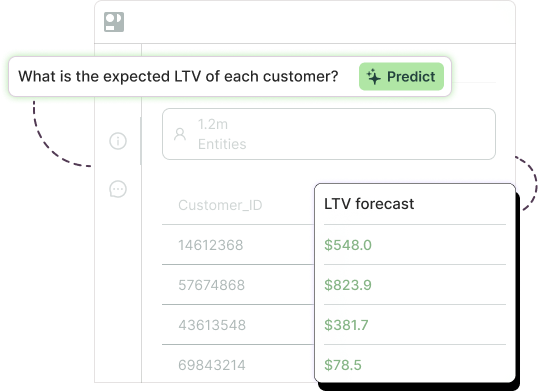
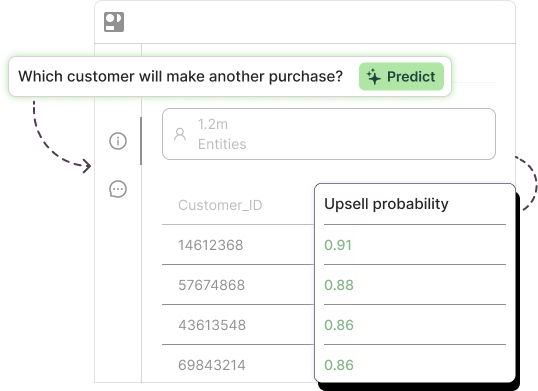
You connect your historical data, ask a business question in plain English, and our Predictive AI Agent takes it from there. It clarifies the objective, prepares the data, engineers features, selects and trains a model, validates it statistically, and pushes scored predictions into Salesforce, HubSpot, or your warehouse. Four stages: ask, automate, train and validate, deploy. Guardrails against data leakage, overfitting, and unbalanced labels run by default, because a prediction nobody can trust is worse than no prediction.
We work on your historical data as it exists. Real transaction tables, real CRM exports, real gaps and duplicates and inconsistent timestamps. That’s the input we were designed for.
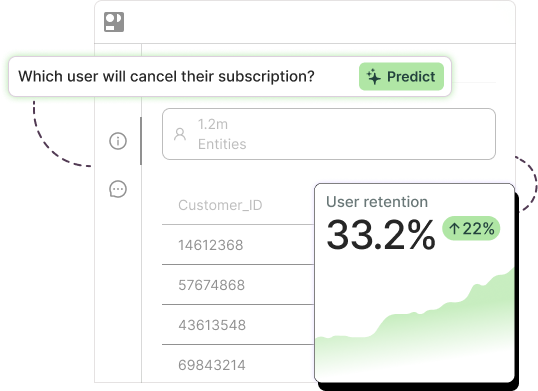
Results, with names attached. Whistle Express reduced churn 30% in competitive markets, going from first churn predictions at two weeks to a live production model inside two months. Across customer deployments, Pecan averages roughly 12% churn reduction for retention teams and 15% ROAS improvement for marketers, with predictive models reaching production in about a week.
Strengths: No data science team required. Most teams have a first model running the same day. Predictions land in the tools where work happens, with explanations and confidence scores attached. Starter and Team pricing is published on the site rather than negotiated behind a form.
Honest limitations: Our data layer is SQL-native. The agent auto-generates the SQL for your training sets, but someone on your team still needs warehouse access and a working knowledge of where your tables live. Highly custom modeling problems may need support from our team. We don’t build generative AI applications, parse documents, or orchestrate LLM agents, and we’re not trying to.
Best for: RevOps, marketing ops, customer success, finance, and demand planning teams at mid-market and enterprise companies. If you’d rather understand the full spectrum before committing, start with our guide to building your own AI model, which ranks the approaches from easiest to hardest.
Hand-offs: one.
2. Databricks
The lakehouse, plus Agent Bricks, which Databricks expanded at the 2026 Data + AI Summit into a full developer agent platform with model choice across providers, Unity Catalog governance, MCP-based tool access, and managed agent memory. More than 100,000 agents built on it, by the company’s count.
Strengths: Unmatched flexibility. Governance for data, models, and agents in one control plane. If your data engineering team is strong, there’s very little you can’t build here.
Limitations: It assumes that strong data engineering team. Compute costs scale with ambition. The gap between predictive modeling and agent tooling can confuse buyers, and it’s worth being clear on generative AI vs predictive AI before you scope a project.
Best for: Data engineering and ML teams building pipelines on a lakehouse.
Hand-offs: four to five.
3. Gemini Enterprise Agent Platform (formerly Google Vertex AI)
Google retired the Vertex AI name at Cloud Next 2026 and folded everything into the Gemini Enterprise Agent Platform. Same services underneath, bigger scope: Agent Studio for visual building, the Agent Development Kit for code-first work, Agent Runtime for deployment, and Model Garden with 200+ foundation models.
Strengths: Deep integration with BigQuery, IAM, and Workspace. Governance tooling matured considerably in 2026. Model choice is genuinely broad.
Limitations: Billing runs across several meters at once, which makes forecasting spend difficult. The learning curve is real. Outside Google Cloud, most of the value evaporates.
Best for: GCP-native organizations with AI engineers on staff.
Hand-offs: four.
4. AWS SageMaker
Now organized around SageMaker Unified Studio, which pulls Redshift, Athena, Glue, EMR, Bedrock, and SageMaker AI into one governed environment with a lakehouse underneath.
Strengths: Total control over the model lifecycle. Enormous scale. If you already run on AWS, everything connects.
Limitations: It’s many products wearing one name, and new team members spend real time working out which piece does what. IAM configuration is its own project.
Best for: AWS-stack companies with ML engineers who want to own the pipeline.
Hand-offs: four to five.
5. Microsoft Foundry (formerly Azure AI Foundry)
A unified workspace for building AI applications and agents, sitting on top of Azure OpenAI and a growing model catalog, with tight ties to Power BI, Dynamics, and the rest of the Microsoft stack.
Strengths: More approachable than SageMaker for mixed-skill teams. Templates and evaluation tooling shorten the first build. Enterprise rollout inside Microsoft shops is straightforward.
Limitations: The platform nudges you toward using a model rather than training one, which matters if your problem is tabular prediction. Model access is shaped by Microsoft’s partnerships.
Best for: Enterprise Microsoft organizations building AI applications and agents.
Hand-offs: three to four.
6. DataRobot
Rebuilt around the Agent Workforce Platform, co-engineered with NVIDIA. DataRobot reports being named a Leader in Gartner’s Magic Quadrant for Data Science and Machine Learning Platforms for the third year running. Predictive AutoML, generative tooling, and agent lifecycle management under one roof, deployable on-prem, hybrid, cross-cloud, or air-gapped.
Strengths: Governance and monitoring are excellent. Model management across a large portfolio is where it earns its price. Infrastructure flexibility beats the hyperscalers.
Limitations: Reviewers consistently note that using it well still requires foundational data science knowledge, despite the accessible framing. Contracts are enterprise-sized.
Best for: Analytics organizations managing many models with real compliance obligations.
Hand-offs: three.
7. H2O.ai
Open-source roots, Driverless AI for automated feature engineering and model building, and TabH2O, a foundation model for tabular data. H2O.ai says it was named a Visionary in Gartner’s 2026 Magic Quadrant for the category.
Strengths: Code-first AutoML with real flexibility. Strong interpretability tooling. Runs on private, protected data, which matters in finance and healthcare.
Limitations: Productionization is where users report the most friction. Deployment options and CI/CD integration lag the cloud platforms. It expects ML fluency.
Best for: ML teams that want automation without giving up control of the code.
Hand-offs: three to four.
8. Snowflake Cortex
AI that runs where your Snowflake data already sits. LLM calls as SQL functions, Cortex Analyst for natural-language-to-SQL, Cortex Search for retrieval, and Cortex ML functions covering time-series forecasting and anomaly detection. Snowflake Intelligence became CoWork and Cortex Code became CoCo in 2026.
Strengths: No data movement. Governance inherits from Snowflake. For an analytics team already fluent in SQL, the on-ramp is short.
Limitations: You have to be a Snowflake shop. Consumption billing rewards discipline. Classical predictive modeling is thinner here than on a platform built for it.
Best for: Snowflake-native teams who want AI functions inside the warehouse.
Hand-offs: two to three.
9. IBM watsonx
Three components that work together: watsonx.ai for model development, watsonx.data for the data layer, and watsonx.governance for risk and compliance, which IBM positions as the anchor. The 2026 releases added multi-tenancy, a model gateway for consistent access across providers, and deployment on IBM Z.
Strengths: Governance and auditability are the reason to buy it, and IBM points to a Leader placement in Gartner’s 2026 Magic Quadrant for AI Governance Platforms. Hybrid deployment is genuinely hybrid. AutoAI handles the modeling for teams that want it handled.
Limitations: A learning curve that reviewers describe frankly. The commercial structure rewards committing to the whole platform rather than one piece of it.
Best for: Regulated industries where the audit trail is part of the deliverable.
Hand-offs: three to four.
10. Alteryx One
Alteryx consolidated its desktop and cloud products into a single platform, keeping the drag-and-drop workflow builder that analysts have used for years, and adding AutoML, generative assistance, and pushdown connections to Snowflake, Databricks, and BigQuery.
Strengths: Analysts who don’t code get real work done, fast. Data prep and blending remain best in class. Workflow lineage and governance are built in.
Limitations: Licensing costs draw consistent complaints. Very large workflows become hard for anyone but their author to read. Machine learning is a feature of an analytics platform here, not the center of gravity.
Best for: Prep-heavy analytics workflows in organizations with a strong analyst bench.
Hand-offs: two to three.
Comparison table
| Platform | Built for | Coding required | Time to first production model | Hand-offs | Cost shape |
| Pecan AI | Business teams needing predictions | No (warehouse access needed) | ~1 week (hours to first model) | 1 | Published tiers, custom at Business |
| Databricks | Data engineering teams | Yes | 2-6 months | 4-5 | Consumption |
| Gemini Enterprise Agent Platform | GCP-native AI engineers | Yes | 2-6 months | 4 | Multi-meter consumption |
| AWS SageMaker | AWS ML engineers | Yes | 2-6 months | 4-5 | Consumption |
| Microsoft Foundry | Microsoft enterprise devs | Some | 1-3 months | 3-4 | Consumption |
| DataRobot | Analytics orgs at scale | Some | 3-8 weeks | 3 | Enterprise contract |
| H2O.ai | ML practitioners | Yes | 3-8 weeks | 3-4 | Open source + enterprise |
| Snowflake Cortex | Snowflake analytics teams | SQL | 2-6 weeks | 2-3 | Consumption credits |
| IBM watsonx | Regulated enterprises | Some | 2-4 months | 3-4 | Subscription + bundles |
| Alteryx One | Analysts and ops teams | No | 2-6 weeks | 2-3 | Per-user subscription |
Time to first production model reflects typical experience for a team of average maturity on a standard use case, not a best case demo. Hand-off counts assume a business question originating outside the data team.
How to choose
Skip the feature matrix for a moment and answer one question: after the pilot succeeds, who owns this?
If the answer is a business team and the use case is predictive (churn, LTV, lead scoring, demand, propensity), you want the shortest path. That’s us. It’s also, in a narrower band, Alteryx One if your team already lives in Designer workflows, or Snowflake Cortex if your analysts write SQL all day and your forecasting needs are straightforward.
If the answer is a platform engineering team building custom infrastructure, go to Databricks, SageMaker, or the Gemini Enterprise Agent Platform, and let your existing cloud commitment decide which. The differences between them matter less than the differences between them and your current stack.
If the answer is a central AI organization managing dozens of models under regulatory scrutiny, DataRobot and IBM watsonx are built for exactly that job, and the governance tooling justifies the contract.
If the answer is an ML team that wants automation without a black box, H2O.ai gives you AutoML you can read.
If the answer is nobody, don’t buy anything yet. That’s not a platform problem.
For a closer look at the predictive end of the market specifically, see our breakdown of the best predictive analytics tools.
Before you sign anything
Take one question your business needs answered this quarter. A real one, with money attached. Write down every person who would have to touch it before the answer changes a decision somewhere. Then ask each vendor on your shortlist to remove names from that list, specifically, by name and role.
The vendors who can’t do it will talk about capability instead. That answer is data too.
Prediction has stopped being the hard part. Nine of the ten platforms above can build you a model that works. The scarce thing in 2026 is a path from question to action that doesn’t run through six calendars, and we built Pecan because that path was missing.
Book a demo and see what we can predict from your data.

Dror is the VP of Data and Analytics at Pecan AI, where he leads the analytics strategy that powers both customer success and Pecan’s own growth. He joined Pecan as Director of Analytics after years of data leadership roles across tech and fintech, bringing a firsthand understanding of what it takes to make data actually useful for business teams.